
300 A Day Is How Much An Hour
Ever found yourself daydreaming, maybe stirring your morning coffee, and a random number pops into your head? Like, "What if I made $300 a day?" Sounds pretty good, right? A nice round number that feels substantial. But then your brain kicks in with the follow-up question: "Okay, but what does that actually mean for my everyday life? How much is that an hour?"
Good news! We're about to do some super easy math that answers that question and opens up a new way to think about your time and money.
The Big Reveal: $300 a Day
Alright, let’s get straight to it. Most people think of a "work day" as roughly eight hours. It’s the classic 9-to-5, give or take. So, if you’re pulling in $300 for a standard eight-hour shift, here’s the magic number:
Must Read
$300 / 8 hours = $37.50 per hour.
Bam! There it is. Thirty-seven dollars and fifty cents an hour. Suddenly, that $300 a day feels a lot more tangible, doesn’t it? It’s not just a big number; it’s a specific amount for every single hour you’re putting in.
But Wait, Why Should I Even Care?
You might be thinking, "Cool math trick. But why is this useful?" Well, my friend, that’s precisely why you should care! Knowing your hourly rate (or a target) is like having a secret superpower for your finances, helping you see money through a super clear lens.
1. The Coffee Test & Everyday Budgeting
Let's talk about that fancy coffee. The one with the extra shot, the special syrup, and the price tag that makes your wallet wince a little. If that coffee costs, say, $5, and your hourly rate is $37.50, then that coffee is costing you roughly 8 minutes of your time ($5 / $37.50 per hour = ~0.133 hours, or about 8 minutes). Is that artisanal oat milk latte worth 8 minutes of your hard-earned time?
Suddenly, every purchase becomes a negotiation with your time. That new shirt? That take-out dinner? It’s not just dollars and cents; it’s minutes and hours of your life. This isn’t about being stingy; it’s about being mindful, making you pause and ask, "Is this truly worth my time?"
2. Valuing Your Time: Beyond Just Work
This hourly mindset isn't just for your job. Think about chores. Your washing machine breaks down, and you’re faced with a choice: spend two hours trying to fix it yourself (and probably making it worse, if you’re like me!), or call a professional who charges $100 for a service call. If your time is "worth" $37.50 an hour, two hours of frustrated DIY are costing you $75 in lost earnings or relaxation. Sometimes, paying someone else is the financially smarter (and sanity-preserving!) choice.

It also applies to your commute. An hour each way means two "unpaid" hours daily, 10 hours a week! This helps you understand the true cost of your job beyond just salary.
3. Unleashing Your Negotiation Power & Goal Setting
Let’s say you’re thinking about a side hustle or negotiating a new project. Knowing $300 a day is $37.50 an hour gives you a powerful baseline. If a gig offers $20 an hour, you know it’s less than your "ideal" rate. This empowers you to negotiate up or politely decline, knowing your time is worth more.
And for savings goals? Want to save $1000 for that dream weekend getaway? At $37.50 an hour, that's roughly 26.6 hours of work ($1000 / $37.50). You can now visualize exactly how many hours of your life you need to dedicate to reach that goal. It makes saving less abstract and more like a fun challenge!
What About Different Hours?
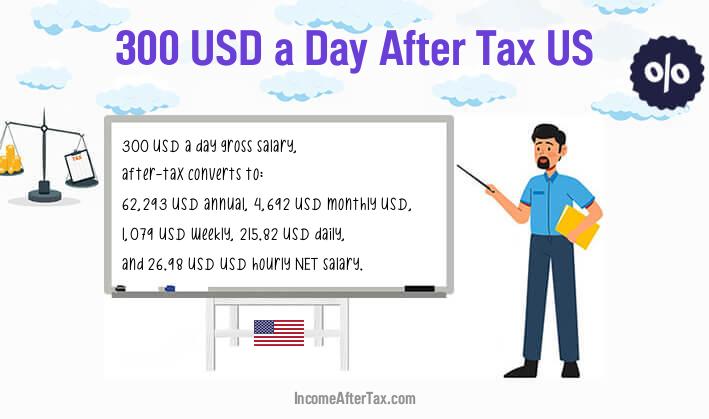
Of course, not everyone works a perfect 8-hour day. What if your hustle means you only work 6 hours? Then $300 / 6 hours = $50 an hour! Or maybe you're really grinding and putting in 10 hours? Then $300 / 10 hours = $30 an hour.
See how quickly that hourly rate changes? It highlights efficient time management. Working smarter, not just longer, becomes clear when you break down daily earnings. The less time you spend to make $300, the more valuable each hour becomes!
A Little Story: The Garage Sale Find
My neighbor, Brenda, once found an old, dusty antique lamp at a garage sale for $20. She spent about 4 hours cleaning it up, doing a little research, and then listing it online. She sold it for $200! She made $180 profit in 4 hours. That's $45 an hour! She was thrilled. She understood, in real-time, the value of her focused effort and time.
That feeling of understanding your hourly worth is incredibly empowering. It helps you evaluate opportunities, say "no" to time-wasting activities, and appreciate the true value of your efforts.
Your Financial GPS
So, there you have it! The simple question, "300 a day is how much an hour?" unpacks a world of financial wisdom. It’s not just a number; it’s a tool – your personal financial GPS, helping you navigate decisions about spending, saving, and valuing your most precious resource: your time.
Go forth, embrace your hourly worth, and maybe treat yourself to that fancy coffee – if it’s truly worth those 8 minutes of your valuable time!