
Which Way Is My Ceiling Fan Supposed To Spin

Have you ever stopped to watch your ceiling fan go round and round? It's mesmerizing, isn't it? Like a hypnotic dance happening right above your head.
But have you ever thought about which way it's supposed to be spinning? It's more than just a random whirlygig. Believe it or not, there's a method to the madness!
The Great Fan Debate: Upward or Downward?
This isn't just a simple question. This is a question that can spark fiery debates. This is a question that can divide families (okay, maybe not, but it could!).
Must Read
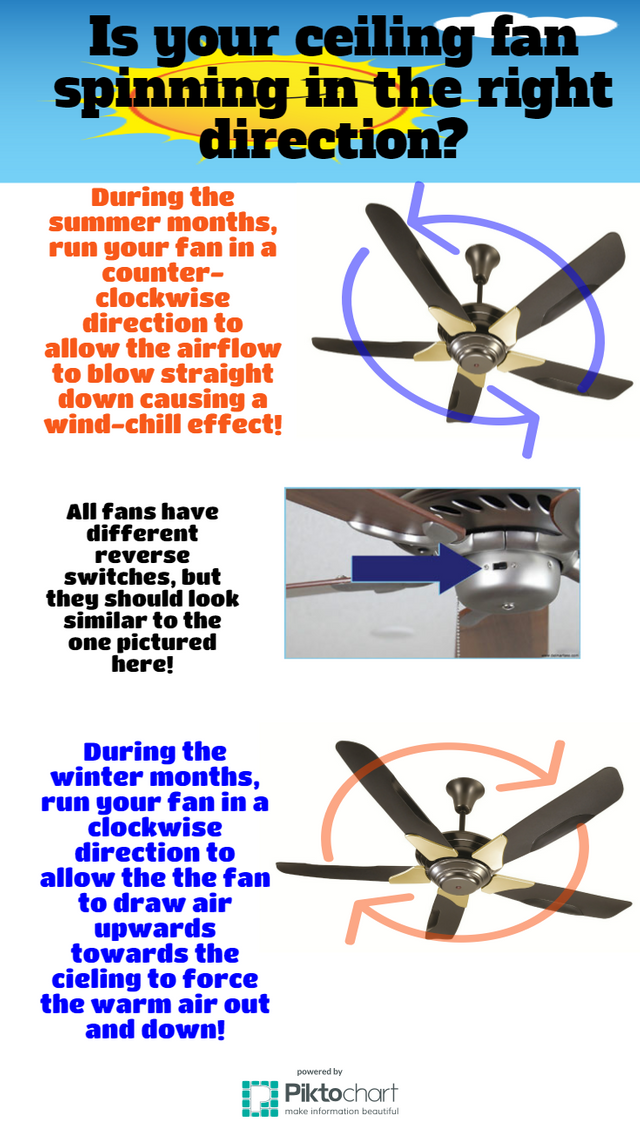
Most ceiling fans have a tiny little switch on the motor housing. It's often overlooked, almost hiding. That switch controls the direction of the blades.
But what direction should it be? That’s where the fun begins!
Summer Mode: The Downward Draft
Think of a hot summer day. You're sweating, wishing for a cool breeze. That's when you want your fan to be in "Summer Mode."
Summer Mode is when the fan spins counter-clockwise (as you look up at it). This pushes air downwards, creating a nice, cooling breeze.
Imagine a gentle waterfall of coolness washing over you. Ahhh, instant relief!
Winter Mode: The Gentle Uplift
Now picture a chilly winter evening. The heating is on, but the warm air is all stuck up near the ceiling. Enter: Winter Mode.
Winter Mode is when the fan spins clockwise. It gently pulls the warm air downwards.
Think of it as a subtle redistribution of heat, making your room feel cozy and balanced.

Why Does it Matter?
You might be thinking, "Does the direction really make that much of a difference?" The answer? Absolutely!
In the summer, the downward breeze helps evaporate sweat and cools your skin. You might even be able to turn down the air conditioning a degree or two, saving energy and money.
During the winter, circulating the warm air from the ceiling can also save on heating costs. It's a win-win!
How to Test Your Fan's Spin
Not sure which way your fan is spinning? Here's a quick and easy test. Stand directly under the fan and look up.
If you feel a breeze pushing down on you, it's in Summer Mode (counter-clockwise). If you don't feel a breeze or feel a gentle uplift, it's probably in Winter Mode (clockwise).
If you're still unsure, turn the fan off and wait for it to stop completely. Then, watch which way it starts spinning when you turn it back on.
The Mystery Switch
Ah, the infamous switch. It's usually located on the motor housing of the fan. It's often a small slider switch.
Sometimes, it can be a little stiff. Don't be afraid to give it a gentle nudge. You might need a stepladder to reach it safely.
Important safety tip: Always turn the fan off before flipping the switch!
Beyond the Basics: Fan Blade Angles
Did you know that the angle of the fan blades also plays a role in how well your fan circulates air? It's true!
Most ceiling fans have blades that are angled slightly. This angle helps to push the air downwards or upwards more effectively.
If your fan blades are flat or damaged, it might not be circulating air as efficiently as it should.
The Fan-tastic Conclusion
So, there you have it! The secret to ceiling fan direction is revealed. It's not just about aesthetics. It's about comfort and energy efficiency!
Next time you're relaxing under your ceiling fan, take a moment to appreciate its subtle power. And maybe, just maybe, flip that switch to optimize your comfort.
It's a small change that can make a big difference. Now, go forth and conquer the mysteries of your ceiling fan!
More Than Just a Fan
Think of your ceiling fan as more than just an appliance. Think of it as a silent, hardworking member of your household.
It's there to keep you cool in the summer and warm in the winter. It's a constant source of comfort and air circulation.
Give it a little love and attention. Make sure it's clean, the blades are in good condition, and the direction is set correctly.
Fan Troubleshooting Tips
Is your fan wobbly? Tighten the screws that hold the blades in place. Sometimes, they can loosen over time.
Is your fan making a strange noise? Check to see if anything is rubbing against the blades. A small adjustment might be all it takes.
If your fan is still having problems, consult a qualified electrician.
The History of Ceiling Fans
Believe it or not, ceiling fans have been around for centuries! Early versions were powered by hand or water.
The electric ceiling fan was invented in the late 19th century. It quickly became a popular way to cool homes and businesses.
Today, ceiling fans are more stylish and efficient than ever before.
Ceiling Fan Styles and Designs
There's a ceiling fan to suit every taste and décor. From traditional to modern, there's a style for everyone.
Some fans have built-in lights. Others have remote controls. Some are even smart and can be controlled with your phone!
Choose a fan that complements your home's style and meets your needs.

The Environmental Benefits
Using a ceiling fan can help reduce your carbon footprint. By circulating air, you can reduce your reliance on air conditioning and heating.
This can save energy and money. It's a win for you and the environment.
Consider using a ceiling fan in conjunction with your air conditioning and heating systems for optimal efficiency.
Embrace the Fan-tastic World of Ceiling Fans
So, next time you look up at your ceiling fan, remember that it's more than just a spinning object. It's a marvel of engineering and a source of comfort.
Take a moment to appreciate its subtle power and the role it plays in your home. And don't forget to check that switch!
Happy spinning!
One Last Thought
Choosing the right ceiling fan and using it effectively is a small way to make a big difference in your comfort and energy consumption.
So, get to know your fan. Experiment with the direction. Find what works best for you.
And enjoy the gentle breeze!