
Which Series Contains Elements 58 Through 71

Okay, buckle up buttercups! We're about to dive headfirst into the wacky world of the periodic table – that chart of elements that might seem a bit daunting, but trust me, it's got its own kind of awesome. Today, we're hunting for a specific group of elements, the cool kids hanging out between numbers 58 and 71.
The Big Question: Where Do We Find These Elusive Elements?
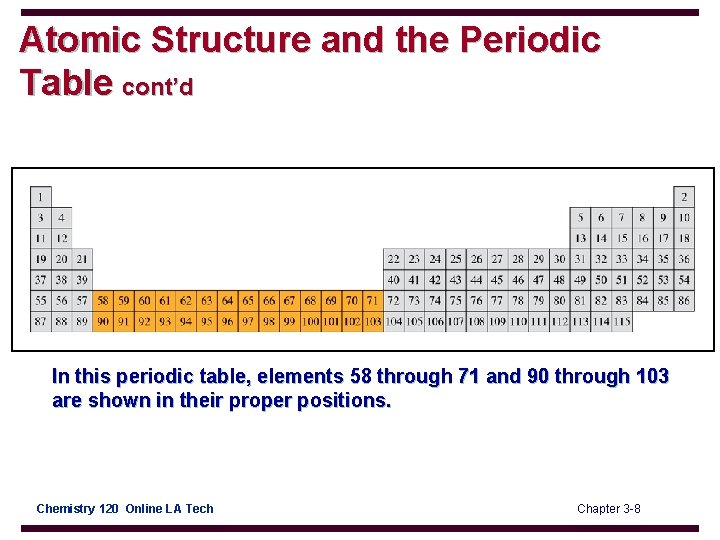
So, where do we find elements 58 through 71? Drumroll, please… They belong to the magnificent, the slightly mysterious, the utterly fascinating Lanthanide Series! Yeah, that's a mouthful, I know. But stick with me; it's easier than pronouncing "Worcestershire sauce" on your first try.
Why are They Special?
Think of the Lanthanides as the rock stars of the periodic table. They're all shiny, silvery-white metals, and they're often found chilling together in the Earth's crust. They're like that group of friends who are always seen together, never venturing too far from one another. "Hey Cerium! Where's Neodymium?" "Oh, he's right over there with Praseodymium, as usual!"
Must Read
But what really makes them unique is their electron configuration. Don't worry, I'm not going to bore you with quantum mechanics (unless you really want me to, in which case… maybe not!). Just know that their electrons are doing some fancy footwork, which gives them similar chemical properties. This is why they often hang out together and why separating them can be a real pain in the atomic butt. Seriously, imagine trying to separate identical twins who are also best friends and love doing the exact same things. Good luck with that!
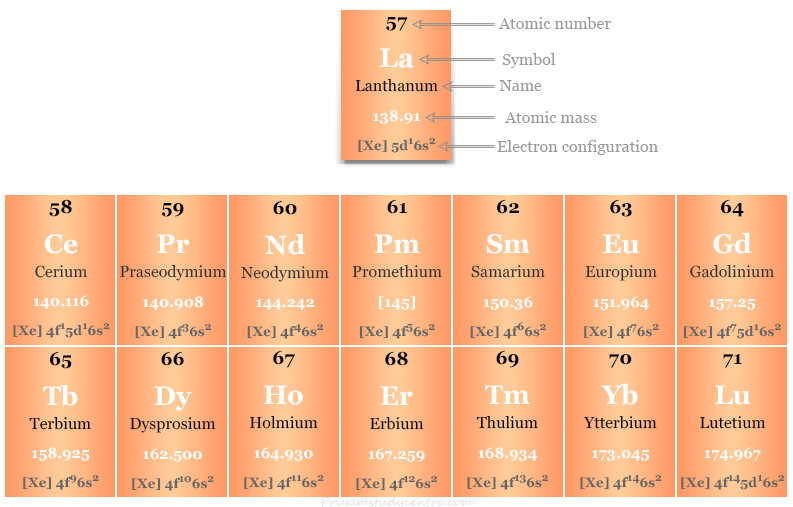
A Lanthanide Lineup: Meet the Stars
Let's give a shout-out to some of the members of the Lanthanide band:
- Cerium (Ce): Number 58. This one's a showoff! It's used in polishing compounds and lighter flints. It's basically the element that sparks joy... literally!
- Praseodymium (Pr): Number 59. Try saying that five times fast! Praseodymium helps give glass a lovely green hue. Think fancy emerald-colored vases and the like.
- Neodymium (Nd): Number 60. Neodymium is a key player in making super-strong magnets. These are the magnets that can hold up your entire whiteboard’s worth of doodles and important grocery lists.
- Samarium (Sm): Number 62. Another magnet maestro! Samarium is also used in some types of cancer treatment. So, it’s basically a magnetic superhero.
- Europium (Eu): Number 63. Europium helps make your TV screen glow with vibrant reds. So next time you're binge-watching your favorite show, give a little thanks to Europium!
- Gadolinium (Gd): Number 64. Gadolinium is used in MRI contrast agents, helping doctors get a clearer picture inside your body. It's like the internal photographer of the element world!
- Lutetium (Lu): Number 71. Bringing up the rear! Lutetium is used as a catalyst in petroleum cracking. Okay, maybe not the most glamorous job, but hey, someone’s gotta do it!
And there you have it! A whirlwind tour of some of the lanthanide legends. Of course, there are others, too, but we wanted to give you a taste of what makes this series so interesting.
Where Do We Find Them in Real Life?
Okay, so these elements might sound a bit exotic, but they're actually all around us! They’re in your smartphones, your computers, your TVs, even your car! They're the unsung heroes of modern technology, quietly working behind the scenes to make our lives easier and more colorful. Next time you use your phone, remember the lanthanides helped make it happen!
"The Lanthanides: Not just a bunch of elements, but the secret sauce of modern technology!"
So, the next time someone asks you about elements 58 through 71, you can confidently declare that they belong to the amazing Lanthanide Series! You'll not only sound incredibly intelligent, but you'll also be armed with the knowledge that you know your way around the periodic table! Go forth and impress your friends, family, and even that slightly intimidating chemistry teacher. You got this!

