
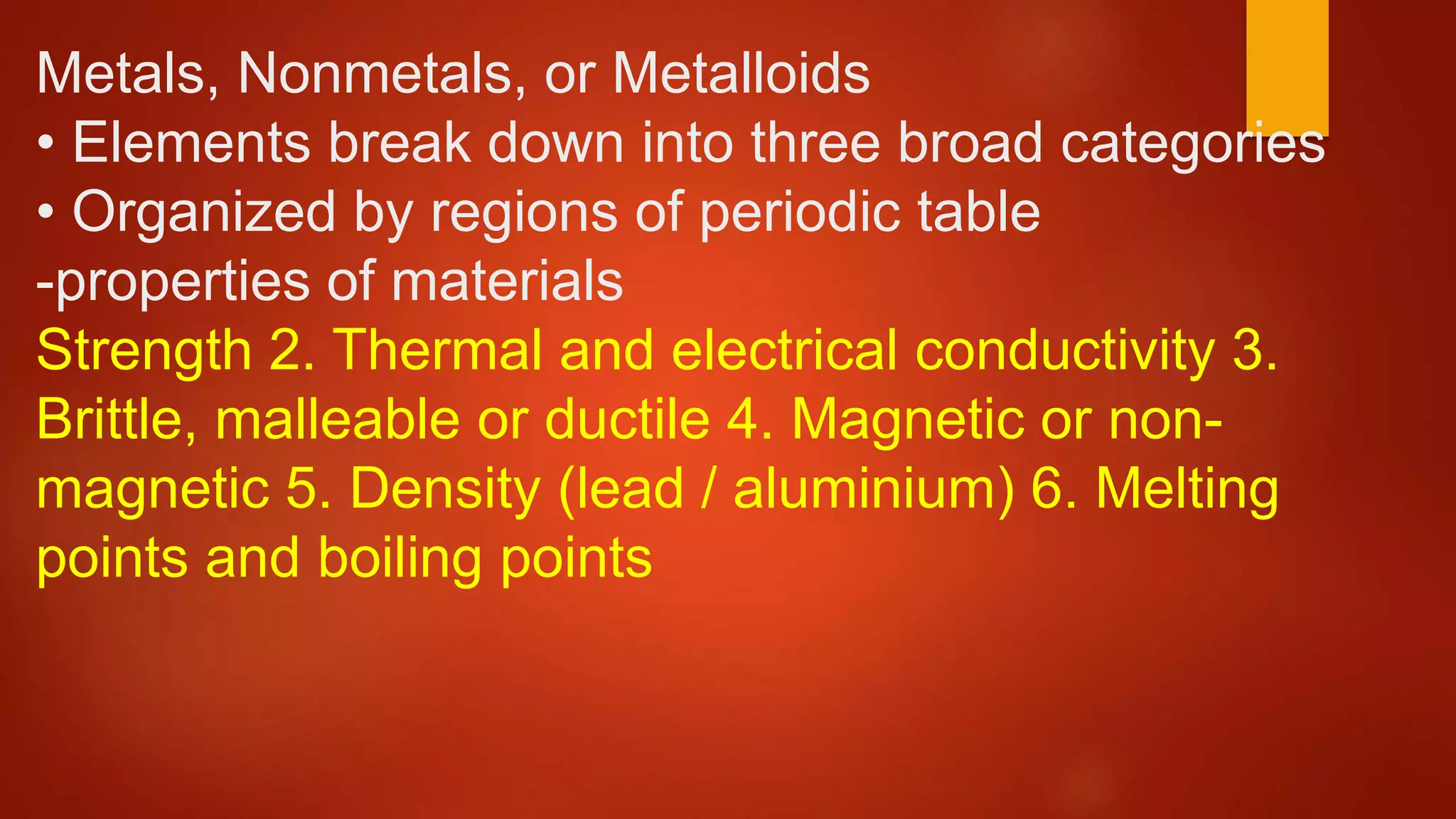
Which Property Do Metalloids Share With Nonmetals
So, you're at a party, right? And you've got your friends – metals, nonmetals, and those quirky metalloids. Metals are the life of the party, shining bright, passing around electrons like they're going out of style, and generally being good conductors. Nonmetals are hanging back, maybe a little more reserved, not so keen on sharing. And then there are the metalloids... they're the awkward in-betweeners. The "sometimes I'm shy, sometimes I'm outgoing" kind of friends. But, what exactly makes them so special?
The Big Question: What Do Metalloids and Nonmetals Have in Common?
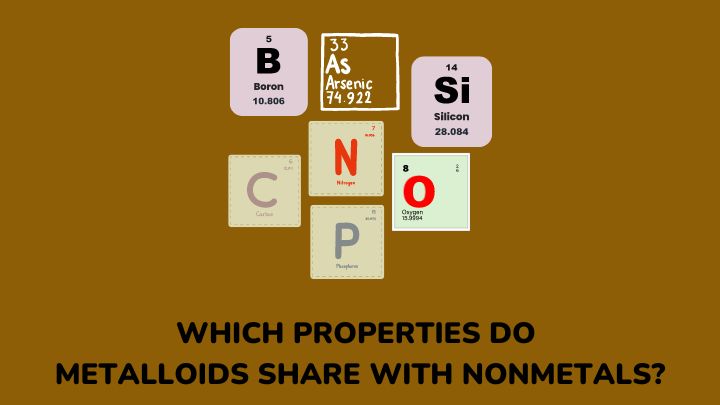
Alright, let's cut to the chase. What common ground do metalloids and nonmetals share that sets them apart from the shiny, electron-giving metals? The answer is their sneaky, unpredictable behavior regarding electricity! It's all about being semiconductors (or insulators). While metals are amazing conductors, like a superhighway for electrons, metalloids and nonmetals... well, they’re more like a country road with a "road closed" sign sometimes.
Semiconductors: The "Sometimes" Conductors
Imagine you're trying to get from point A to point B. Metals are like taking the Autobahn – smooth sailing, no traffic, and you're there in a flash! Nonmetals, on the other hand, are like trying to walk through a dense forest with no path. Good luck with that! They resist the flow of electrons like your cat resists getting into the bathtub. But metalloids... ah, they're tricky. Under certain conditions, like maybe if you bribe them with enough energy (heat, light, whatever!), they'll grudgingly let some electrons through. That's semiconductor behavior in a nutshell!
Must Read
Think of Silicon, a super famous metalloid. It's the rockstar of the semiconductor world! Without silicon, your computer, your phone, heck, even your fancy toaster oven wouldn't work. It's the backbone of all those tiny transistors that control the flow of electricity inside those devices. Now, silicon isn’t always conducting. In its pure form, it's not a great conductor. But, tweak it a little (add some impurities – a process called doping!), and BOOM! Suddenly, it's conducting electricity in a controlled, predictable way. That’s the magic of a semiconductor!
Nonmetals, like our friend Sulfur, are generally insulators. Meaning, they really, REALLY don't want electrons flowing through them. Picture trying to push a boulder uphill – that's how electrons feel trying to get through a nonmetal. They're the opposite of metals in this regard. You can use sulfur as an insulator to cover wires and prevent electricity from escaping to prevent any accidents.
Why This Matters (And Why You Should Care)
Okay, so why should you care that metalloids and nonmetals can be semiconductors or insulators? Well, because it's the foundation of modern technology! The ability to control the flow of electricity is what makes all those amazing gadgets we use every day possible. Without semiconductors, we'd be stuck in the Stone Age (okay, maybe not that bad, but you get the idea). Think about it: no smartphones, no internet, no streaming cat videos at 3 AM. The horror!
So, next time you're using your phone, remember those quirky metalloids and those stubborn nonmetals. They might not be as flashy as the metals, but they're secretly pulling all the strings (or rather, controlling all the electrons) behind the scenes. They're the unsung heroes of the digital age! And remember, the next time someone asks you what metalloids and nonmetals have in common, you can confidently say, "Their sometimes-conducting, sometimes-insulating superpowers!" You'll be the hero of the party!
"Metalloids and Nonmetals: The power to control electricity, one electron at a time!" - Your Friendly Neighborhood Science Enthusiast
And isn't that what it's all about? Understanding the world around us, one electron at a time. Go forth and spread the knowledge (and maybe some cat videos)!

