Which Properties Are Characteristic Of Metalloids

Metalloids! Doesn't that sound like something out of a sci-fi movie? Actually, they're super interesting elements right here on Earth, and understanding them unlocks a little bit of the magic behind everyday technology. Think of them as the chameleons of the periodic table – not quite metals, not quite nonmetals, but somewhere delightfully in between. Why should you care? Well, if you use a smartphone, computer, or even some solar panels, you're already benefiting from their unique properties!
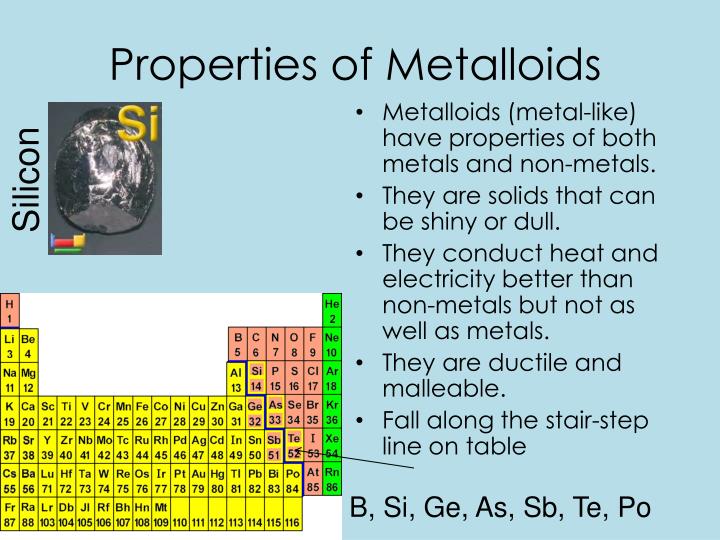
So, what exactly are metalloids, and what makes them so special? These elements – boron (B), silicon (Si), germanium (Ge), arsenic (As), antimony (Sb), and tellurium (Te) – don't fit neatly into the metal or nonmetal categories. They possess characteristics of both, leading to some very handy applications. Let's dive into some of their key properties:
Semiconductivity: This is the big one! Metalloids, especially silicon and germanium, are semiconductors. This means they can conduct electricity, but not as well as metals. Crucially, their conductivity can be controlled by adding impurities or changing the temperature. This controlled conductivity is the foundation of modern electronics. Imagine trying to build a computer with materials that were either always conductive (like copper) or never conductive (like rubber)! It wouldn't be possible.
Must Read
Appearance: Metalloids often have a metallic luster, meaning they appear shiny like metals. However, their chemical behavior is more similar to nonmetals. This visually demonstrates their "in-between" nature.
Variable Chemical Behavior: Depending on the conditions, metalloids can act as either electron donors (like metals) or electron acceptors (like nonmetals). This versatility makes them useful in a variety of chemical reactions.

Brittle Nature: Unlike metals, which are generally malleable (easily shaped) and ductile (easily drawn into wires), metalloids tend to be brittle. They're more likely to shatter than bend.
Different Uses, Different Benefits: For beginners, understanding metalloids is a great introduction to the periodic table and the different types of elements. For families, discussing metalloids can be a fun way to connect science to everyday objects like phones and computers. For hobbyists, especially those interested in electronics or chemistry, knowing about metalloid properties can open up new possibilities for projects and experiments.
.PNG)
For example, silicon is the backbone of the semiconductor industry, used in everything from microchips to solar panels. Boron is used in hardening steel and in some cleaning products. Arsenic, though toxic, is used in certain alloys and in some historical medicinal applications (though its use in medicine is now extremely limited due to its toxicity).
Getting Started: Want to learn more? A simple way to start is to research the individual elements mentioned above. Look up their uses and the chemical reactions they participate in. You can also find fun science experiments online that demonstrate semiconductivity using simple circuits and components. Even just paying attention to the materials listed on your electronic devices can be a great starting point.
Metalloids might seem like a niche topic, but they play a vital role in our modern world. Their unique properties, bridging the gap between metals and nonmetals, make them indispensable in countless applications. So, next time you pick up your phone or switch on your computer, remember the unsung heroes of the periodic table: the metalloids!