
Which Of The Following Is Not A Fossil Fuel
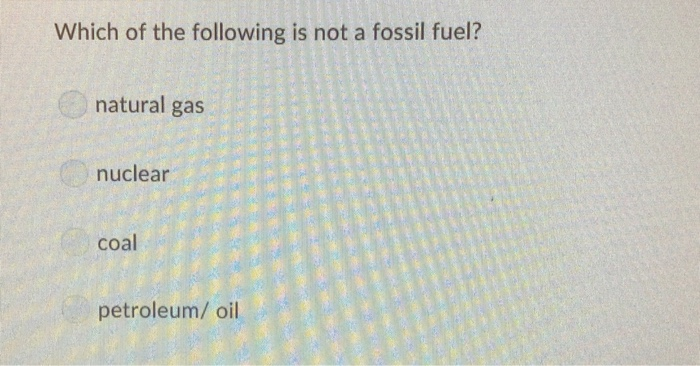
Hey! Let's talk fossil fuels. You know, the stuff powering, well, pretty much everything! But can you tell the real deal from the imposters? Let's play a game: Which of these ISN'T a fossil fuel?
Ready? Let's dive in!
Fossil Fuel Frenzy: What's the Fuss?
First, a quick recap. What even are fossil fuels? They're basically ancient sunlight, trapped and transformed. Think of prehistoric plants and critters, buried millions of years ago, cooked under pressure and heat. Yummy, right? (Okay, maybe not yummy). These "cooked" remains morphed into the fuels we burn today: coal, oil (petroleum), and natural gas.
Must Read
Coal is basically squished swamp gunk. Imagine a gigantic salad of ferns and moss, left to rot for eons. Sounds delightful! Not.
Oil? Think ancient marine plankton, tiny microscopic organisms. Imagine gazillions of them squished into goo. That's your gasoline!
And natural gas? Often found chilling alongside oil deposits. It's mostly methane, a super potent greenhouse gas. Let's just say it's the silent-but-deadly cousin of the fossil fuel family.
The Lineup: Which One Doesn't Belong?
Okay, here are your suspects:
- Coal
- Natural Gas
- Petroleum (Oil)
- Geothermal Energy
Think carefully! One of these things is not like the others. One of these things just doesn't belong!
Clues and Quirks: Cracking the Code
Let’s consider the geological backstory of each one.
Coal, oil, and natural gas—they all share a common thread: They are derived from the fossilized remains of organic matter. That "fossil" part is key!
Here's a crazy fact: Did you know some scientists believe that diamond, at least some of it, is actually formed from ancient organic matter too? So, in a very distant way, diamonds could be distantly related to fossil fuels. But hey, we're not burning diamonds for power (usually!).
Let's circle back to our question. Now, what about geothermal energy? Geothermal power taps into the Earth's internal heat. This heat can come from the radioactive decay of elements deep inside the planet (think uranium and thorium). It also comes from the residual heat left over from the Earth's formation. Think of it as a cosmic after-party!
The Big Reveal: The Imposter Exposed!
Drumroll please! The answer is... Geothermal Energy!

Why? Because geothermal energy doesn't rely on ancient, squished organic matter. It uses the Earth's inherent heat. That’s it!
Think of it this way: Fossil fuels are like delicious, ancient veggie burgers. Geothermal is like tapping into the Earth's own internal oven! Both are sources of energy, but their origins are wildly different.
Geothermal Goodness: A Quick Shout-Out
Geothermal energy is a renewable resource. The Earth isn't going to run out of internal heat anytime soon (we hope!). Iceland, for example, is a geothermal powerhouse. They heat homes, power industries, and even melt snow with geothermal energy. Talk about eco-friendly!

It’s also incredibly reliable. Unlike solar or wind power, geothermal energy is available 24/7, 365 days a year. The Earth is always hot under the collar, figuratively speaking, of course.
Fossil Fuel Fun Facts: Because Why Not?
Just a few more quirky tidbits to fuel your fossil fuel fascination:
- Petroleum jelly (Vaseline): Yup, it's a petroleum byproduct. Smear some ancient plankton on your skin! (Okay, don't actually do that).
- The Great Molasses Flood: In 1919, a giant tank of molasses (a byproduct of sugar refining) burst in Boston. It created a sticky, sweet tidal wave that tragically killed 21 people. While not directly fossil fuel related, it highlights the potential dangers of industrial storage.
- "Peak Oil": This is the point when oil production hits its maximum and starts to decline. Some say we've already passed it. Others say we haven't. It's a hot debate!
So, there you have it! You're now a certified fossil fuel expert. Impress your friends at parties. Bore your relatives at dinner. The possibilities are endless!
And remember, while fossil fuels have powered progress for centuries, understanding alternative energy sources like geothermal (and solar, wind, etc.) is essential for a sustainable future. The Earth will thank you!