Which Of The Following Elements Is A Metalloid

Okay, let's talk about something that might sound a little intimidating at first: metalloids! Why bother learning about them? Well, for starters, they're everywhere, playing crucial roles in the technology that powers our lives. Plus, understanding them gives you a deeper appreciation for the amazing organization of the periodic table. It’s like unlocking a secret level of understanding about the world around you. Think of it as adding another tool to your mental toolbox for understanding how things work. So, what exactly are they, and why are they so special?
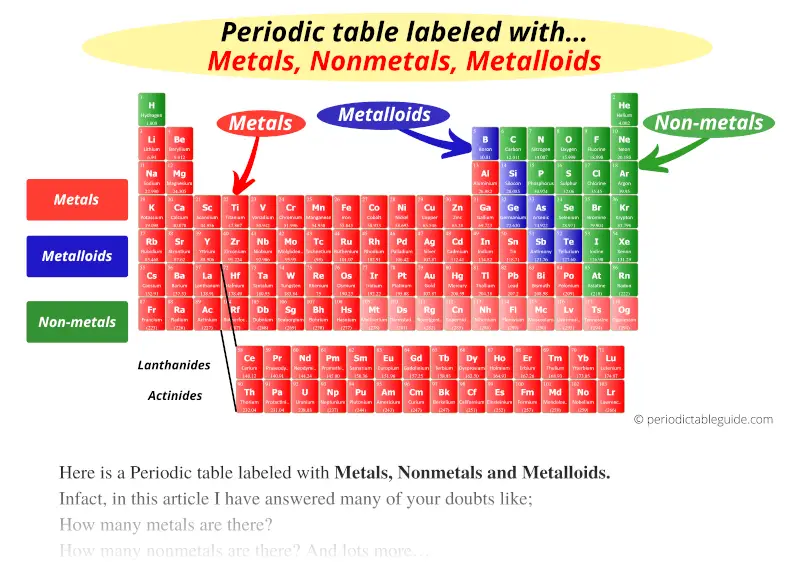
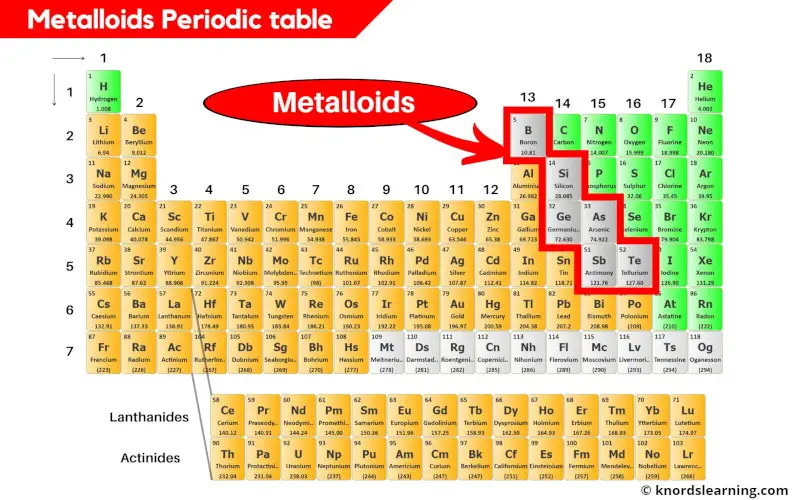
Imagine a seesaw, perfectly balanced between two extremes. That’s kind of like a metalloid. These elements, sometimes called semimetals, are the bridge between metals and nonmetals on the periodic table. They don't neatly fit into either category, possessing properties of both. This unique characteristic is what makes them so darn useful. Instead of being pure conductors of electricity like metals, or pure insulators like many nonmetals, metalloids are semiconductors. They can control the flow of electricity, making them ideal for creating all sorts of electronic devices. This ability to "switch" conductivity is their superpower!
Think about your smartphone, your computer, even your car. Chances are, they're packed with semiconductors made from metalloids. One of the most famous examples is silicon (Si). It's the backbone of the entire computer industry! Silicon is used to create microchips, the tiny brains that control everything from your thermostat to the International Space Station. Another important metalloid is germanium (Ge), also used in semiconductors. Boron (B) is another example, used in everything from laundry detergent to heat-resistant glass.
Must Read
In education, understanding metalloids is crucial for learning about chemistry and physics. High school students often experiment with circuits and LEDs, unknowingly relying on metalloids to make those circuits work. Even simple science kits often include components that utilize metalloids. In daily life, beyond electronics, metalloids show up in unexpected places. For example, some metalloid compounds are used in flame retardants, helping to keep us safe.

Want to explore the world of metalloids further? Here are a few simple ideas: First, research the specific components inside your electronics. Try to identify which ones are likely to contain metalloids. A simple Google search for "parts of a [device name]" can often reveal surprising details. Another fun project is to learn more about the history of silicon. How did scientists discover its semiconducting properties, and how did it revolutionize the world? You can also explore online interactive periodic tables that offer in-depth information about each element, including its properties and uses. Look for resources that specifically highlight the semiconductor properties of metalloids.
The key takeaway? Metalloids are not just some abstract concept in a textbook. They are the unsung heroes of modern technology, quietly enabling the digital world we live in. By understanding their unique properties, you gain a deeper appreciation for the chemistry that shapes our world. So, next time you're using your phone or computer, take a moment to appreciate the humble metalloids that make it all possible!