Where Does Energy Come From In An Ecosystem
Hey there, friend! Ever wonder where all the oomph comes from in nature? You know, the get-up-and-go that keeps the whole shebang running? Well, grab your metaphorical coffee (or actual coffee, I won't judge!), and let's chat about where ecosystems get their energy.
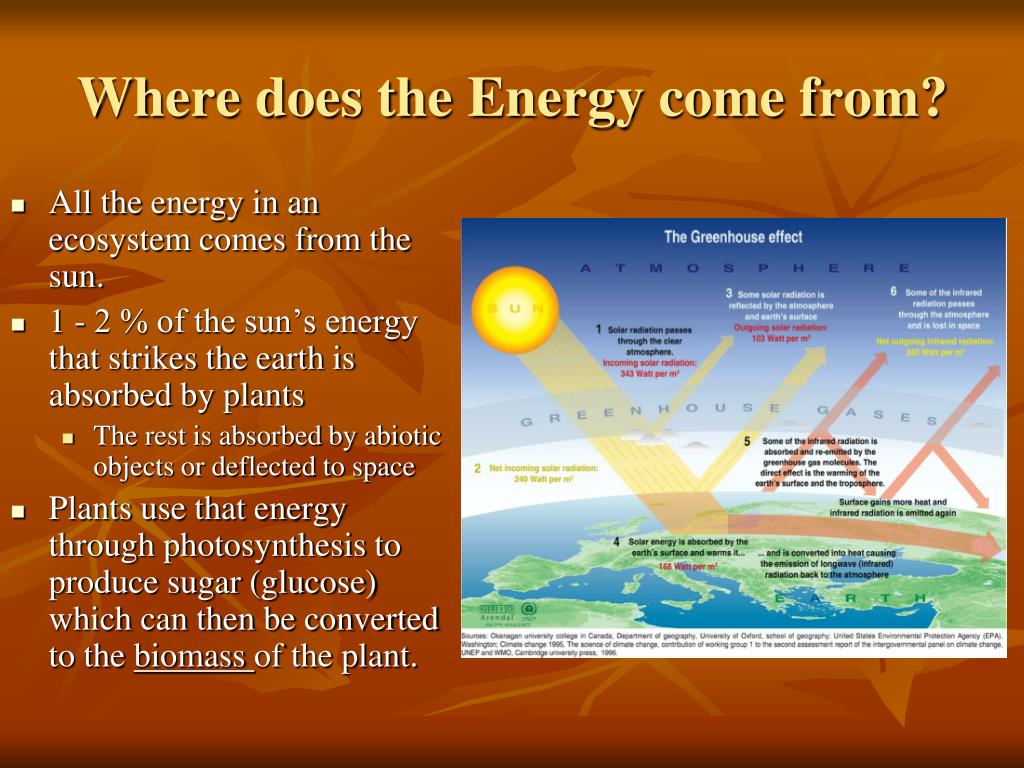
Think of an ecosystem like a giant, hungry machine. What fuels that machine? Pizza? Sadly, no (though that would be awesome). The answer, my friend, is the Sun! Yup, that big ol' ball of fire in the sky is the ultimate energy source for almost every ecosystem on Earth. Isn't that wild?
Photosynthesis: The OG Energy Converter
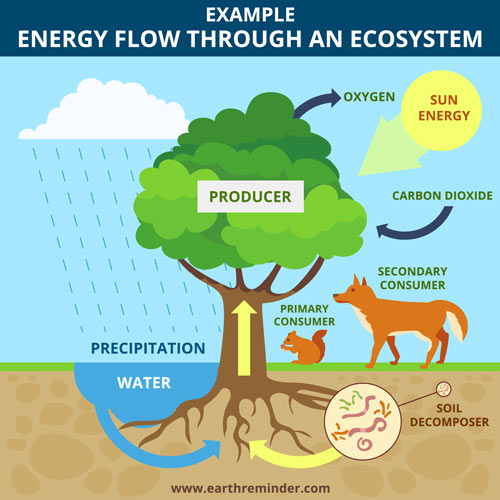
So, how does sunshine turn into, well, life? That's where our green buddies, the plants (and some algae and bacteria, too!), come in. They're the energy converters, the magicians of the natural world. They perform something called photosynthesis. You probably remember that from school, right? (Don't worry, I won't give you a pop quiz!).
Must Read
Basically, photosynthesis is like this: plants take in sunlight, carbon dioxide (from the air), and water (from the ground), and then, bam!, they create sugar (food for themselves) and oxygen (which we breathe!). It's like a solar-powered bakery! And they're baking for everyone! Ok, mostly just for themselves, but we get the by-product which is, you know, essential for survival. Thanks, plants!
This sugar, this plant-made food, is chemical energy. It's stored energy that other organisms can then use. Think of it like a plant-based battery!

Trophic Levels: The Food Chain Fiesta
Now, this is where things get interesting (and maybe a little…chomp chomp). The energy stored in plants doesn't just stay with the plants, does it? Nope! It gets passed along. We're talking about trophic levels, which is just a fancy way of saying "who eats whom" in an ecosystem.
First up, we have the producers (the plants!). They're at the bottom of the food chain, making all that delicious energy. Then come the consumers. These are the critters that eat the producers. We've got herbivores (plant-eaters), carnivores (meat-eaters), and omnivores (who eat both! Talk about indecisive!).
Think of a classic example: grass (producer) gets eaten by a grasshopper (herbivore), which gets eaten by a frog (carnivore), which gets eaten by a snake (also a carnivore!), which might get eaten by an eagle (top predator!). It’s a wild ride, right? Each level is passing on some of that precious energy, initially from the sun!
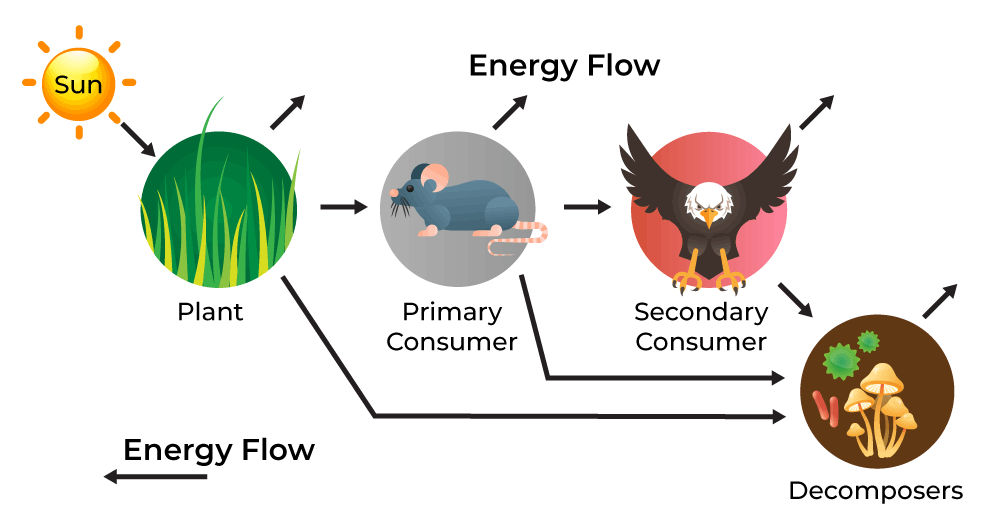
But here's the thing: energy isn't passed on perfectly. With each step up the food chain, some energy is lost as heat. (Think of it like taxes – everyone’s gotta pay!). That's why there are generally fewer top predators in an ecosystem than there are plants. There's just not enough energy to support a ton of eagles, snakes, lions... you get the picture.
Decomposers: Nature's Clean-Up Crew
What happens when things die? Do all those nutrients just vanish into thin air? Nope! That's where our unsung heroes, the decomposers, come in. These are things like fungi and bacteria. They break down dead organisms and waste, releasing nutrients back into the soil.

Think of them as nature's recyclers! They take all that leftover organic matter (dead leaves, animal carcasses, you name it) and turn it back into usable ingredients for the plants. Pretty cool, huh? They’re essentially restarting the cycle, ensuring the circle of life keeps spinning!
A Note on Other Ecosystems
Now, I mentioned earlier that the sun is the ultimate energy source for almost every ecosystem. What about the exceptions? Well, there are some pretty amazing ecosystems deep down in the ocean, near hydrothermal vents. These vents spew out chemicals from the Earth's interior, and some bacteria can use those chemicals to create energy through a process called chemosynthesis. Talk about resourceful!
So, there you have it! Energy in an ecosystem comes primarily from the Sun, gets converted by plants, passed along through the food chain, and recycled by decomposers. It's a beautiful (and sometimes brutal) system, isn't it? Now, who’s for another cup of coffee?