
What Size Generator Do You Need To Run A House

Okay, picture this: the lights flicker, the TV sputters, and suddenly... darkness! Your house is officially off the grid. Now, you're not living in a horror movie; it's just a power outage. But wouldn't it be fantastic to have a magical box that says, "Fear not, I bring electricity!" That, my friend, is a generator. But before you rush out and buy one that's the size of a small car (tempting, I know!), let's figure out what size generator you really need to keep your humble abode humming.
Step 1: The Great Appliance Census
Think of this as your home's electrical inventory. We need to figure out what appliances you absolutely must have running during an outage. Are we talking survival mode (lights, fridge, maybe a phone charger) or are we aiming for a full-blown movie night experience, complete with popcorn maker and surround sound?
Start with the big guys. Your refrigerator is a definite must. Then consider your furnace (especially if you live somewhere that experiences "polar vortex" type weather) or your air conditioner (if surviving summer without it is like living on the sun). Add in a few lights, and maybe that trusty coffee maker (because a power outage is no excuse for caffeine withdrawal!).
Must Read
Finding the Numbers: Watts Up?
Every appliance has a wattage rating. It's usually printed on a sticker on the appliance itself. Look for something that says "Watts" or "W". This is the amount of power the appliance uses. If you can't find the wattage, you might find the amps and voltage. Don't worry, we can still work with that! Just multiply the amps by the voltage (Watts = Amps x Volts). For example, if your refrigerator draws 5 amps at 120 volts, it uses 600 watts.
Now, for the fun part: making a list! Write down each appliance you want to power, and its wattage. Don't forget to note which appliances need extra power to start up!

Step 2: The Startup Surge (or the "Why My Generator Keeps Tripping" Story)
Some appliances, especially those with motors (like refrigerators, air conditioners, and well pumps), need a burst of extra power to get started. This is called the starting wattage, and it can be two to three times the running wattage! Imagine trying to push a car that's stuck in the mud – it takes a lot more effort to get it moving than to keep it moving. Your appliances are the same way.
This is crucial. If your generator doesn't have enough surge capacity, it'll trip, leaving you in the dark again, which is the exact opposite of what we're trying to accomplish.

Step 3: Add It All Up (Like You're Winning the Lottery!)
Now, for the grand total! First, add up the running wattage of all the appliances you want to power simultaneously. This is your total running wattage.
Next, identify the appliance with the highest starting wattage. Add that starting wattage to the total running wattage. This is your peak wattage. For example, if all the appliances need 2000W running but your fridge needs 3500W to start then you will need 5500W.
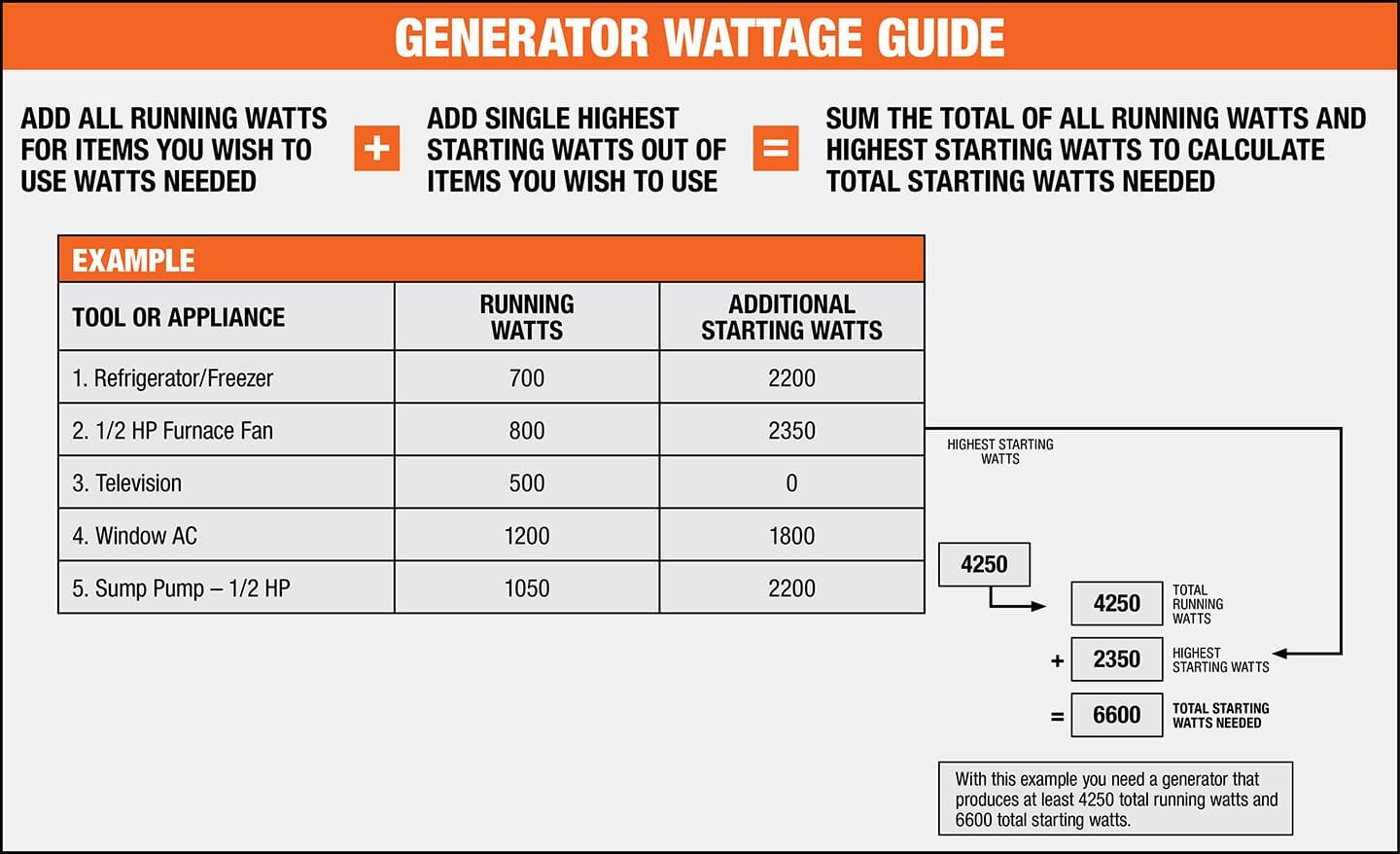
That peak wattage is the magic number! You need a generator that can handle at least that much power. To be safe, add a little extra wiggle room – say, 10-20% – because who knows when you'll decide you need to power a disco ball during a power outage? (Hey, no judgment!).
Step 4: Shopping Time! (The Fun Part!)
Now you're armed with knowledge! When you're shopping for a generator, pay close attention to the wattage ratings. Look for both the "running wattage" and the "peak wattage" or "starting wattage." Make sure the generator can handle your peak wattage needs. And don't be afraid to ask questions! The salesperson should be able to help you find the right size generator for your needs.
Remember: It's better to have a little extra power than not enough. A generator that's too small will constantly trip, leaving you frustrated and in the dark.
Choosing the right generator doesn't have to be scary. With a little planning and some basic math, you can find the perfect power source to keep your home running smoothly during any outage. So go forth, conquer the darkness, and enjoy the sweet, sweet feeling of being prepared!
