
What Size Generator Do I Need For My Camper
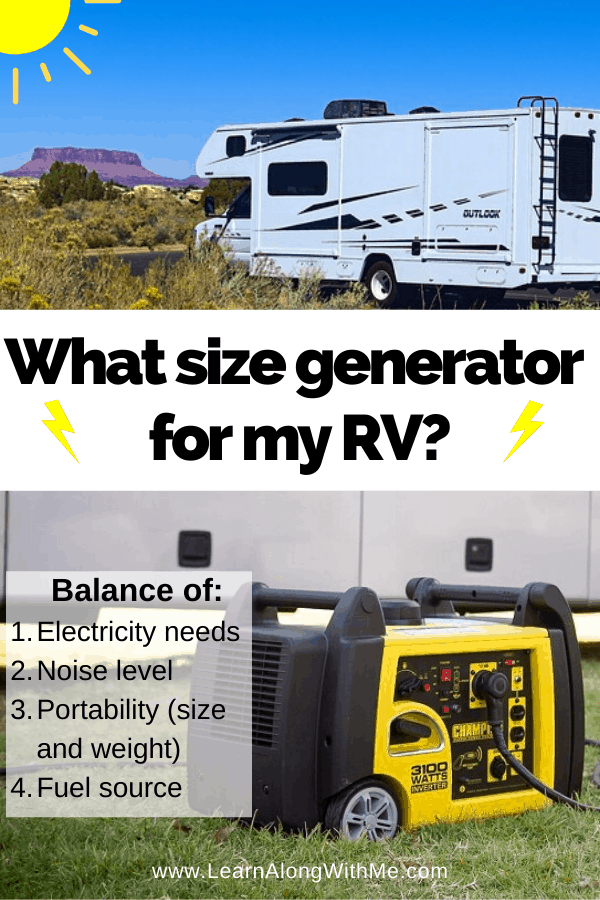
So, you're thinking about adding a generator to your camper arsenal? Awesome! Freedom awaits! Picture this: You're miles from civilization, the stars are blazing, and you're about to whip up a gourmet s'more... but your battery is flatter than a pancake left out in the rain.
That's where a generator swoops in like a superhero in a power suit. But, before you rush out and buy the biggest, loudest, gas-guzzling beast you can find, let's talk about sizing. Getting the right generator is like finding the perfect pair of jeans – too big, and you're swimming in excess; too small, and… well, let's not go there.
The Great Camper Power Audit
First things first: we need to figure out what you're actually trying to power in your camper. It's time for a power audit! Don't worry, it's not as scary as it sounds. Grab a pen, a piece of paper (or your favorite note-taking app), and let’s become power detectives.
Must Read
Start by listing every electrical appliance you plan to use. Think beyond the obvious stuff, like your air conditioner. Include that fancy blender you use for margaritas, the TV for those rainy days, and even your phone charger. We need to account for every little power-hungry gremlin!
Now comes the slightly more technical (but still totally manageable!) part: finding the wattage of each appliance. Look for a sticker or plate, usually on the back or bottom of the appliance. It will list the wattage (W) or amperage (A) and voltage (V).
Decoding the Wattage Mystery
Most appliances will clearly state their wattage. If you find amperage (A) and voltage (V) instead, don't panic! Just multiply them together (A x V = W) to get the wattage. Congratulations! You’re officially a wattage wizard.
Here's a quick cheat sheet of common camper appliances and their approximate wattage needs:
* Air Conditioner: 1500-3500W (depending on size) * Microwave: 600-1200W * Refrigerator: 150-200W (running), 600W (startup) * Television: 50-200W * Coffee Maker: 600-1200W * Phone Charger: 5-10W * Hair Dryer: 1200-1875W (the ultimate power hog!)
Remember, these are just estimates. Always check the actual appliance for its specific wattage. Ignoring this is like guessing how much salt to add to your grandma's famous cookies – disaster is imminent.
Starting Watts vs. Running Watts
Now for a crucial distinction: starting watts versus running watts. Some appliances, particularly those with motors (like your air conditioner or refrigerator), require a surge of power when they first start up.
This "starting wattage" can be significantly higher than the wattage they consume while running. Imagine it like trying to push a stalled car – it takes a lot more effort to get it moving than to keep it rolling. This is a critical number to consider.
To find the starting wattage, check the appliance's label. It may be listed separately, or you might have to do some detective work online. If you can't find it, a good rule of thumb is to assume the starting wattage is 2-3 times the running wattage for appliances with motors.
Calculating Your Total Power Needs
Okay, you've gathered your appliance list and their wattages. Time to crunch some numbers! Add up the running watts of all the appliances you plan to use simultaneously. Be realistic! Are you really going to be blow-drying your hair, microwaving popcorn, and running the air conditioner all at the same time?
Next, identify the appliance with the highest starting wattage. This is your power surge champion! Add that starting wattage to the total running wattage you calculated earlier. This final number is the minimum generator size you need.

For example, let's say you want to run a 1500W air conditioner (with a 3000W starting wattage), a 100W TV, and charge your phone (10W). Your total running wattage is 1610W. But, you also need to account for that air conditioner's starting surge. So, your minimum generator size is 3000W + 100W + 10W = 3110W.
The Golden Rule: Always Oversize!
Here's a pro tip: Always oversize your generator! Don't aim for the bare minimum. Generators run more efficiently and last longer when they're not constantly operating at full capacity. Plus, it gives you some wiggle room if you decide to add more appliances later.
A good rule of thumb is to add at least 20% to your calculated wattage needs. In our example above, that would mean aiming for a generator that's at least 3732W (3110W x 1.2). Round up to the nearest readily available size, and you're golden!
Generator Types: The Loud and the Quiet
Once you know the size of generator you need, it's time to consider the different types available. The two main contenders are conventional generators and inverter generators.
Conventional generators are typically more affordable and produce more power for the price. However, they're also generally louder and less fuel-efficient. Imagine them as the blue-collar workhorses of the generator world: reliable, but not exactly known for their finesse.

Inverter generators, on the other hand, are quieter, more fuel-efficient, and produce cleaner power. This "clean power" is especially important for sensitive electronics like laptops and smartphones. They're like the luxury SUVs of generators: smooth, quiet, and packed with features… but they come with a higher price tag.
Noise Matters: Be a Good Neighbor
When choosing a generator, consider the noise level. No one wants to be that camper, the one who ruins everyone else's peaceful retreat with a deafening roar. Check the decibel (dB) rating of the generator. The lower the dB, the quieter it is.
Many campgrounds have noise restrictions, so be sure to check the rules before you go. Investing in a quiet generator is not only courteous but also good for your own sanity. Trust me, listening to a lawnmower all day is not the ideal camping soundtrack.
Fueling Your Adventure: Gas, Propane, or Dual Fuel?
Generators run on either gasoline, propane, or both (dual fuel). Gasoline generators are readily available and often more powerful. However, gasoline can be messy to handle and can degrade over time.
Propane generators are cleaner-burning and propane has a longer shelf life. Plus, many campers already carry propane for their stoves and heaters. Dual-fuel generators offer the best of both worlds, giving you the flexibility to choose the fuel that's most convenient.

Consider the pros and cons of each fuel type based on your camping style and storage capabilities. Remember, you'll need to store extra fuel safely, so factor that into your decision.
Safety First, Always!
No matter which generator you choose, safety is paramount. Generators produce carbon monoxide, a deadly, odorless gas. Always operate your generator outdoors, in a well-ventilated area, away from windows and doors. Install carbon monoxide detectors in your camper and test them regularly. Don't risk it!
Never refuel a generator while it's running or hot. Let it cool down completely before adding more fuel. Keep flammable materials away from the generator. And always follow the manufacturer's instructions carefully.
The Joy of Having Power On Demand
Choosing the right generator for your camper might seem a little daunting at first. But, with a little research and planning, you'll be well on your way to enjoying the freedom and convenience of having power on demand. So get out there, explore the great outdoors, and don't let a dead battery ruin your adventure!
Happy camping! And may your s'mores always be perfectly toasted.