
What Is The Scientific Definition Of Energy

Okay, so grab another sip of that coffee, because we’re about to tackle one of those words that everyone thinks they get, but then you poke at it, and it’s like, “Wait, what is that, really?” We’re talking about energy, my friend.
You know, the stuff you feel like you don’t have enough of on a Monday morning? Or the thing that makes your phone buzz and light up? We use the word all the time, right? “That person has great energy!” or “I need more energy to get through this meeting!” But what does a scientist, in their lab coat and with their fancy equations, actually mean when they say energy?
Prepare yourself, because the scientific definition is deceptively simple, almost boring even. But stick with me, because it unlocks a whole universe of cool stuff. Ready? Here it is:
Must Read
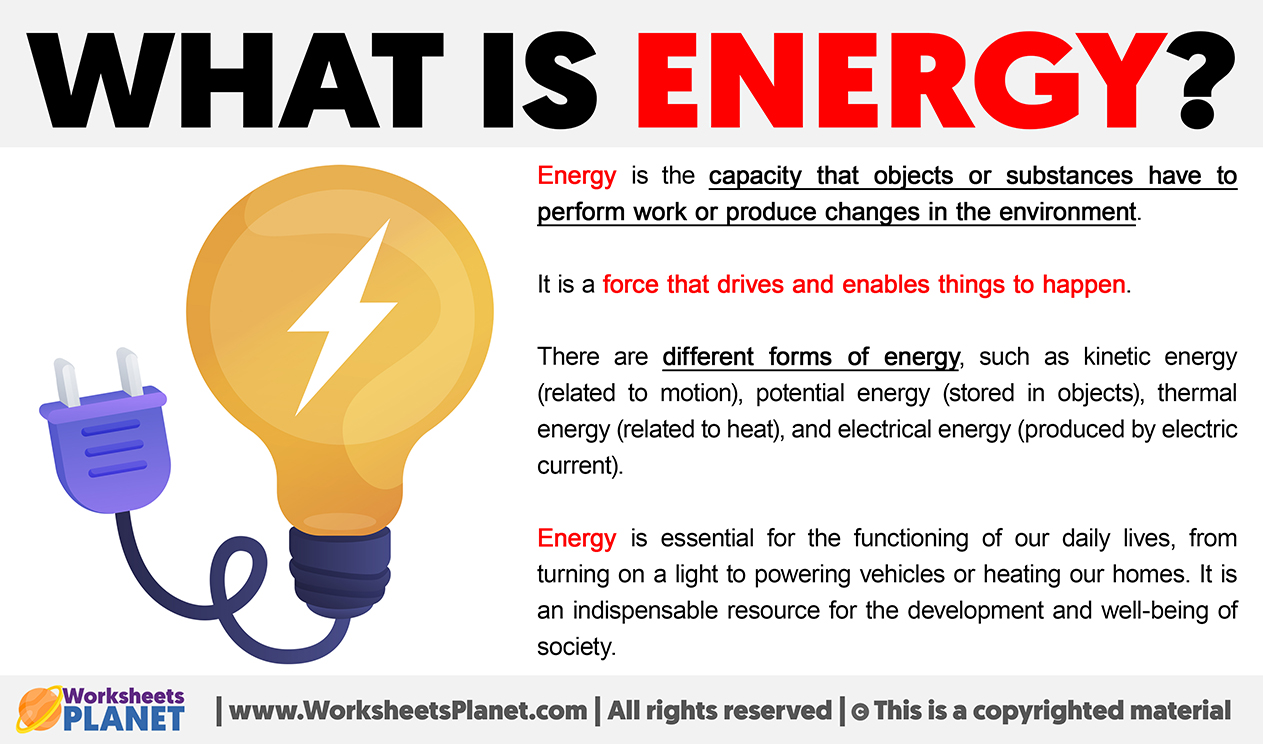
Energy is the ability to do work.
Yup. That’s it. “The ability to do work.”
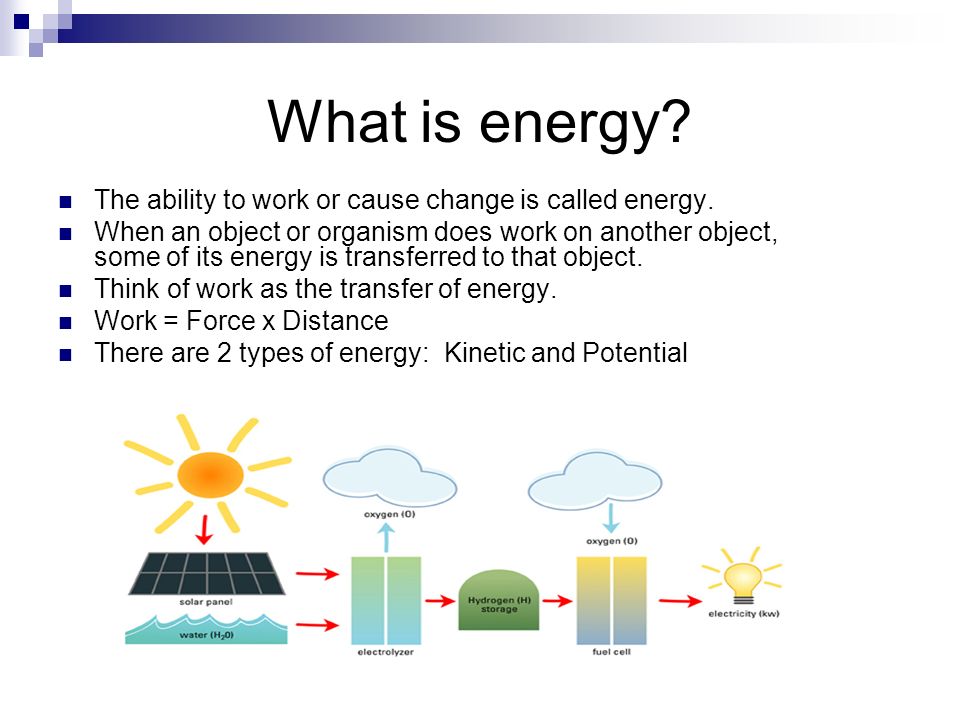
Now, I know what you’re thinking. “Work? Like, doing chores? Or my actual job?” And that’s where the little linguistic trick comes in. In science-speak, “work” isn’t about ticking things off your to-do list. It has a super specific meaning. For a scientist, work happens when a force causes an object to move a certain distance. Boom!
Think about it. If you push a shopping cart across the grocery store, you’re doing work. You’re applying a force, and that cart is moving a distance. Ta-da! Work!
But here’s the kicker: if you push with all your might against a brick wall, and that wall doesn’t budge an inch? Sorry, pal. In the eyes of physics, you’ve done zero work. Zilch! Nada! You might be sweating, grunting, and feeling utterly exhausted, but if there’s no movement, there’s no scientific work happening. It’s a bit rude, honestly, but that’s science for ya!
So, if energy is the ability to do that kind of force-over-distance movement, then suddenly, everything clicks into place, doesn’t it?
Your car, for example, has energy (from the fuel!) which gives it the ability to move its heavy self down the road. That’s work! Your body, fueled by that delicious coffee and maybe a bagel, has the energy (from calories!) to lift your arm to take another sip. More work!
But here’s where it gets really fun: energy isn’t just one thing. Oh no, that would be far too simple! It’s like a giant, super-talented shape-shifter. It comes in a gazillion different forms, all of which ultimately boil down to that "ability to do work" definition.
Ever heard of kinetic energy? That’s the energy of motion. A speeding train, a flying bird, even a tiny atom zipping around – they all have kinetic energy because they’re moving, and that motion means they could, hypothetically, do work (like, push something else if they collided with it!).
Then there’s potential energy. This one’s a bit trickier, but super cool. It’s stored energy, the energy of position or state. Imagine a ball sitting at the very top of a hill. It’s not moving, right? So no kinetic energy. But does it have the ability to do work? You bet! Give it a tiny nudge, and gravity will take over, sending it tumbling down, doing all sorts of work along the way. That ball had a ton of potential energy just sitting there, waiting for its moment.

A stretched rubber band? Potential energy! The food you eat? Chemical potential energy, just waiting to be converted into the kinetic energy that lets you, well, live! There's also thermal energy (heat!), electrical energy, light energy, sound energy, and even nuclear energy. They’re all just different costumes that our friend "energy" likes to wear.
And here's the absolute best part, the mic drop of all scientific laws: the Law of Conservation of Energy. It basically says that energy can never be created or destroyed. Ever! It just changes from one form to another. Think about that roller coaster click-clacking up the first big hill. It's gaining potential energy. Then, whoosh! Down it goes, that potential energy transforming into a thrilling burst of kinetic energy. Friction and air resistance turn some of it into thermal energy (heat!), but the total amount of energy in the system? Always the same. Mind-blowing, right?
So, the next time you hear someone talk about energy, whether it’s about powering a city or just getting out of bed, you'll know exactly what they mean (or at least, what a physicist means!). It’s the universal currency of change, the very fabric that allows anything and everything to happen in our universe. Pretty neat for such a simple definition, wouldn't you say?