
What Is The Most Rare Metal
Hey there, fellow curious human! Ever found yourself gazing at a piece of jewelry, perhaps a shiny gold ring, and thought, "Wow, this is rare"? Or maybe you've heard whispers of platinum or rhodium being the ultimate in scarcity? Well, buckle up, because we're about to dive into the sparkling, slightly mind-bending world of the absolute rarest metal on Earth, and trust me, it's not what you think!
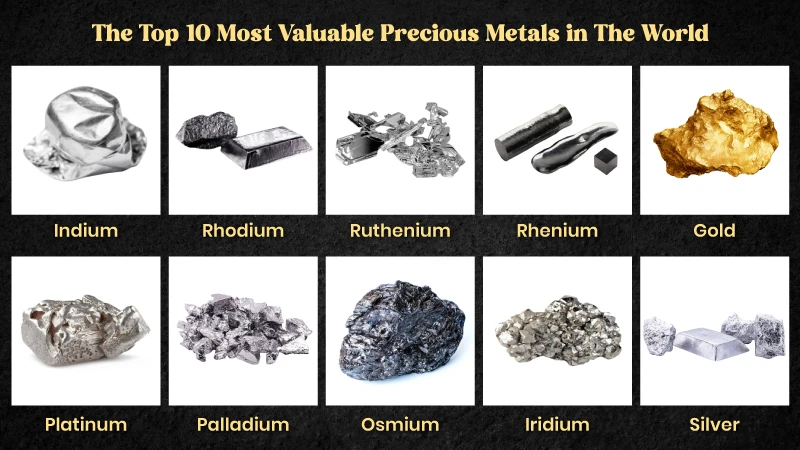
Most of us naturally gravitate towards precious metals when we think "rare." Gold? Definitely valuable, but you can still find it in decent quantities. Platinum? A step up, for sure, often called "white gold" for a reason. Rhodium? Now we're talking serious scarcity and price per ounce, used in catalytic converters and fancy jewelry. These are all fantastic metals, incredibly useful and undeniably precious. But when we talk about pure, unadulterated, "blink and you'll miss it" rarity in the natural world? We need to think way smaller. Like, atom-by-atom smaller.
The Great Metal Guessing Game: Who's the Rarest?
So, what's your initial guess? Take a moment. Is it something from a sci-fi movie? A secret element only found in meteorites? The truth, as it often is, is far more fascinating and, dare I say, a little bit mind-blowing when you truly grasp it. It’s not just about how much of it exists, but how long it exists.
Must Read
You see, "rarest" isn't a simple one-and-done answer. There are metals we create in labs that exist for fractions of a second. Then there are naturally occurring metals that are so incredibly unstable, they barely register before decaying into something else. It’s like trying to catch a whisper in a hurricane!
And The (Naturally Occurring) Winner Is... Francium!
Prepare yourself for a name that sounds like it belongs to a fancy perfume or an obscure European country: Francium. That's right, Francium (element number 87 on the periodic table, if you're keeping score) takes the crown for being the rarest naturally occurring element on our planet.
Why is it so rare? Well, it's incredibly unstable. We're talking about a half-life of just 22 minutes for its most stable isotope. Twenty-two minutes! That means if you had a chunk of Francium, half of it would be gone, transformed into another element, in less time than it takes to watch an episode of your favorite sitcom. It's like a fleeting celebrity, here for a moment, then poof, it's off to its next gig as something else entirely.
At any given moment, it's estimated there's probably no more than 30 grams of Francium in the Earth's crust at any one time. Total. Across the entire globe. That's less than an ounce! Imagine trying to collect that. It forms from the radioactive decay of uranium and thorium, but it vanishes almost as quickly as it appears. We literally have to search for it atom by atom, or create it in extremely specific lab conditions. It’s a ghost of an element, constantly appearing and disappearing.
But Wait, There's More! The "Made in a Lab" Rarity
Now, if we broaden our definition of "rare" to include things made by human hands, we enter the realm of superheavy elements. Think elements like Oganesson (element 118) or Tennessine (element 117). These are created in particle accelerators, often by smashing smaller atoms together, and they exist for mere milliseconds or even nanoseconds before decaying. They are the ultimate in ephemeral existence – here for a literally breathtaking fraction of a moment, then gone.
These synthetic elements push the boundaries of our understanding of matter and the universe, even if they can only be observed briefly. They remind us of the incredible power of human ingenuity and our endless quest to understand the building blocks of everything.
Why Does This Make Life More Fun?
So, you might be thinking, "Okay, cool, a super-rare metal. But how does knowing about Francium make my life more fun?" Ah, my friend, this is where the magic happens! Knowing about Francium isn't just a fun fact; it's a doorway to a deeper appreciation for the universe around us.
It ignites your curiosity. It makes you look at the world, and even the periodic table, with fresh eyes. It reminds you that even in the seemingly solid, predictable world of science, there are incredible mysteries and fleeting wonders. It’s like discovering a secret level in a video game you thought you knew inside and out.

When you learn about something like Francium, you start to see the world as a place brimming with hidden wonders, tiny miracles unfolding every second. It's a reminder that even the air you breathe, the ground you walk on, is a complex dance of elements, some of which are so shy and fleeting, they barely exist.
It fosters an explorer's mindset, not just for distant lands, but for the fundamental particles that make up reality. And isn't that a truly thrilling way to go through life? With wide-eyed wonder, ready to be amazed by the unexpected?
So, the next time you're idly pondering the universe, remember Francium. Remember its incredible, almost poetic rarity. Let it inspire you to ask more questions, to dig a little deeper, and to find the extraordinary in the seemingly ordinary. Because the world, my friend, is positively bursting with incredible, rare, and utterly captivating facts just waiting for you to discover them. Happy exploring!