
What Is The Least Common Multiple Of 36 And 54
Have you ever been organizing a massive potluck and found yourself staring blankly at a mountain of hotdog buns and a slightly less intimidating pile of sausages? You know, that moment when you realize you've bought enough for a small army, but the numbers… the numbers just don't match? That, my friends, is when the spirit of the Least Common Multiple, or LCM, descends upon you.
And today, we're talking about the dynamic duo of 36 and 54. These two numbers, while seemingly innocent, hold a secret. A secret that, once unlocked, can save you from the aforementioned sausage-bun predicament, prevent awkward leftover scenarios, and generally make your life a teensy bit smoother.
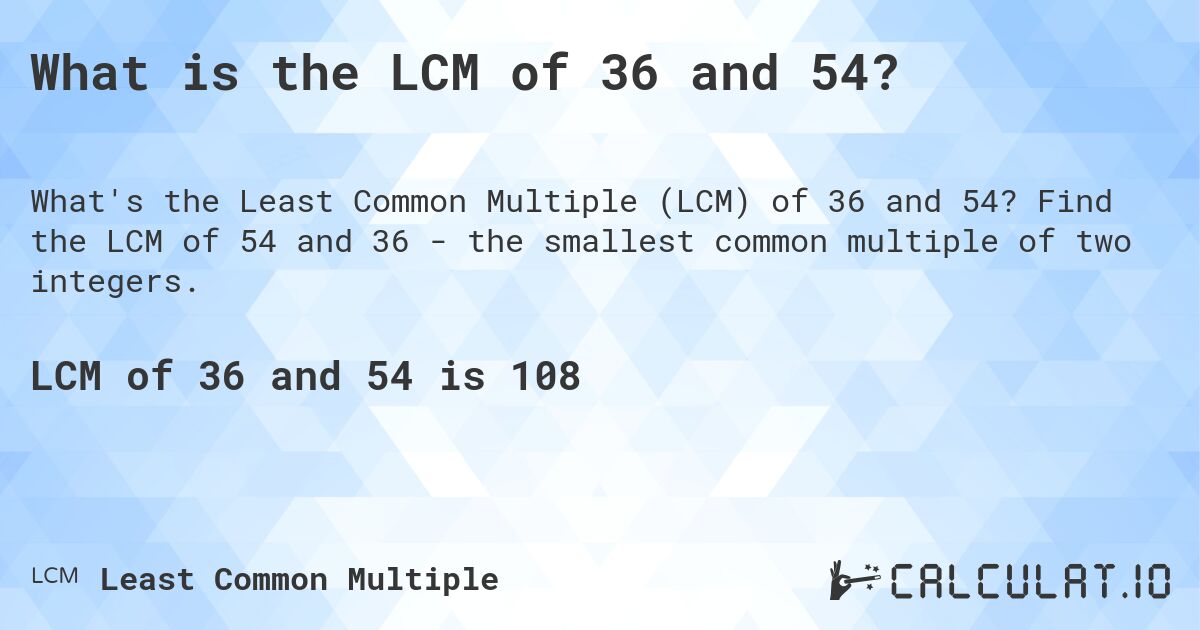
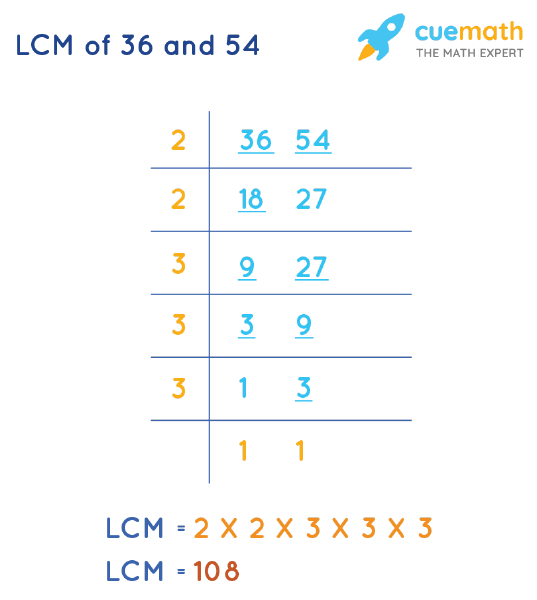
So, what is the Least Common Multiple of 36 and 54? Drumroll, please… It's 108!
Must Read
But Wait! What Does That Mean?
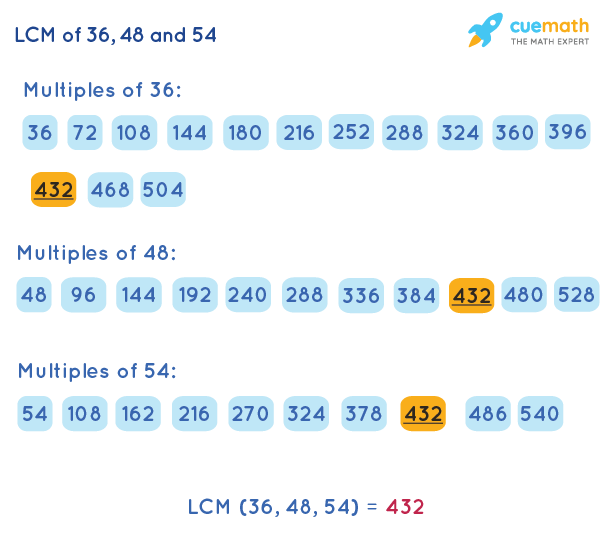
Okay, okay, let's break it down. Think of multiples as the "times table" results of a number. The multiples of 36 are 36, 72, 108, 144, and so on. The multiples of 54 are 54, 108, 162, and so on. The common multiples are the numbers that appear in both lists. And the least common multiple? It's the smallest number they both share. In our case, 108 is that magical number.
Imagine 36 and 54 are two friends, Bertram and Gertrude, who are running laps around a track. Bertram, bless his heart, takes 36 seconds to complete a lap. Gertrude, ever the speedy one, zips around in 54 seconds. When will they cross the starting line together again? After 108 seconds! That's their LCM in action.
Or, let's say you're building Lego towers. You have 36 red bricks and 54 blue bricks. You want to make identical towers, each with the same number of red and blue bricks, and you want to use all the bricks. What's the largest number of identical towers you can build? This actually leads to the Greatest Common Factor, or GCF, but stick with me! Knowing LCMs is still helpful to understand the relationships between numbers.
The LCM of 36 and 54 also helps understanding fractions. Suppose we have 1/36 + 1/54. Instead of searching for some random number to add the fractions we should try to change both the denominator to the LCM of 36 and 54. So, we have 3/108 + 2/108 = 5/108.

Why Should I Care About This Number Stuff?
Beyond avoiding potluck disasters and perfectly balanced Lego towers, understanding the LCM can actually be quite helpful in unexpected places. Think about planning schedules, optimizing production runs, or even understanding musical rhythms.
"But it's just a number!" you might cry.
But it's more than just a number. It's a connection point. It's a place where two seemingly different things align. It's a solution to a problem you didn't even know you had.
Consider this: You're choreographing a dance routine. One dancer does a sequence that repeats every 36 counts. Another dancer's sequence repeats every 54 counts. To create a visually appealing climax where both dancers are in sync, you need to know when their sequences will align. Boom! 108 counts. The LCM saves the day (and the dance!).
So, the next time you encounter 36 and 54, remember their little secret: 108. It's a testament to the underlying order and harmony that exists even in the most seemingly chaotic situations. And who knows, maybe it will inspire you to finally tackle that overflowing bin of mismatched socks. After all, even socks deserve a little LCM love.
Maybe you'll start seeing the LCM everywhere - the meeting times of two different clubs, the synchronization of traffic lights on a certain city block. Perhaps the world is one giant, complex math equation waiting to be solved!
