
What Is The Least Common Multiple Of 20 And 5
Ever played a game where you're trying to find the perfect meeting point? Like, two friends wanting to sync their walks, but they walk at different paces? Well, that's kind of what the Least Common Multiple (LCM) is all about!
Today, we're diving into the exciting world of numbers, specifically 20 and 5. Prepare for a mathematical adventure! It’s less scary than it sounds, promise!
The Quest Begins: Unveiling the LCM
So, what's the LCM of 20 and 5? Think of it as finding the smallest number that both 20 and 5 can divide into evenly. No remainders allowed! It's like finding the perfect pizza slice that everyone can share equally.
Must Read
Let's unravel this mystery, shall we? Time to put on our detective hats and use our mathematical magnifying glasses. Excitement awaits!
Listing the Multiples: A Sneak Peek
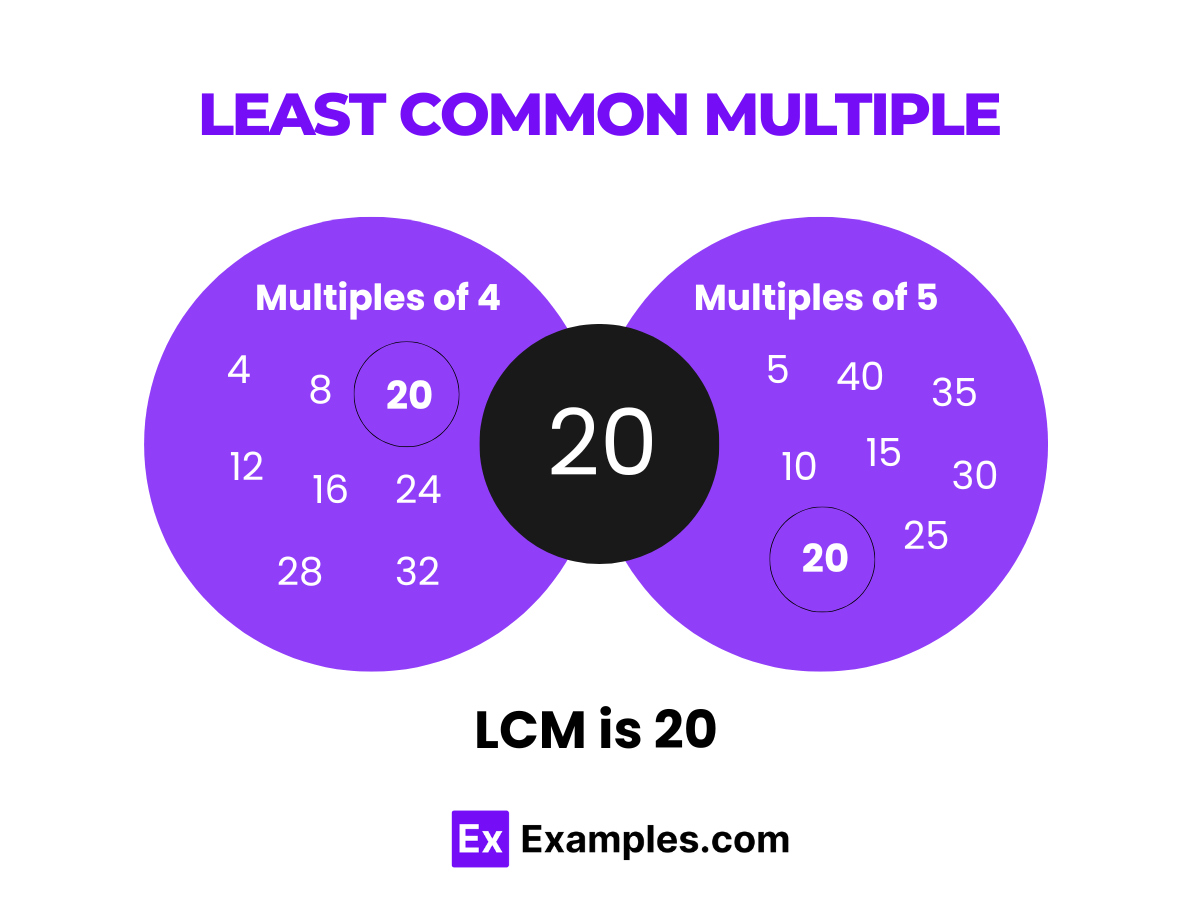
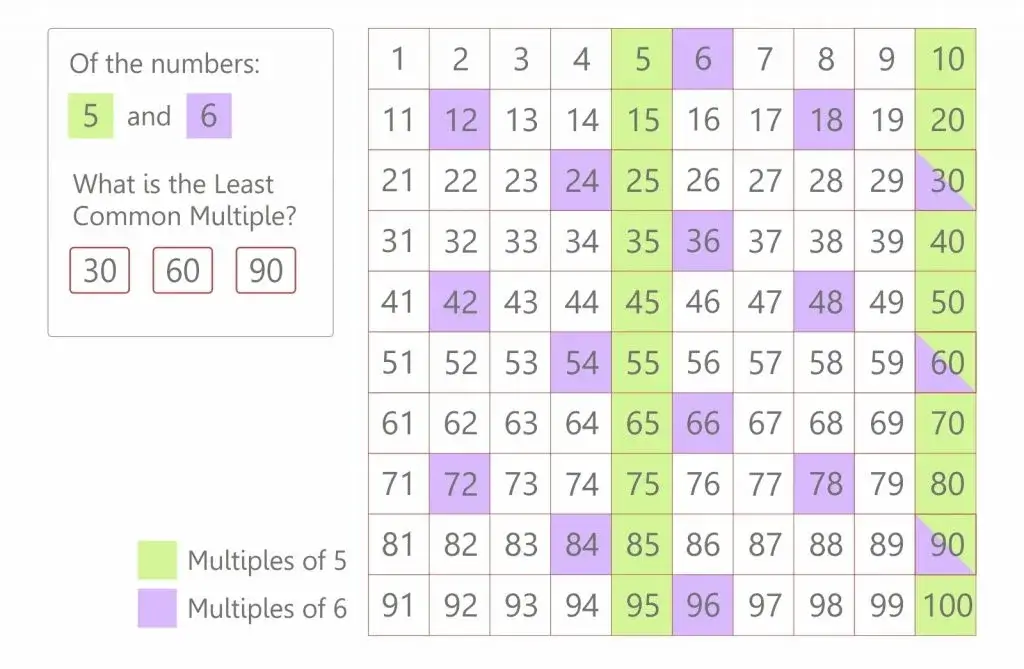
One way to find the LCM is to list out the multiples of each number. Multiples are what you get when you multiply a number by 1, 2, 3, and so on. It's like creating a multiplication table on the spot.
For 20, the multiples are: 20, 40, 60, 80, and so on. For 5, they are: 5, 10, 15, 20, 25, and so on. See anything interesting?
Aha! 20 appears in both lists. That makes it a common multiple. It means both 20 and 5 can happily divide into 20 without leaving any crumbs behind.
Finding the "Least"
Now, we need to make sure it’s the least common multiple. That means there isn't a smaller number that both 20 and 5 can divide into. It's all about finding the smallest possible meeting point.
Looking at the multiples, is there a number smaller than 20 that appears in both lists? Nope! 5 goes into 20, 10 does not go into 20 evenly, 15 does not go into 20 evenly. Therefore, the least number that both numbers go into is 20.
So, drumroll please… the LCM of 20 and 5 is 20! Wasn't that exciting? (Okay, maybe mildly interesting, but still!).
The Prime Factorization Party
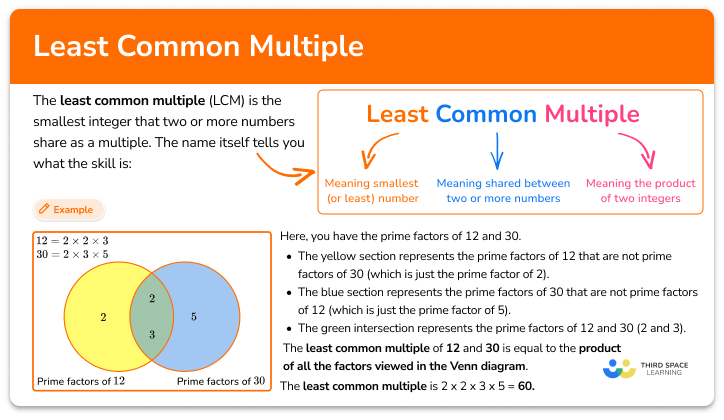
There's another, perhaps even cooler, way to find the LCM. It involves prime factorization. Think of it as breaking down a number into its prime number building blocks.
Prime numbers are those special numbers that can only be divided by 1 and themselves. Examples include 2, 3, 5, 7, 11, and so on. They're the VIPs of the number world.
Deconstructing 20
Let’s break down 20 into its prime factors. 20 can be divided by 2, giving us 10. Then, 10 can be divided by 2, giving us 5. 5 is a prime number!
So, the prime factorization of 20 is 2 x 2 x 5, or 22 x 5. We've successfully disassembled 20 into its prime components!
Deconstructing 5
Now let's tackle 5. Well, 5 is already a prime number! So, its prime factorization is simply 5. Easy peasy!
Putting the Pieces Back Together
Here's where the magic happens. To find the LCM, we need to take the highest power of each prime factor that appears in either factorization.
We have 22 from the factorization of 20 and 5 from the factorization of 5. So, the LCM is 22 x 5, which is 4 x 5 = 20.

Ta-da! We arrived at the same answer using a different method. It's like finding the same treasure using two different maps!
Why Bother with the LCM?
Okay, you might be thinking, "Why do I even need to know this LCM stuff?" Good question! The LCM is actually quite useful in various real-life situations.
Think about baking. If one recipe calls for 20 grams of sugar and another calls for 5 grams, the LCM can help you figure out how to adjust the recipes to make a larger batch.
It's also used in scheduling problems. Imagine you have two buses that leave a station at different intervals. The LCM can help you determine when they'll both be at the station at the same time.
LCM: More Than Just a Number
The LCM isn't just a random number. It's a tool that can help us solve problems and understand the relationships between numbers. It can be applied to all sorts of scheduling issues!
It's about finding common ground, syncing schedules, and making things work together. It is like finding the sweet spot to ensure perfect coordination.
So, the next time you encounter a situation where you need to find a common multiple, remember the LCM. It might just save the day!
LCM in Action: A Real-World Example
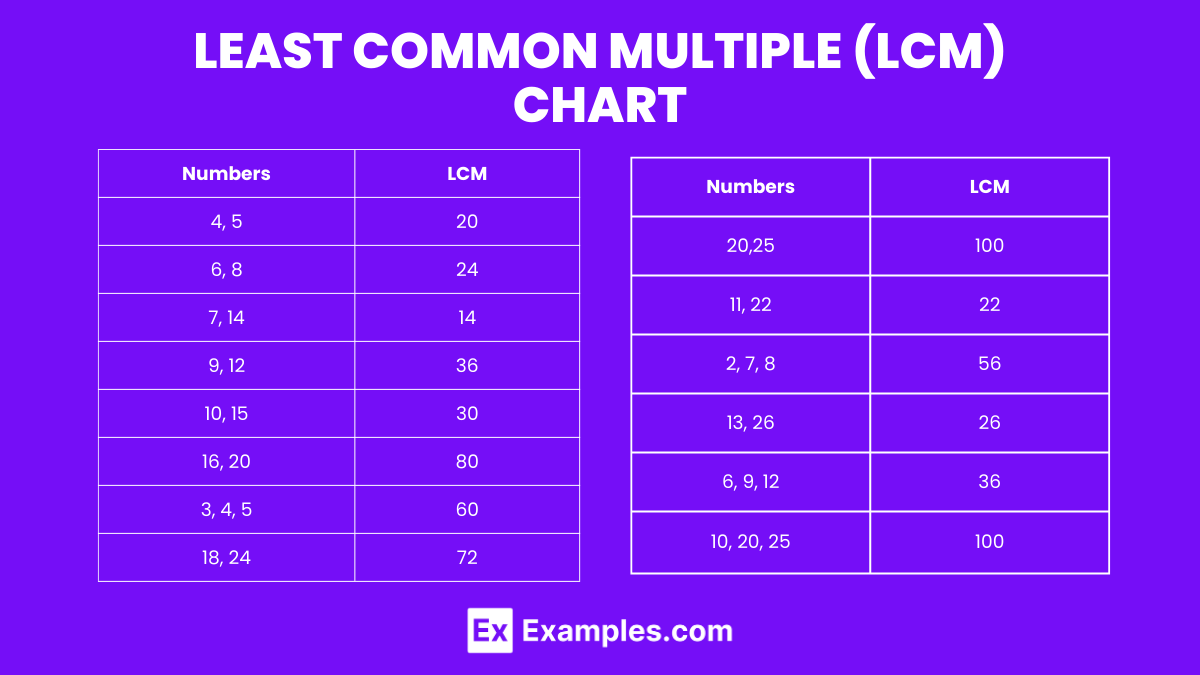
Let's say you have two tasks. Task A needs to be done every 20 days, and Task B needs to be done every 5 days. When will both tasks need to be done on the same day again?
You guessed it! We need to find the LCM of 20 and 5. We already know it's 20. This means that every 20 days, both tasks will need to be completed on the same day.
See? The LCM is practical and can help you organize your life (or at least your to-do list)! It's like having a secret weapon for scheduling efficiency.
LCM vs. GCF: A Dynamic Duo
The LCM often hangs out with its buddy, the Greatest Common Factor (GCF). While the LCM is about finding the smallest common multiple, the GCF is about finding the largest common factor.
Factors are numbers that divide evenly into a given number. For example, the factors of 20 are 1, 2, 4, 5, 10, and 20. The factors of 5 are 1 and 5.
The GCF of 20 and 5 is 5, because 5 is the largest number that divides evenly into both 20 and 5. The LCM and GCF are two sides of the same mathematical coin!
Keep Exploring!
The world of numbers is full of fascinating concepts like the LCM and GCF. There is a lot more where this comes from! The possibilities are endless.
Don't be afraid to explore and experiment. Play with numbers, solve puzzles, and challenge yourself. You might just discover a hidden talent for mathematics!
Who knows, maybe you'll even become the next math whiz! Keep your thinking cap on and your curiosity ignited!
The Final Verdict
So, to recap, the Least Common Multiple of 20 and 5 is 20. We explored two different methods to find it: listing multiples and prime factorization.
We also discussed why the LCM is useful and how it relates to the GCF. And you're now one step closer to math mastery!
Now go forth and conquer the world of numbers! The LCM awaits your mathematical prowess!
One Last Thought
Remember, math isn't just about memorizing formulas. It's about understanding concepts and applying them to solve problems. The LCM is a great example of this.
It's a tool that can help us make sense of the world around us. And that's something to celebrate! Maybe with a perfectly divided pizza slice...
So, embrace the LCM, embrace math, and embrace the joy of learning! Happy calculating!