
What Is The Distance Light Travels In One Year
Okay, picture this: I'm staring up at the night sky, trying to impress my date with my (limited) knowledge of astronomy. I point to a fuzzy patch and confidently declare, "That, my dear, is probably light that's been traveling for, like, a really long time." She raises an eyebrow. "How long is 'really long'?" I mumbled something about billions of miles and quickly changed the subject. Mortifying, right? But it got me thinking... how do we even measure these vast, cosmic distances?
Turns out, "really long" needs a unit of measurement. And that unit, my friends, is the light-year. So, what is it?
The Light-Year: More Than Just a Catchy Name
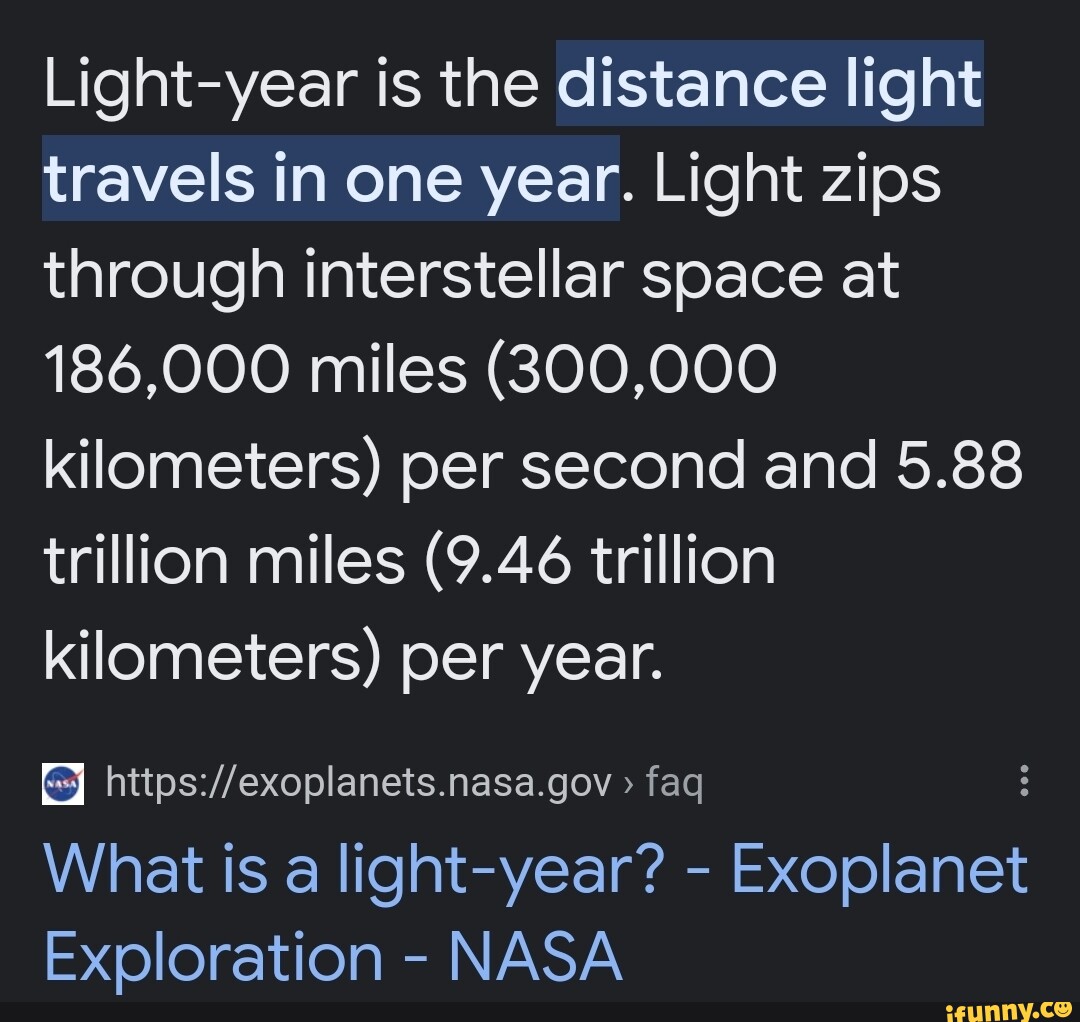
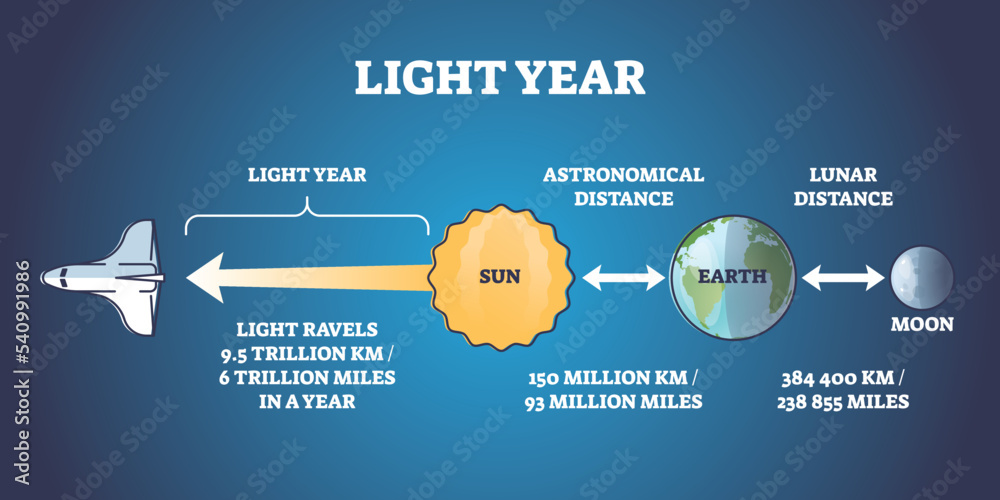
A light-year isn't a measure of time (despite the "year" part), but rather a measure of distance. It’s the distance light travels in one Earth year. Seems simple enough, right? But brace yourselves, because we’re about to dive into some seriously big numbers.
Must Read
Now, light is fast. Really fast. Like, annoyingly fast when you're trying to download a large file. Its speed in a vacuum is approximately 299,792,458 meters per second. Let that sink in. Think about how long it takes you to blink. Light could have circled the Earth like, seven times in that blink.
So, if light is hurtling through space at that speed for an entire year, you can imagine it covers a considerable amount of ground (or, you know, vacuum).
Let’s break it down, shall we?
- Seconds in a year: Roughly 31,536,000 (that's 60 seconds x 60 minutes x 24 hours x 365.25 days - leap years, gotta love 'em!)
- Meters in a light-year: Multiply the speed of light by the number of seconds in a year! So, 299,792,458 meters/second * 31,536,000 seconds = a truly staggering 9,460,730,472,580,800 meters.
Yeah, good luck saying that number out loud. We usually round it to about 9.461 x 10¹⁵ meters. Or, if you prefer, roughly 9.461 trillion kilometers or about 5.879 trillion miles. Woah.
That's one light-year. Just imagine all the things that are multiple light-years away! It’s mind-boggling.

Why Use Light-Years? Because Kilometers Are Just Too Clumsy
Imagine trying to describe the distance to the nearest star, Proxima Centauri, using kilometers. It's about 40,208,000,000,000 km away. See? Your eyes are already glazing over. It's just too cumbersome. Using light-years, we can say it's about 4.24 light-years away. Much easier to digest, right?
Light-years are the preferred unit for measuring interstellar distances. They help astronomers deal with the vastness of space without having to write down ridiculously long numbers. (Think of it as the astronomy equivalent of switching from inches to miles when describing a road trip.)
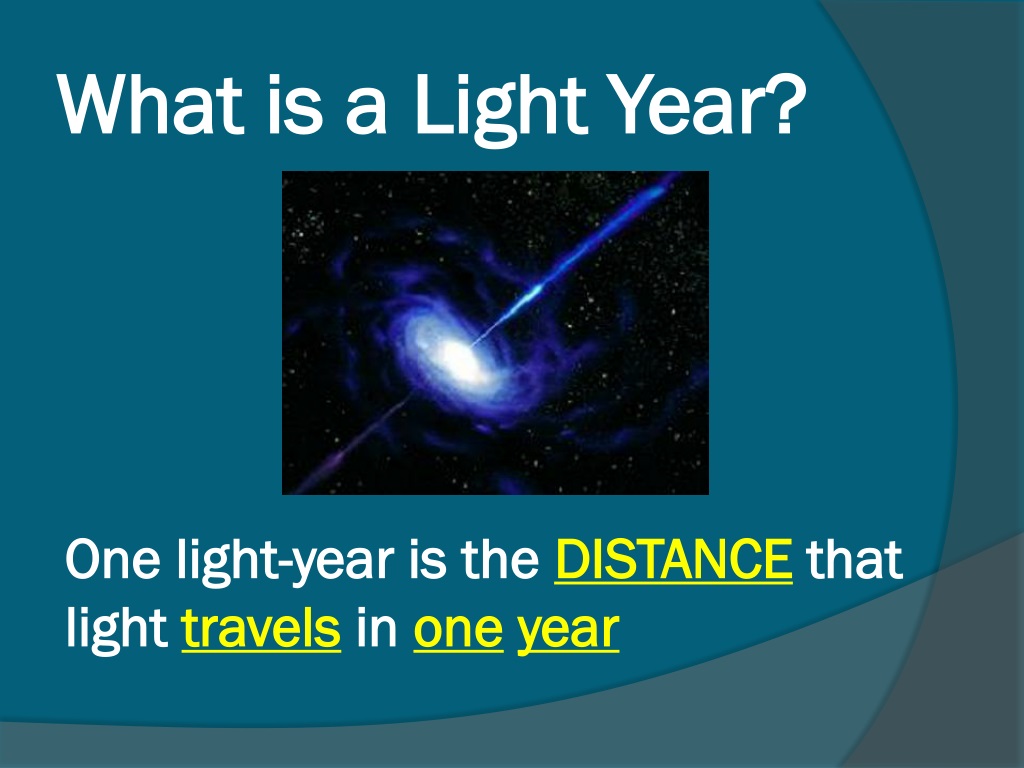
Think about it this way: the universe is so immense that even light, the fastest thing we know of, takes years to travel between stars. That fuzzy patch I pointed out on my date? The light from that galaxy may have started its journey millions, even billions, of years ago. By the time we see it, the galaxy itself might have changed significantly, or even ceased to exist! It’s a wild thought, isn’t it?
So Next Time...
Next time you're gazing at the stars, remember that you're looking back in time. And when someone asks you how far away something is, you can confidently say, "Oh, just a few light-years, nothing to worry about." (Just maybe don’t quote the exact number unless you want to scare them off!).
The universe is an enormous place, and the light-year is our way of wrapping our heads around its sheer scale. Now, if you'll excuse me, I'm going to go practice saying "9.461 trillion kilometers" so I can impress someone with my knowledge of astronomy... eventually.
