
What Is The Difference Between Rate And Unit Rate

Ever feel like numbers are conspiring against you? Like they're whispering secrets in a language you almost understand? Well, fear not, my friend! Today, we're cracking the code on two sneaky number ninjas: rate and unit rate.
Rate: The Relationship Rockstar
Think of a rate as a relationship status between two different things. It's like saying, "Hey, thing A and thing B are connected!" For example, you might say, "I drove 120 miles in 2 hours."
That's a rate! It's showing the relationship between distance (miles) and time (hours). It's a power couple, folks!
Must Read
Imagine you're baking cookies for a HUGE party. Your recipe says, "For every 3 cups of flour, add 1 cup of sugar." That's your rate right there! Flour and sugar are hanging out, doing their cookie thing together.
Rates in Disguise: Keep an Eye Out!
Rates can show up in all sorts of places. A store might advertise, "3 t-shirts for $20!" That's a rate between the number of t-shirts and the cost. Sneaky, right?
Or maybe you're comparing internet plans. One plan offers "100 GB of data for $50." Yep, another rate! Data and dollars, a match made in... the internet!
Rates are everywhere once you start looking. They're the unsung heroes of our numerical lives.
Unit Rate: The Simplified Superstar
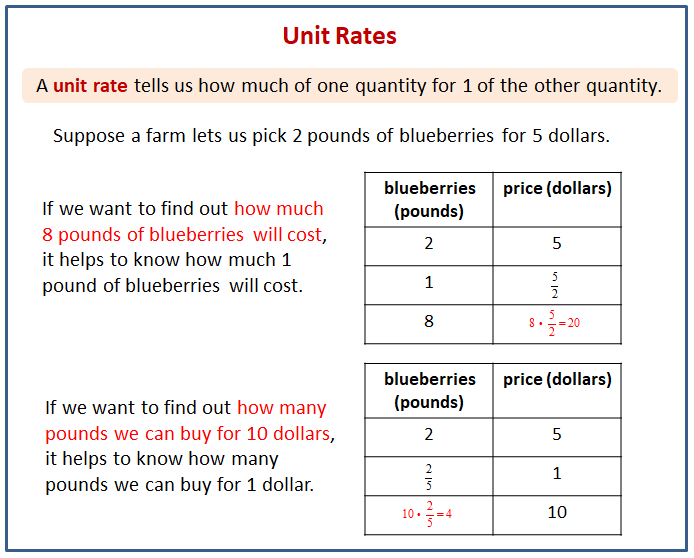
Now, let's talk about unit rate. This is where things get really exciting (I promise!). Unit rate is like a rate that's been put through a simplifying machine. It tells you the amount of one thing per one unit of another thing.
Remember our driving example? 120 miles in 2 hours? To find the unit rate, we want to know how many miles we drove in one hour. We divide 120 miles by 2 hours, and... BOOM! 60 miles per hour!
60 miles per hour is the unit rate. It's the amount of miles traveled for each hour of driving. It's the ultimate in driving data clarity!
Unit Rates: Making Comparisons a Breeze
Unit rates are super helpful when you're trying to compare different options. Let's say you're shopping for cereal (a very important task, indeed!).
Box A costs $4 for 20 ounces, and Box B costs $5 for 25 ounces. Which one is the better deal? Don't panic!
Let's find the unit rate for each. Box A: $4 / 20 ounces = $0.20 per ounce. Box B: $5 / 25 ounces = $0.20 per ounce. In this case, both boxes are the same price!
Now you can confidently choose your cereal, armed with the power of unit rates!
Unit rates put everything on a level playing field. They make comparing prices, speeds, and efficiency so much easier.
Unit Rate is about ONE
The key to remembering unit rates is the word "unit." We always want to know the amount for one unit of something.
Think of it like this: "How much does it cost for one apple?" Or, "How many words can I type in one minute?" Or even, "How many belly laughs can I have per one joke?"

It's all about that single, solitary unit! Once you find it, you're golden.
Rate vs. Unit Rate: The Showdown!
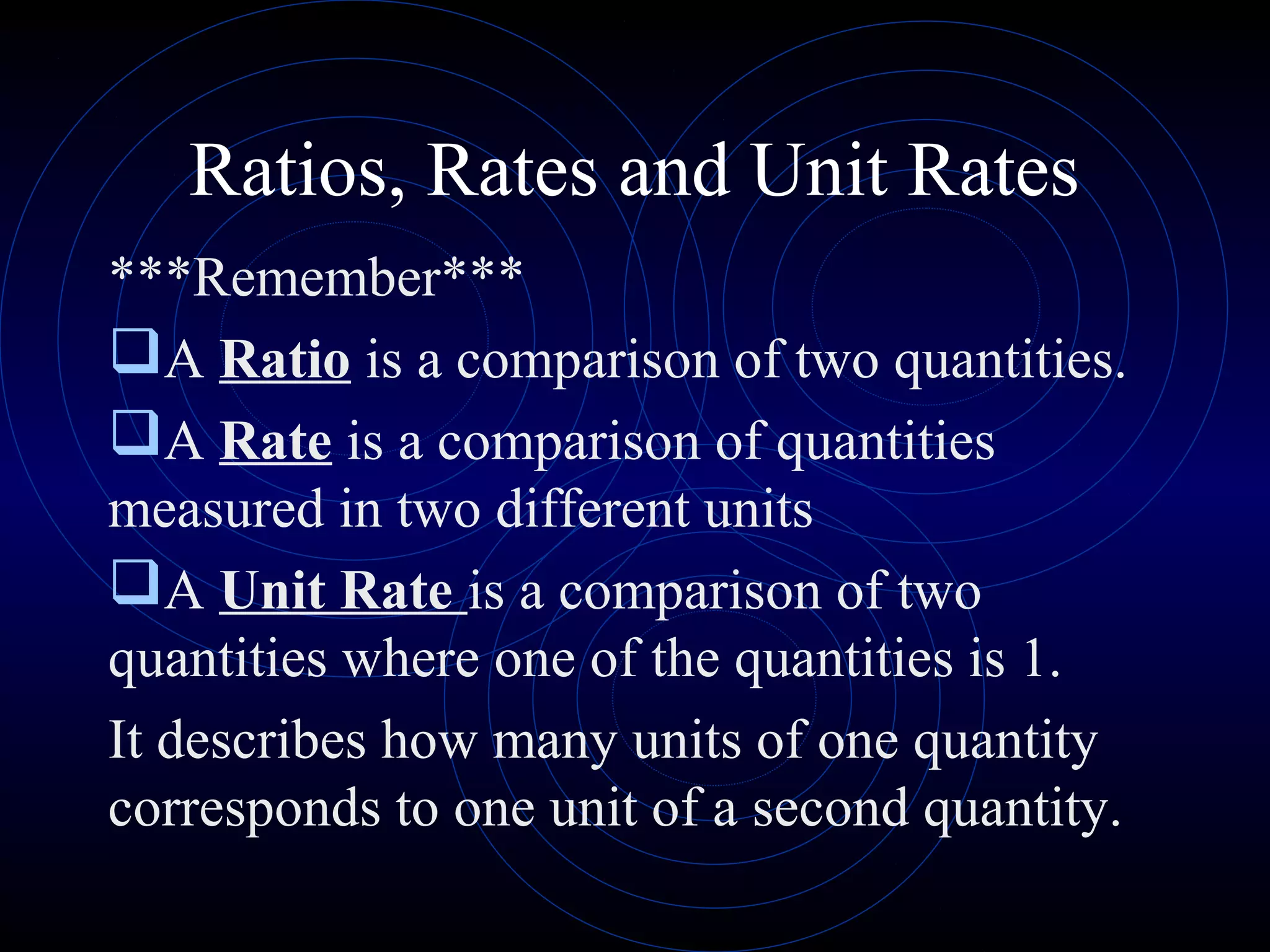
So, what's the big difference between a rate and a unit rate? A rate simply shows the relationship between two things. A unit rate simplifies that relationship to show the amount of one thing per one unit of another thing.
Think of a rate as a general overview. It's like saying, "These two things are related, but I'm not getting into specifics."
A unit rate, on the other hand, is like a super-focused close-up. It zooms in on the relationship to give you the most precise information possible.
Rate: 5 dogs eat 20 treats. Unit Rate: 1 dog eats 4 treats. Do you see how the unit rate simplifies everything?
Real-World Rate & Unit Rate Examples
Let's look at some more real-world examples to solidify our understanding:
Rate: A printer prints 30 pages in 3 minutes. This tells us the relationship between pages and time.

Unit Rate: The printer prints 10 pages per minute. This tells us exactly how many pages are printed in one minute.
Rate: You earn $50 for working 5 hours. This shows the connection between earnings and hours worked.
Unit Rate: You earn $10 per hour. This tells you your earnings for one hour of work (your hourly wage!).
Rate: A car travels 300 miles on 10 gallons of gas. This links the distance traveled and the amount of gas used.
Unit Rate: The car gets 30 miles per gallon. This tells you how many miles the car can travel on one gallon of gas (fuel efficiency!).
Why Should I Care?
Okay, okay, I hear you. Why should you even bother with rates and unit rates? Because they are incredibly useful in everyday life! Knowing how to calculate and use them can save you time, money, and a whole lot of frustration.
Think about comparing prices at the grocery store. Unit rates help you determine which product is the best deal, regardless of the package size.
Or consider planning a road trip. Knowing your car's gas mileage (a unit rate!) allows you to estimate how much gas you'll need and how much it will cost.
Even something as simple as cooking requires an understanding of rates and unit rates. If you need to double a recipe, you're essentially using rates to adjust the ingredient amounts.
Rates and unit rates are the secret weapons of smart decision-making. Master them, and you'll become a financial ninja, a comparison connoisseur, and a generally more awesome human being.
Wrapping it Up: Embrace the Rates!
So, there you have it! The difference between rate and unit rate, demystified and delivered with a healthy dose of enthusiasm.
Remember, a rate is simply a relationship between two things, while a unit rate is that relationship simplified to show the amount per one unit.
Don't be afraid to embrace the rates! They're your friends, not your enemies. With a little practice, you'll be spotting them everywhere and using them to make smarter, more informed decisions. Go forth and conquer the numerical world!
Now, go forth and calculate! May your rates be ever in your favor!