
What Is The Density Of Nickel

Hey there, friend! Pull up a chair, grab a mug. Ever have one of those random, 'hmm, I wonder...' thoughts pop into your head? Like, what's the deal with everyday stuff? Today, my brain decided to chew on nickel. Specifically, its density. Sounds a bit science-y, I know, but stick with me – it's actually pretty fun!
First, A Quick Density Chit-Chat
So, density. What even is that, right? Forget the textbooks for a sec. Think of it like this: how much 'stuff' is packed into a certain amount of space. Imagine two identical-looking boxes. One is full of feathers, the other is full of bricks. Which one is heavier? The bricks, obviously! That's because bricks are denser than feathers. More mass, squished into the same volume. Simple as that!
It's all about how tightly those atoms are spooning each other, you know? Are they spread out and chill, or are they having a massive, shoulder-to-shoulder party in there?
Must Read
And The Nickel Reveal Is...
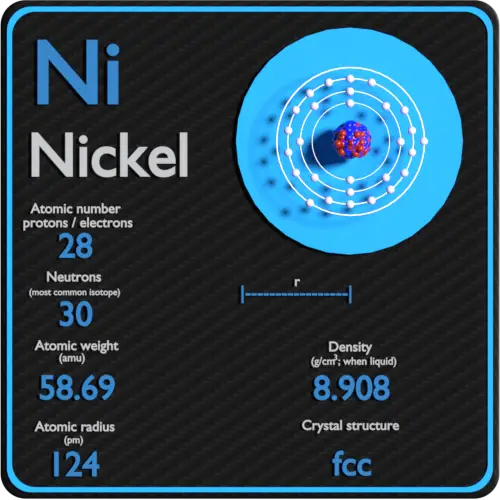
Alright, drumroll please! Our buddy nickel, that silvery-white metal we often forget about (but use all the time), clocks in with a density of about 8.9 grams per cubic centimeter. Or, if you prefer the big-kid numbers, that's 8,900 kilograms per cubic meter. Sounds a bit abstract, doesn't it? So, let's put it into perspective, shall we?
Is that heavy? Light? What does 8.9 even mean in the grand scheme of things? Good questions! Let's bring in some friends for comparison. Because that's how we figure out if something's a lightweight champ or a bona fide bruiser, right?

Nickel vs. The Metal Squad
Let's line 'em up! First up, the featherweight of the bunch, aluminum. You know aluminum, that super light stuff from soda cans and airplane parts? Its density is a mere 2.7 g/cm³. So, nickel is like, three times heavier than aluminum for the same chunk of material! Pretty wild, huh? If you picked up an aluminum sphere and a nickel sphere of the same size, the nickel one would make you go, "Whoa!"
Next, let's compare it to a real workhorse: iron. Iron, the backbone of buildings and engine blocks, comes in at about 7.8 g/cm³. Guess what? Nickel is actually denser than iron! Yeah, you heard that right. Our unassuming little nickel is a heavyweight contender, out-densitying one of the most common heavy metals out there. Who knew?
So, if you thought iron was beefy, nickel just politely flexed its metallic bicep and said, "Hold my beer."
But let's not get too carried away. It's not the ultimate champion. Take lead, for example. That stuff is dense, weighing in at around 11.3 g/cm³. And then there's the undisputed queen of density (among common metals, anyway): gold. Gold sits at a staggering 19.3 g/cm³. Now that's a metal that feels substantial! So, nickel isn't quite in the "makes your hand ache" league of lead or gold, but it's definitely holding its own on the heavier side of the spectrum. It's got a satisfying heft, for sure.

Why Does This Even Matter, Anyway?
Good question! Why do we care about nickel's atomic cuddle puddle? Well, density matters for everything! If you're designing a coin, you want it to feel substantial, right? Not like some flimsy piece of plastic. Nickel's density gives coins that nice, reassuring heft. Think about a two-euro coin, or a Canadian nickel – feels good in your hand, doesn't it? That's thanks, in part, to its density. It contributes to that feeling of value and durability.
It also plays a role in its other jobs. Nickel is often used in alloys (fancy mixtures with other metals) to make them stronger and more resistant to corrosion. Its density contributes to the overall characteristics of these super-materials. From jet engines to guitar strings, that specific density adds to the metal's personality and performance.

Nickel's Other Cool Traits (Besides Being Chunky)
Beyond its impressive density, nickel is also super corrosion resistant. Meaning it doesn't rust easily, which is a huge plus! It's also pretty tough and has a lovely bright, silvery look. Combine that with its significant density, and you've got a seriously versatile and useful metal, don't you think?
It's in your phone batteries, in some kitchen utensils, in jewelry, and of course, in coins. This dense, durable, and good-looking metal is quietly doing a lot of heavy lifting (pun intended!) in our everyday lives.
So, There You Have It!
Next time you're fiddling with a coin, or maybe just pondering the mysteries of the universe over your coffee, give a little nod to nickel and its delightful density. It's not just a number; it's what gives nickel its distinctive feel and makes it so useful in countless applications. Pretty cool for something we often take for granted, right? Now, about that second cup...