
What Is Proportional Limit In Stress Strain Curve
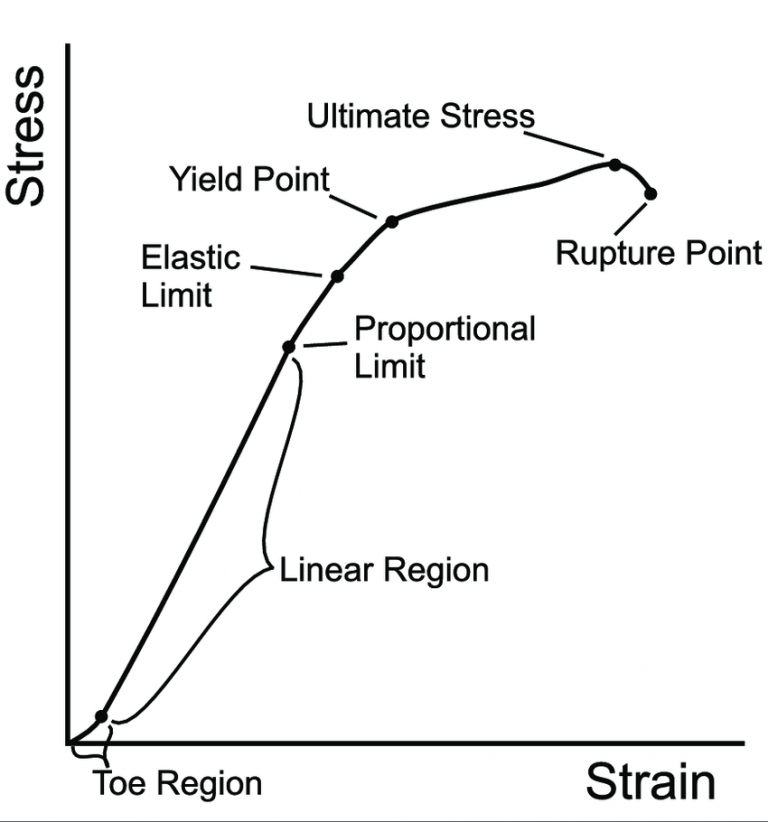
Ever stretched a rubber band a little too far? We've all been there. That feeling when you suspect it might not bounce back the same? Well, materials have their own versions of that rubber band moment. It all boils down to something engineers call a "stress-strain curve." Sounds intimidating, right?
The Stress-Strain Curve: A Relatable Analogy
Imagine you're trying to make a new friend. You start with light conversation, right? You ask about the weather, hobbies, favorite flavor of ice cream. It’s easy. The other person is relaxed and responds normally.
This is like applying a small amount of stress to a material. The material strains a little, stretches or deforms, but it's cool. When you stop applying that stress, it goes right back to its original shape.
Must Read
Now, imagine you start asking about their deepest, darkest secrets on the first meeting. Awkward! They might recoil, get defensive, or worse... ghost you! That is permanent deformation.
Entering the Proportional Limit Zone
This is where the proportional limit comes in. Think of it as the point where your "friendly" questioning is still going smoothly. A perfectly linear relationship. No weird vibes yet.
Beyond the proportional limit, things get less predictable. The amount of strain (deformation) is no longer directly proportional to the amount of stress you apply. It’s like you’re asking tougher questions, and the answers are getting less and less straightforward. The friendship is starting to feel… strained. Get it? Strained!
In technical terms, the proportional limit is the maximum stress a material can withstand while maintaining a linear relationship between stress and strain. Simple as that!

Hooke's Law: The Proportionality Protector
You might have heard of something called Hooke's Law. This law basically says that stress is proportional to strain. The proportional limit is the point up to which Hooke's Law holds true.
Think of Hooke's Law as the golden rule of material behavior. As long as you stay within the proportional limit, you can reliably predict how the material will behave under stress. Once you cross that line, all bets are off.
It's like having a guaranteed recipe for a perfect cake. Follow the recipe (stay within Hooke's Law), and you'll get a predictable, delicious result. Deviate from the recipe (exceed the proportional limit), and you might end up with a pancake-shaped disaster. We've all been there.
The Elastic Limit: A Close Cousin
Now, here’s where things get a tiny bit more confusing. There's also something called the elastic limit. This is VERY close to the proportional limit.

The elastic limit is the maximum stress a material can withstand and still return to its original shape when the stress is removed. Basically, no permanent damage.
In many materials, the proportional limit and the elastic limit are so close together they're practically the same. For all practical purposes, they’re twins. But technically, the elastic limit can be a smidge higher.
Why Does the Proportional Limit Matter?
So, why should you care about this obscure point on a stress-strain curve? Well, if you're an engineer designing bridges, buildings, or anything else that needs to be strong and reliable, it's pretty darn important.
Staying within the proportional limit ensures that your structure behaves predictably and safely. You don't want your bridge to start deforming permanently every time a car drives across it, right? Right.
Imagine building a house with LEGOs. If you push down on the roof just a little, it bends, but pops right back. That's below the proportional limit. Push too hard, and the roof stays bent. You've exceeded it.

My Unpopular Opinion: Overthinking the Proportional Limit
Okay, here’s my unpopular opinion. While theoretically important, focusing solely on the proportional limit can sometimes be overkill. Especially in real-world applications.
In many cases, engineers are more concerned with the yield strength, which is the point where the material starts to deform permanently. Or even the ultimate tensile strength, which is the point where it breaks completely.
It's like focusing on whether your friend slightly raised an eyebrow during your awkward question, instead of noticing they haven't blocked your number yet. Perspective, people!
Beyond the Curve: Real-World Considerations
The stress-strain curve is a simplified model of material behavior. In reality, things are much more complex. Temperature, loading rate, and material defects can all affect how a material behaves.

Think of baking a cake in a different oven, or at a higher altitude. The recipe might need adjustments. The same goes for material properties.
So, while understanding the proportional limit is a good starting point, it's important to consider all the factors that can influence material behavior in the real world. Context matters!
The Proportional Limit: A Stepping Stone to Material Mastery
Ultimately, the proportional limit is a fundamental concept in material science and engineering. It helps us understand how materials behave under stress and how to design structures that are safe and reliable.
It's like learning the alphabet before you can write a novel. You gotta start somewhere!
So, the next time you're stretching a rubber band, or building a LEGO castle, remember the proportional limit. It might just save you from a structural disaster (or at least a broken rubber band). And remember, sometimes it's okay to ask slightly awkward questions, just don't push it too far.