
What Is Peak To Peak Voltage
So, you know how sometimes you're just sitting there, sipping your ridiculously overpriced latte, and your brain starts to wander into the truly wild corners of the universe? Like, "What really makes my phone charge without spontaneously combusting?" Or, "How come my toaster always seems so… enthusiastic?"
Well, grab another croissant, because today we're diving into something called Peak to Peak Voltage, and trust me, it’s less terrifying than it sounds, and arguably more fun than explaining your tax returns to a badger.
First, a Quick, Painless Peek at Voltage!
Before we go peak-diving, let’s quickly understand plain old voltage. Think of electricity not as tiny invisible pixies, but as a bunch of really enthusiastic, slightly manic surfers. Voltage? That’s the energy they’ve got, the sheer "oomph" behind their wave. High voltage? Big, scary wave. Low voltage? More like a puddle after a light drizzle.
Must Read
It's the electrical "pressure" that pushes electrons around. Like water pressure in a hose. More pressure, stronger squirt. More voltage, stronger electrical push.
The Rollercoaster of Electricity: Alternating Current
Now, most of the electricity waltzing into your home isn't a steady, calm river. Oh no. It’s an alternating current (AC), which means it’s doing a wild, undulating dance. It goes up, it goes down, it hits highs, it hits lows, like my emotional state before I've had my morning coffee.

This dance is usually a smooth, curvy waveform. Imagine drawing a wavy line repeatedly – that's our AC signal. It’s constantly changing direction and magnitude.
Hitting the "Peak"
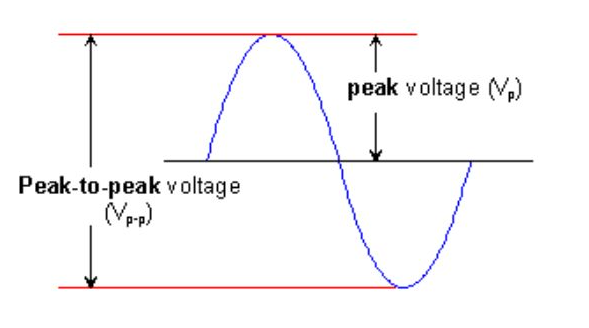
When that enthusiastic electricity hits its absolute highest point in its little dance routine – that’s its peak voltage. Imagine our surfer riding the absolute crest of the tallest wave he can find. He’s yelling "Wahoo!" That's the maximum positive intensity it reaches.
But here’s the kicker! Because it’s alternating current, it doesn’t just go up and then calm down. Oh no, it swings wildly in the other direction too! It goes negative!
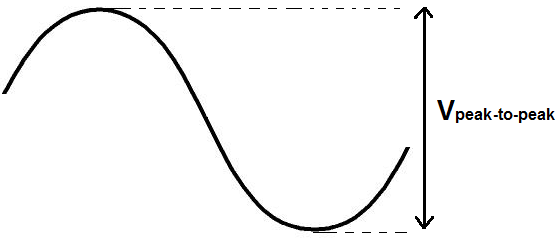
Yes, electricity can have a "negative" value, meaning it's flowing the other way. Like a dramatic teenager, it hits a high, then immediately plummets to a low, eventually hitting its most negative point. This is also a "peak," but on the opposite side of the zero line.
Behold! Peak-to-Peak Voltage!
So, we have a positive peak (the tippy-top of the wave) and a negative peak (the very bottom of the wave, like a trench in the ocean floor). Peak-to-peak voltage is simply measuring the entire dramatic swing from the highest positive point to the lowest negative point.

Picture a massive, terrifying rollercoaster. You climb all the way to the very top – that’s your positive peak. Then you plunge into the deepest, darkest valley, below the starting point – that’s your negative peak. Peak-to-peak voltage is the total height difference from the tippity-top of that first hill to the rock-bottom of the valley. It’s the full vertical height of the ride, not just how high you went above the ground.
If your rollercoaster went 100 feet above ground, and then 100 feet below ground, its peak-to-peak "height" would be 200 feet! Mind blown, right?
So, while your home wall outlet might be described as "120 Volts AC," that's usually its RMS voltage (Root Mean Square – a fancy average). Its actual peak voltage is closer to 170V, and therefore its peak-to-peak voltage is around a whopping 340V! Your tiny toaster is dealing with some serious electrical gymnastics!

Why Do We Even Care About This Electrical Drama?
Good question! Why do engineers obsess over this full dramatic swing? Well, because some gadgets are like delicate soufflés; they can only handle so much drama. Knowing the peak-to-peak voltage helps them design things that don't, you know, spontaneously combust, or give off sparks that look suspiciously like tiny firework displays.
- It’s crucial for determining the maximum stress an electronic component will experience. If a capacitor is rated for 200V, an AC signal with a peak-to-peak voltage of 300V is definitely going to cause it to throw a tantrum (and potentially explode).
- It helps us understand the true strength of a signal, especially when dealing with audio or radio waves. A stronger peak-to-peak means a louder sound or a clearer radio signal. It's the full dynamic range!
- Surprisingly, in some DC (direct current) power supplies, engineers might look at peak-to-peak ripple voltage – how much the "steady" DC signal wiggles and deviates. Nobody likes a wobbly power supply.
So, the next time you plug in your phone, or flick on a light switch, just remember the silent, incredible electrical rollercoaster happening behind the scenes. Those electrons aren't just chilling; they're on a wild ride from one peak to another, and understanding that full dramatic swing is what keeps our gadgets humming safely. And probably makes engineers sleep a little better at night.
You’re now officially smarter about electricity than, well, most people. Go forth and amaze your friends with your newfound peak-to-peak prowess! Another coffee, perhaps?