What Is Kw Equal To In Chemistry

Have you ever paused to think about something as seemingly simple as water? We drink it, swim in it, and rely on it for life. But beneath its calm surface, water is a surprisingly dynamic chemical compound. It’s not just H2O molecules quietly going about their business; sometimes, they're breaking apart and rejoining in a fascinating dance. Understanding this hidden world of water's self-ionization is not only a cornerstone of chemistry but also genuinely fun, because it helps us make sense of everything from why lemon juice is sour to how our bodies keep blood pH just right. And at the heart of this understanding is a neat little constant known as Kw.
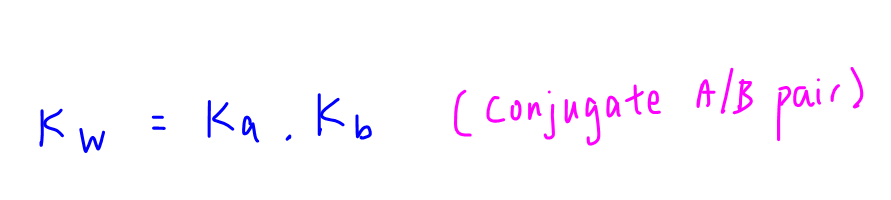
So, what exactly is Kw? In the simplest terms, it stands for the ion product constant for water. It quantifies the extent to which water molecules break apart into hydrogen ions (H+, often written as H3O+ in water) and hydroxide ions (OH-). This process, called autoionization or self-ionization, is happening all the time, even in pure water. The constant Kw tells us the equilibrium relationship between these two ions: [H+][OH-] = Kw. At a standard temperature of 25°C, Kw is consistently 1.0 x 10⁻¹⁴. This seemingly tiny number is incredibly powerful! Its main benefit is that if you know the concentration of one of these ions (H+ or OH-), you can immediately calculate the other, giving you a full picture of water's acidity or basicity.
This constant is more than just a theoretical concept; it's a vital tool with many practical applications. In education, it's fundamental for students learning about acid-base chemistry, helping them calculate pH values for solutions and understand buffer systems that resist changes in pH. But its relevance stretches far beyond the classroom. Think about your everyday life: when you're testing the pH of your swimming pool, you're indirectly using the principles that Kw governs to ensure the water is safe and comfortable. Gardeners and hydroponic enthusiasts rely on understanding pH to optimize nutrient absorption for their plants, an understanding rooted in the balance Kw describes. Even in our own bodies, maintaining a precise blood pH is critical for survival, and the complex buffer systems that achieve this delicate balance are built upon the foundation of water's ionization properties and the Kw value.
Must Read
Ready to explore Kw a little more hands-on? You don't need a fancy lab! A simple way to dive in is by grabbing some pH indicator strips (available online or at a local pharmacy). Test various household liquids like lemon juice, vinegar, baking soda solution, soap, and even plain tap water. Observe how the colors change, indicating their acidity or basicity. While you won't be directly calculating Kw with these strips, you'll be visualizing the H+ and OH- concentrations that Kw links together. For a deeper dive, try looking up some online simulations of acid-base titrations, which often involve using Kw in their calculations. It's a fantastic way to see this little constant in action, shaping our world in countless, often unnoticed, ways.