
What Is Advantage Of Ac Over Dc

Ever plug in your phone, fire up the coffee machine, or just flick a light switch and not give a second thought to the invisible magic making it all happen? Most of us don't! But behind every powered moment in your day is a fascinating story of electricity, specifically the unsung hero that lights up our homes and cities: Alternating Current, or AC. And no, we're not talking about the legendary rock band (though they're pretty electrifying too!).
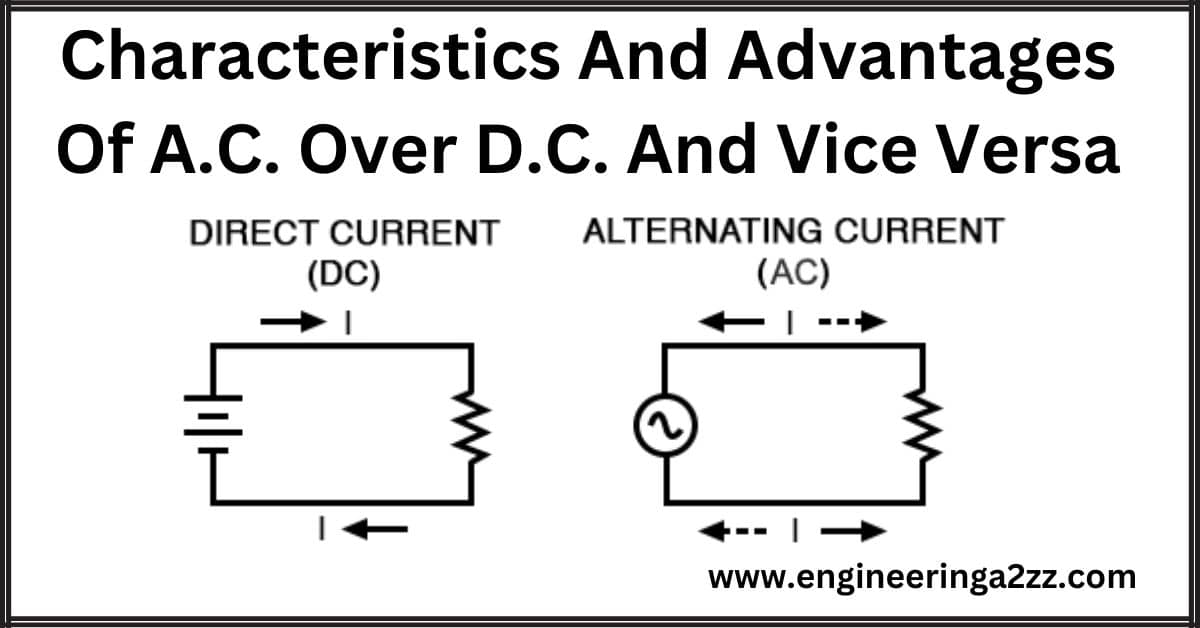
You might have heard of AC and its cousin, DC (Direct Current). While DC gets a lot of love these days because it's what our beloved gadgets run on internally, it's AC that actually brings the juice to your doorstep. So, what's the big deal? Why has AC been the reigning champion of our power grids for well over a century? Let's plug in and find out!
The Power of Long-Distance Travel
Imagine electricity as a busy highway. You need to get a lot of cars (power) from one big city (a power plant) to thousands of smaller towns and homes (your house). If you try to send power over long distances at a low voltage, it's like trying to send all those cars down a narrow dirt track. You'd lose a lot of energy to friction (resistance) along the way, turning it into wasted heat.
Must Read
This is where AC truly shines. With AC, it's incredibly easy to transform voltage. We can crank up the voltage really high for transmission – think of it as turning that dirt track into a super-efficient, multi-lane interstate where cars can zoom along with minimal fuss. High voltage means lower current for the same amount of power, and lower current means significantly less energy loss over vast distances. It's a game-changer for getting power from hydroelectric dams in remote mountains or massive solar farms in the desert all the way to your suburban kitchen.
Transformers: AC's Best Friend
The secret sauce to AC's voltage transformation prowess lies in a simple, yet ingenious device: the transformer. Those unassuming grey boxes on utility poles, or even the small brick on your laptop charger, are all transformers. They use magnetic fields to effortlessly step AC voltage up or down.
With DC, transforming voltage is a much more complex, inefficient, and expensive affair, requiring intricate electronic converters. This fundamental difference was at the heart of the famous "War of the Currents" between Thomas Edison (a proponent of DC) and Nikola Tesla (the champion of AC) in the late 19th century. Tesla and Westinghouse's AC system ultimately won out for large-scale power distribution precisely because of the transformer's elegant simplicity.
Safety & Generation: Built for the Grid
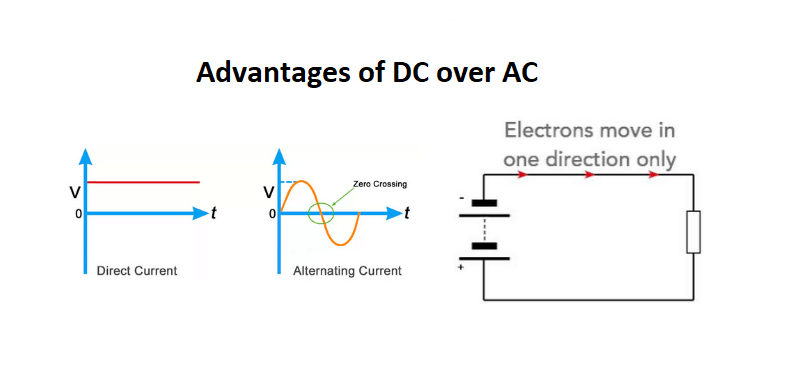
While high voltage AC is certainly dangerous, the ability to easily step it down to a safer, usable level (like 120V or 240V for your home) makes it practical and manageable. Also, AC has a neat trick called "zero crossing." Because it constantly alternates direction, there are tiny moments when the current is actually zero. This makes it easier and safer to interrupt the current with switches and circuit breakers, adding another layer of safety to our electrical systems.
Furthermore, most large-scale power generation, whether from spinning turbines powered by steam, water, or wind, naturally produces AC. The rotating motion of generators inherently creates an alternating electrical output. This means that AC is generated efficiently and can be directly fed into the grid without needing conversion, simplifying the entire power production process.
Where AC Meets DC: The Harmony of Power
So, if AC is so fantastic for the grid, why do our phones, laptops, and LED lights all run on DC? Good question! While AC is perfect for transmission, modern electronic components like microchips prefer the steady, unwavering flow of DC. This is why almost every electronic device you own has an adapter or power supply that takes the AC from your wall socket and converts it into the low-voltage DC that the device needs to operate. It’s a beautiful partnership: AC brings the power efficiently to your home, and then specialized converters tailor it perfectly for your gadgets.
Next time you plug something in, take a moment to appreciate the incredible engineering that delivers that power. From the distant hum of a power plant to the tiny charger brick on your nightstand, AC is the unsung hero, constantly delivering the energy that fuels our modern lives. It’s a testament to ingenuity, quietly working behind the scenes, making our daily routines smoother and our world a little brighter.
![PPT - L 26 Electricity and Magnetism [4] PowerPoint Presentation, free](https://image1.slideserve.com/1596877/advantages-of-ac-over-dc-l.jpg)
