
What Happens When A Gas Turns Into A Liquid
Hey there! Ever wondered what actually happens when a gas chills out (literally) and turns into a liquid? Like, what's the microscopic party all about? Let's dive in – it's way cooler than you think. (Pun totally intended.)
Okay, so imagine a gas. Think of it like a bunch of hyperactive kids at a birthday party. They're bouncing off the walls, running around like crazy, and generally ignoring personal space. These "kids" are the molecules, and their hyperactivity is actually just them zooming around with a lot of energy.
That energy? We call it kinetic energy. Fancy, right? It’s basically the energy of motion. So, these gas molecules have tons of kinetic energy, which is why they spread out and fill whatever space they're in. Ever tried to contain pure chaos? Good luck!
Must Read
Now, what happens when you start turning down the thermostat on that party? (Figuratively, of course. No one actually lowers the thermostat at a birthday party – that's just rude.)
Cooling Things Down: The Big Chill
This is where the magic starts! When you cool a gas, you're essentially slowing those molecules down. Think of it like taking away the sugar rush. They start to lose their kinetic energy – that boundless enthusiasm fades away.
As they slow down, they don't need as much space. They start getting a little...cramped. Is anyone else feeling claustrophobic just thinking about it?
Think of magnets. When they're far apart, they're like, "Meh, whatever." But bring them closer, and BAM! Attraction happens. Gas molecules are the same! As they slow down, those tiny, almost imperceptible attractions between them (we call them intermolecular forces, if you want to sound smart at your next cocktail party) suddenly become a big deal.

These forces are like super glue (but much, much weaker). They start pulling the molecules closer together. It's like the hyperactive kids finally noticing each other and forming little groups, maybe even trying to hold hands (the molecular equivalent, anyway).
From Chaos to...Order? Kind Of
Now, the molecules are packed much more closely together. They're still moving, but they're not bouncing off the walls anymore. They're more like shuffling their feet awkwardly at a middle school dance. It’s not total stillness, mind you; it’s still a party, just a much more subdued one.
This is the liquid state! The molecules are close together, so the liquid has a definite volume (you can pour it!). But they can still move around each other, so the liquid takes the shape of its container (you can pour it into something!). See the difference?
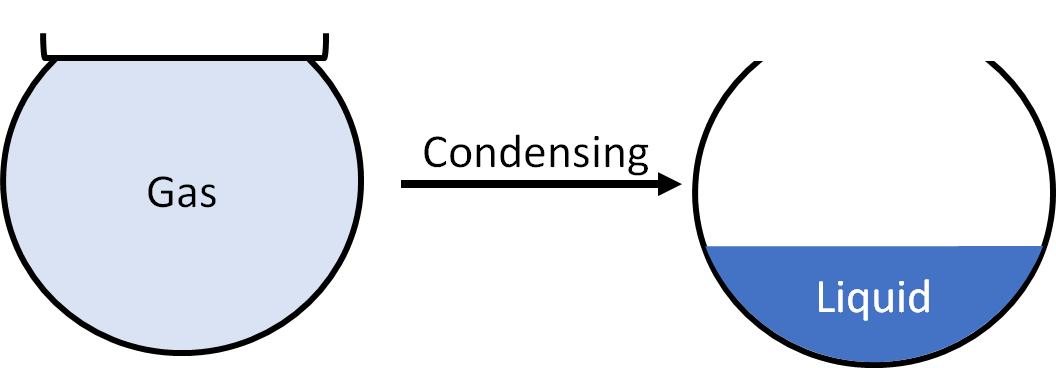
So, to recap: We took a bunch of hyperactive gas molecules, removed some energy (cooled it down), and forced them to get close and personal, thanks to those sneaky intermolecular forces. And boom, liquid! Honestly, who knew science could be so dramatic?
It’s all about the temperature and the pressure, really. Crank up the pressure, and you squish those molecules closer together, encouraging the liquid phase. Lower the temperature, and you slow 'em down, giving those forces a chance to shine. Science at its finest, isn't it?
But Wait, There's More!
Here's a fun fact: different gases need different temperatures to become liquids. Nitrogen, for example, needs to be incredibly cold before it'll turn liquid. Like, colder than your ex's heart. Water, on the other hand, is relatively easy to turn into a liquid, hence all the oceans, lakes, and puddles.
So the next time you see a puddle or pour a glass of water, remember the microscopic molecular dance that's happening. All those tiny particles, slowing down, getting closer, and just generally chilling out (again, pun intended) until they become a liquid.
Pretty cool, right? (Okay, I'll stop with the cold puns now. Maybe.)