
What Does Typ Mean On A Drawing
Ever found yourself staring at a blueprint, a furniture assembly guide, or even just a simple sketch for a home renovation project, and noticed those three unassuming letters: Typ.?
Perhaps you’ve squinted, tilted your head, and wondered, "What in the world does that even mean? Is it a typo? A secret abbreviation I'm not privy to? Am I missing out on some fundamental drawing wisdom?"
Well, dear reader, lean in close, because today we're going to decode this little mystery, and I promise you, it's not only simple but actually quite clever and, dare I say, a little bit fun!
Must Read
The Great Unveiling: What "Typ" Actually Means
Drumroll, please! "Typ" on a drawing is simply shorthand for "Typical."
Yup, that's it! Not some arcane engineering term, not a hidden message from the Illuminati, just good ol' "typical." Feeling a bit underwhelmed? Don't be! The beauty isn't in the word itself, but in the intelligent, time-saving, and clarity-boosting concept behind it.
Think about it for a moment. Why would designers, architects, and engineers bother adding this seemingly obvious note? It's all about efficiency and avoiding visual clutter.
Why "Typical" Is Terrifically Tidy
Imagine you're designing a magnificent treehouse. Your design calls for eight identical bolts to secure the main platform to the tree. Are you going to draw every single bolt with all its detailed dimensions – the thread type, the diameter, the length – eight separate times? Of course not! That would be a chaotic mess, a visual migraine for anyone trying to read your drawing.
Instead, you draw one bolt, add all its specific details, and then you might add a note that says, "Bolt A, Typ. 8 places." Or, even more commonly, you might dimension one of a series of repeating elements and simply add "Typ." to that dimension.
What you're effectively saying is, "Hey, see this one? This one is representative of all the others that look just like it. Apply these dimensions or details to all the similar elements you see on this drawing, unless otherwise specified."
Isn't that brilliantly simple?
How "Typ" Makes Life Easier (and More Fun!)
This tiny three-letter abbreviation is a testament to smart design communication. Here's why it's so great:
-
For the Creator: Saves Time & Sanity!
Imagine trying to draw every single repeating detail. You'd be there for ages! "Typ" lets designers focus on unique elements and critical areas, making their work faster and less prone to repetitive errors. It's like finding a shortcut in a video game for architects! -
For the Reader/Builder: Reduces Confusion & Eyestrain!
When you see "Typ," you immediately understand that you don't need to hunt for individual dimensions for every single identical component. You find one, apply it to the rest, and move on. This streamlines the interpretation process, reduces the likelihood of misreading details, and makes complex drawings far less intimidating. It's your secret decoder ring for clarity! -
For Everyone: Promotes Clarity & Cleanliness!
A drawing riddled with redundant dimensions and notes is messy and hard to read. "Typ" helps keep drawings clean, crisp, and focused on essential information. It’s the minimalist approach to technical documentation, and who doesn't love a clean aesthetic?
Beyond Blueprints: A Broader Life Lesson
While "Typ." originates in the world of technical drawings, the principle behind it has a lovely, subtle parallel in everyday life. It's about recognizing patterns, understanding common practices, and appreciating efficiency. It’s about realizing that sometimes, the simplest solutions are the most profound.
When you encounter a new situation, whether it's setting up new furniture or trying a new recipe, you often look for the "typical" way things are done. You learn one step, and then you apply that understanding to similar, repeating steps. It's how we learn, how we adapt, and how we make sense of our world!
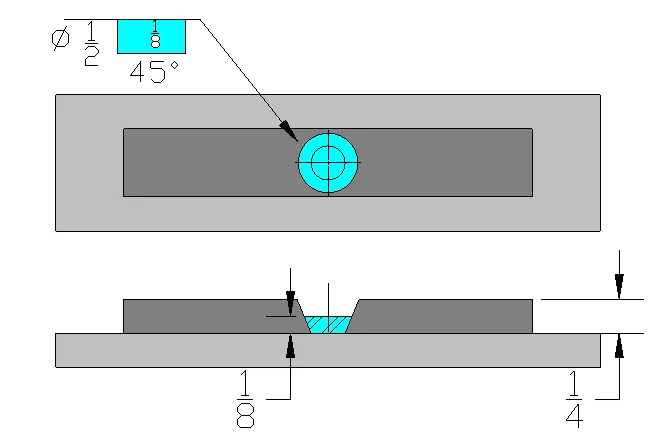
So, the next time you see "Typ." on a drawing, don't just see three letters. See a clever shortcut, a nod to efficiency, and a silent cheer for clarity. You're now in on the secret!
Embrace the Typical, Embrace the Wonder!
Understanding these little details, like what "Typ" means, isn't just about reading drawings; it's about gaining a deeper appreciation for the thought, precision, and clever communication that goes into making the world around us. It's about pulling back the curtain on something that might have seemed complex and realizing it's built on wonderfully logical and simple principles.
So go forth, armed with your newfound knowledge! Look for patterns, understand the "typical," and feel that little spark of satisfaction that comes with decoding the world, one tiny, brilliant abbreviation at a time. Who knows what other fascinating secrets you'll uncover?