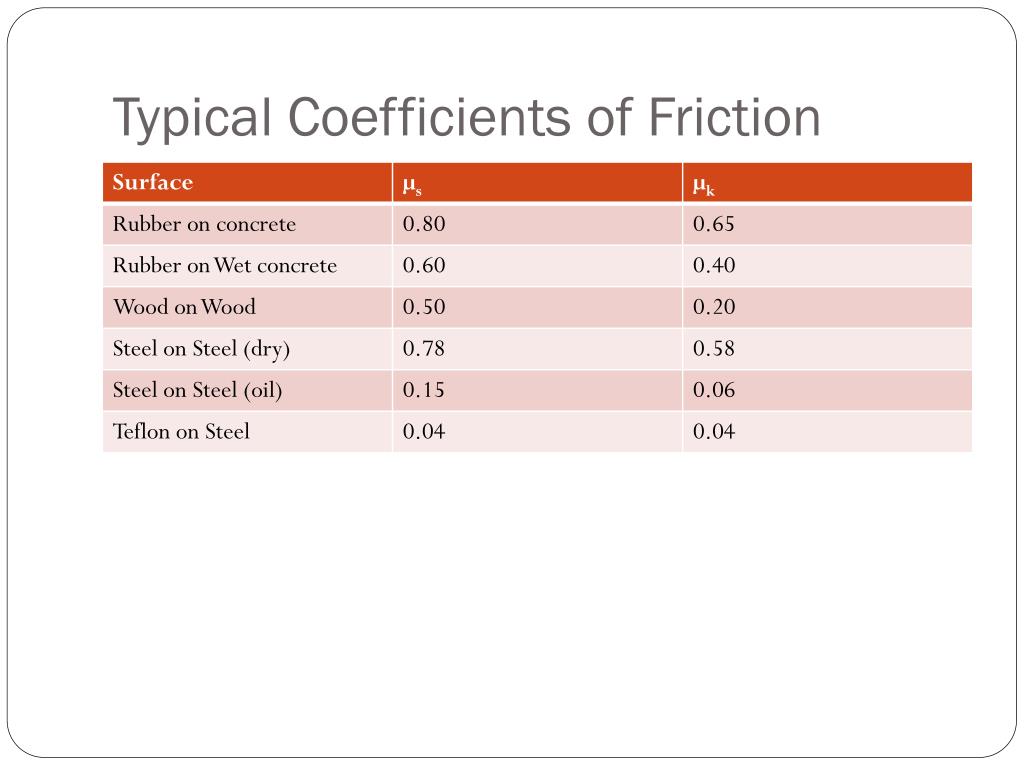
What Does The Coefficient Of Friction Tell You

Ever wonder why you can walk without constantly slipping and sliding? Or why some surfaces seem stickier than others? The answer lies in a fascinating, and surprisingly useful, concept called the coefficient of friction! Forget dry textbooks and complicated equations; we're diving into the world of friction to see how this number impacts our everyday lives. It's more exciting than it sounds, promise!
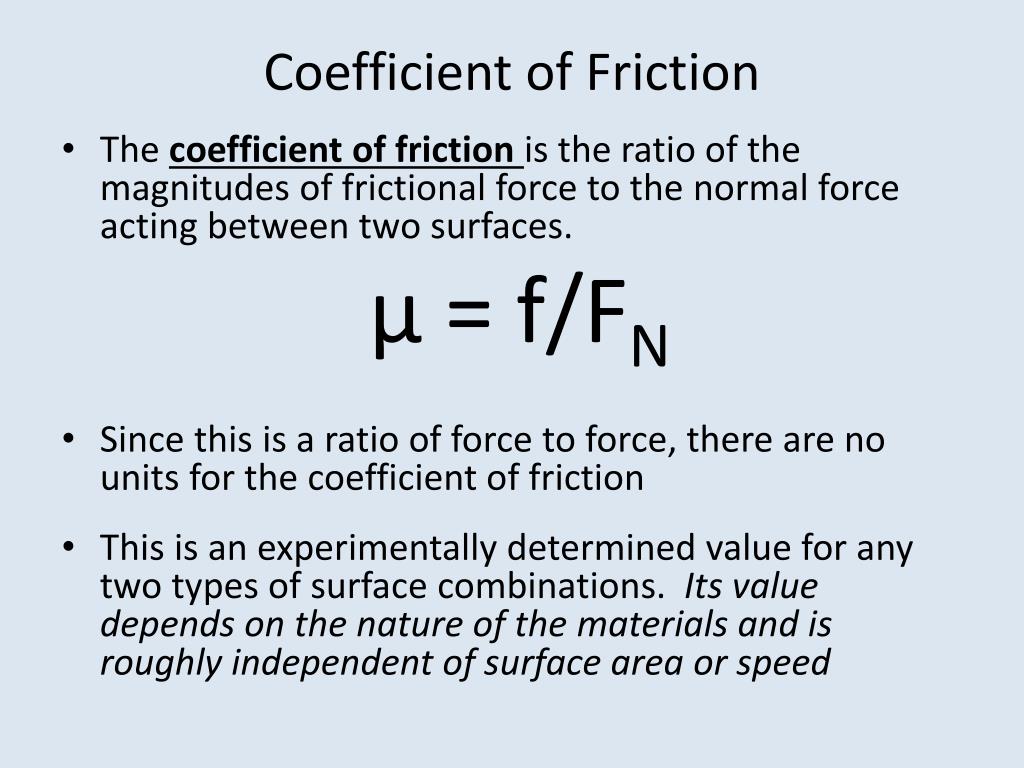
So, what exactly is the coefficient of friction? Simply put, it's a numerical value that tells you how much force is needed to move one object over another. Think of it as a measure of "stickiness" or "resistance" between two surfaces. A higher coefficient of friction means it's harder to slide the objects, while a lower coefficient means it's easier. Imagine pushing a heavy box across a smooth ice rink (low friction) versus pushing it across a rough concrete floor (high friction). The difference you feel? That's friction in action!
The purpose of the coefficient of friction is to quantify this interaction. It helps engineers, scientists, and even everyday people predict and control how things will move. Knowing this number is crucial in designing everything from car tires and brakes to ski equipment and even the soles of your shoes. Without it, we'd be living in a world of unpredictable slips and slides!
Must Read
The benefits of understanding the coefficient of friction are vast. Let's consider a few examples:
- Car Safety: Engineers use the coefficient of friction between tires and road surfaces to design braking systems that prevent skidding and ensure safe stopping distances. Different road conditions (dry, wet, icy) have drastically different coefficients of friction, which affects how your car handles.
- Sports and Recreation: Skiers and snowboarders rely on the low coefficient of friction between their equipment and the snow to glide down the slopes. Conversely, rock climbers depend on the high friction between their shoes and the rock face to maintain their grip.
- Everyday Life: The design of your shoes considers the coefficient of friction to provide adequate traction on various surfaces, preventing slips and falls. Even the grip on your phone or the texture of a doorknob is designed with friction in mind!
The coefficient of friction isn't just a random number; it's a valuable tool that helps us understand and interact with the world around us. It allows us to build safer, more efficient, and more enjoyable things. So, the next time you're walking on an icy sidewalk or marveling at a race car hugging a curve, remember the coefficient of friction – the unsung hero working tirelessly behind the scenes to keep us upright and moving!
While the precise calculation of the coefficient of friction can involve some math, the fundamental concept is simple and accessible to everyone. It’s about understanding how surfaces interact and using that knowledge to improve our lives. Isn't that pretty cool?