What Direction Does Ceiling Fan Go In The Summer

Okay, let's talk ceiling fans. Specifically, the age-old question that plagues us all every summer: which way should this dang thing be spinning?! It's right up there with "where did I put my keys?" and "is it Friday yet?" on the list of life's great mysteries.
Seriously though, think about it. You're sweating, the AC is cranked (but your electricity bill is giving you the side-eye), and you're staring up at that fan, wondering if it's a friend or a foe in this battle against the heat. Are you getting the optimal breeze? Or are you just wasting energy and making yourself dizzy?
Don't worry, we've all been there. I once spent a solid 15 minutes using a broom handle (don't judge) to try and reverse my ceiling fan, only to discover it had a tiny little switch on the motor housing that I'd completely overlooked. I felt like Indiana Jones discovering the Ark of the Covenant, only instead of ancient treasure, I found slightly cooler air.
Must Read
The Summer Spin: Counter-Clockwise is Your Bestie
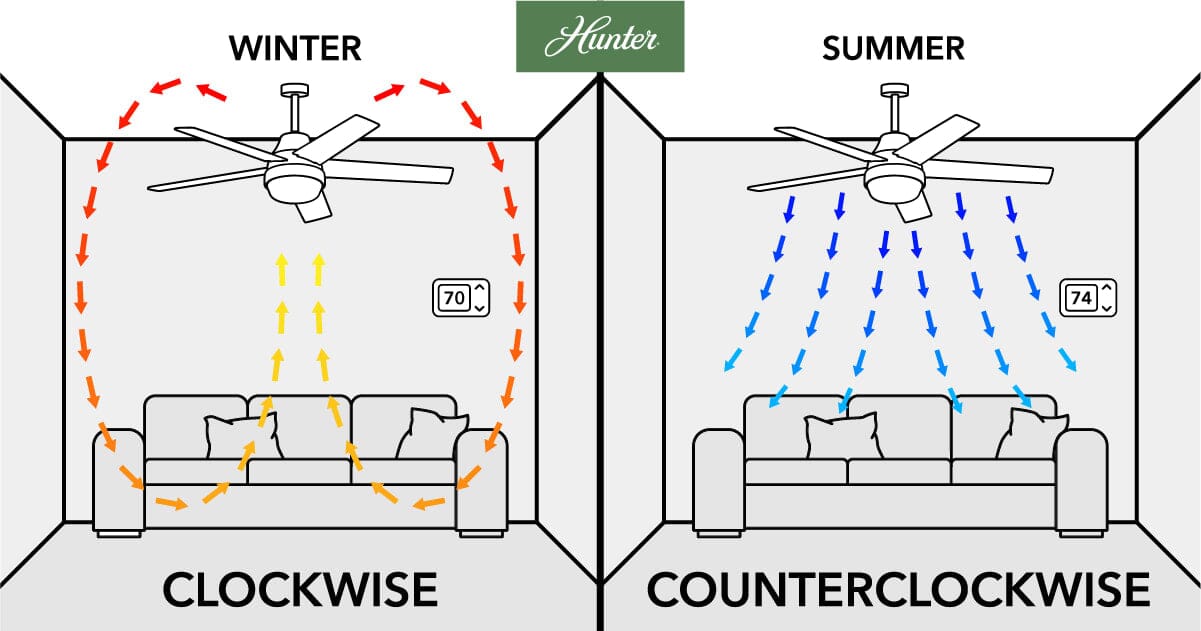
Alright, so here's the lowdown. In the summer, you want your ceiling fan to be spinning counter-clockwise (as you look up at it, of course). Think of it like this: you want the fan blades to scoop the air and push it down, creating a lovely little breeze that hits your skin and makes you feel like you're relaxing on a tropical beach... even if you're actually just sitting in your living room surrounded by laundry.
That downward airflow is key. It's like having a personal assistant dedicated solely to gently nudging the hot air away from you. It's not just about moving the air, it's about creating a wind chill effect. That's right, even indoors, you can trick your brain into thinking it's cooler than it actually is. Talk about a mind game!

Imagine you're trying to cool down a bowl of soup. You wouldn't just leave it there, would you? No, you'd blow on it to dissipate the heat. That's essentially what your ceiling fan is doing, only it's blowing on you instead of soup. (Although, wouldn't a ceiling fan that blows soup be amazing? Just a thought.)
Here's a pro tip: Stand directly under the fan. Do you feel a nice, refreshing breeze? Excellent! Your fan is doing its job. Do you feel like you're standing in a stagnant swamp of slightly moving air? Time to flip that switch, my friend.
:max_bytes(150000):strip_icc()/ceiling-fan-rotate-direction-1907533-v4-5ba94e6346e0fb002576cebf.png)
Why Does It Matter? The Science-y (But Still Easy) Explanation
Okay, I promised easy-going, so I won't get too technical. But here's the gist: warm air rises. So, in the summer, all that hot air is hanging out near your ceiling, having a party without you. The counter-clockwise rotation helps to disrupt that party and circulate the air, bringing the cooler air from lower down in the room up to where you are.
Think of it like this: the hot air is a grumpy old man sitting in his favorite chair, refusing to budge. The ceiling fan is a friendly (but persistent) kid who's trying to get him to move so everyone else can join the fun. Eventually, the grumpy old man (the hot air) gives in, and everyone's happy. (Except maybe the grumpy old man, but hey, you can't please everyone.)
![Ceiling Fan Directions for Summer vs Winter [Infographic]](https://airflowacademy.com/wp-content/uploads/2021/06/Ceiling-fan-directions-infographic-768x1425.jpg)
And here's the best part: by using your ceiling fan effectively, you can actually lower your AC usage. That's right, you can save money and be comfortable. It's a win-win! You'll be able to buy more ice cream with the money you save on your electricity bill. (Okay, maybe not that much ice cream, but still…)
So, next time you're feeling the summer heat, take a look up. Make sure your ceiling fan is spinning counter-clockwise, and bask in the glory of slightly cooler, slightly cheaper, and all-around more pleasant air. And if you accidentally reverse the direction and create a wind tunnel in your living room? Well, at least you'll have a good story to tell.