
What Are The Units For Stress
Ever wondered about the hidden language of the things around us? Like, how do engineers know a bridge won't collapse, or why your phone screen doesn't just shatter into a million pieces every time it gets a bump? It all comes down to understanding stress. And no, we're not talking about your deadlines or that never-ending to-do list! We're talking about the awesome, tangible, physics kind of stress.
So, what exactly are the units for this fascinating thing called stress? Let's dive in and unravel this mystery, chill-style!
What Even Is Stress (The Physics Kind)?
Before we get to the units, let's make sure we're on the same page about what "stress" means here. Imagine you're pushing on something, or pulling it, or trying to twist it. That's a force. Now, imagine that force isn't just applied to a single point, but spread out over a surface, like your hand pressing on a table.
Must Read
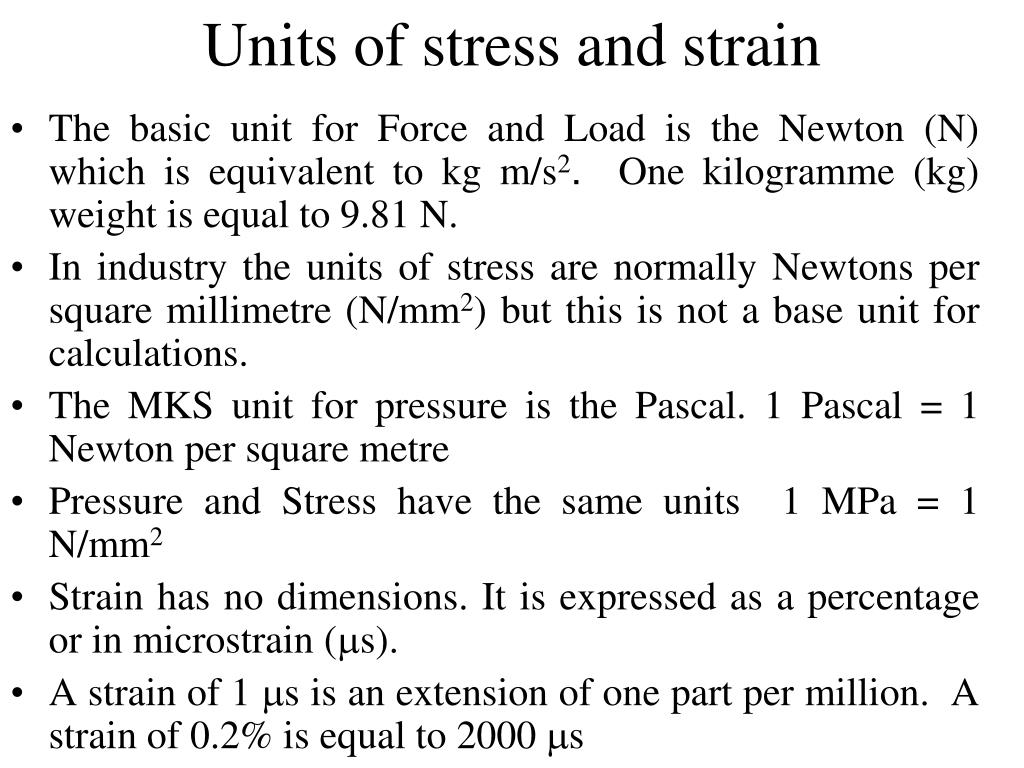
Stress, in engineering terms, is simply the force applied per unit of area. Think of it as how concentrated that force is.
Here’s a fun way to think about it: if an elephant stood on your foot, that would hurt, right? A lot of force in a small area. But if that same elephant laid down on a giant mattress covering your whole body, you’d just feel a big squish, not intense pain. Same elephant (same force), but the force is spread out over a much larger area. That's the core idea of stress!
First, Let's Talk Force
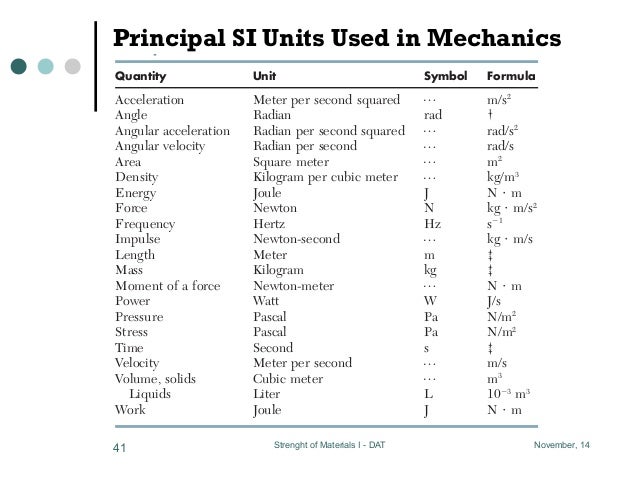
To understand stress, we first need to understand force. The standard unit for force in the metric system (which is what scientists and most of the world use) is the Newton (N).
A Newton is roughly the force you'd need to lift a small apple. Pretty manageable, right? If you push a shopping cart, you're applying Newtons of force.
Next Up: Area
The "per unit of area" part is equally important. Area is pretty straightforward: it's the size of a surface. In the metric system, the standard unit for area is the square meter (m²).
Imagine a square on the floor that's one meter by one meter. That's one square meter. It's a decent size – maybe big enough for a small rug or a comfortable dog bed.
Putting It Together: The Pascal!
Alright, drum roll please! Since stress is force divided by area, the natural unit for stress would be... wait for it... Newtons per square meter (N/m²)!
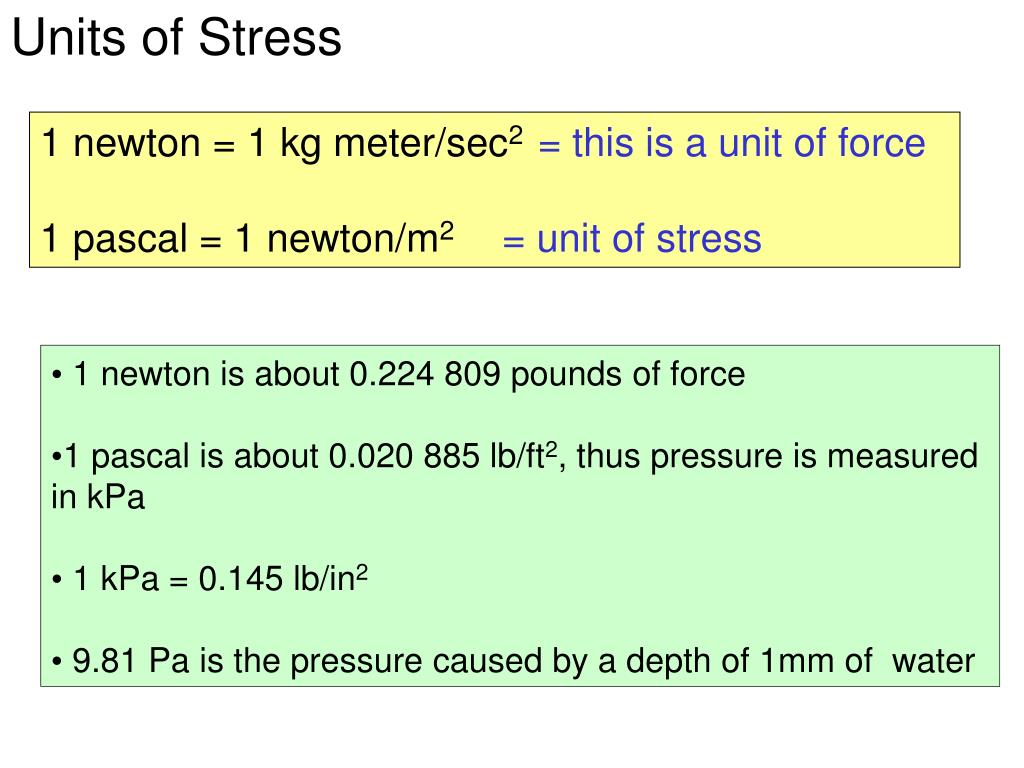
But because scientists love giving special names to combinations of units (it sounds cooler and is easier to say!), they named the Newton per square meter after the brilliant French mathematician and physicist Blaise Pascal. So, one Newton per square meter is known as one Pascal (Pa).
So, if you apply a force of 1 Newton over an area of 1 square meter, you've created 1 Pascal of stress.
Why Pascals Are Usually Tiny (and What We Do About It)
Here's a fun fact: 1 Pascal is actually a pretty small amount of stress in the grand scheme of things! Imagine gently pressing an apple (1N) flat against a whole square meter. Not much pressure, right?
Materials like steel beams, concrete, or even the plastic in your phone case can withstand enormous amounts of stress before breaking. We're talking about forces way, way more than just one apple over one square meter.
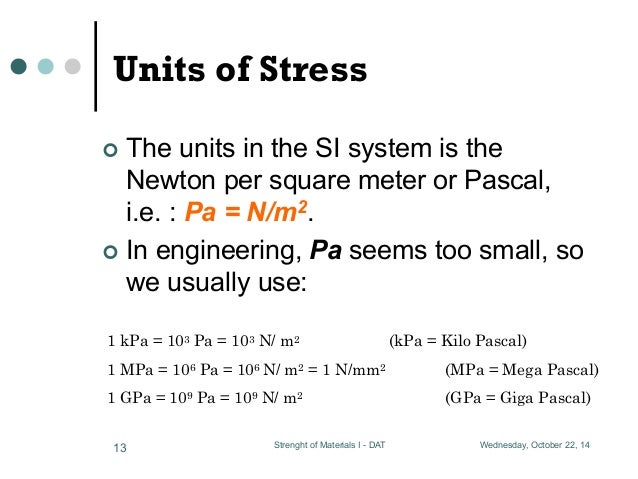
That's why engineers and material scientists often use larger units:
- Kilopascal (kPa): This is 1,000 Pascals.
- Megapascal (MPa): This is 1,000,000 Pascals (or 1,000 kPa). This is a very common unit when talking about the strength of materials like metals and plastics.
- Gigapascal (GPa): This is a whopping 1,000,000,000 Pascals (or 1,000 MPa). You'll hear this for super strong materials, like diamonds or certain composites.
So, when you see a material spec saying it has a strength of 200 MPa, it means that material can handle a force equivalent to 200 million apples pressing on every square meter of its surface before it starts to deform or break! Mind-boggling, right?
What About PSI?
You might also hear about pounds per square inch (psi), especially in countries that use the imperial system (like the US) or for things like tire pressure.

It's the same concept: a unit of force (pounds) divided by a unit of area (square inches). So, while the numbers are different, the underlying idea is identical to Pascals. For example, a car tire might be inflated to around 30-35 psi, which translates to roughly 200-240 kPa.
Why Is This So Cool and Important?
Understanding stress isn't just for super smart scientists in lab coats. It's incredibly relevant to our everyday lives and the world around us!
- Building skyscrapers and bridges: Engineers calculate the stress on every beam and column to ensure they can safely hold the immense weight without collapsing.
- Designing airplanes: Knowing the stress limits of materials helps design wings and fuselages that can withstand extreme forces during flight.
- Making safer cars: Car manufacturers test how different parts react to stress during impacts to protect passengers.
- Your phone screen!: Ever wondered how a thin piece of glass can be so tough? Engineers choose materials with high stress resistance and design them to distribute forces effectively.
It's all about making sure things don't break unexpectedly. From the tiny screws holding your glasses together to the massive cables supporting suspension bridges, the concept of stress, measured in Pascals, is a silent hero keeping our world safe and functional.
So next time you see a bridge, or even just pick up your phone, give a little nod to the humble Pascal. It's a unit that packs a punch, telling us just how much abuse a material can take before it gives up the ghost! Pretty cool, huh?