
What Are The Properties Of A Transition Metal
Hey there, science enthusiast (or soon-to-be enthusiast)! Ever wondered what makes things colorful, strong, and, well, just plain interesting? Let's dive into the world of transition metals – those elements hanging out in the middle of the periodic table, just waiting to show off their awesome properties. Prepare to be amazed; this isn't your grandma's chemistry lesson!
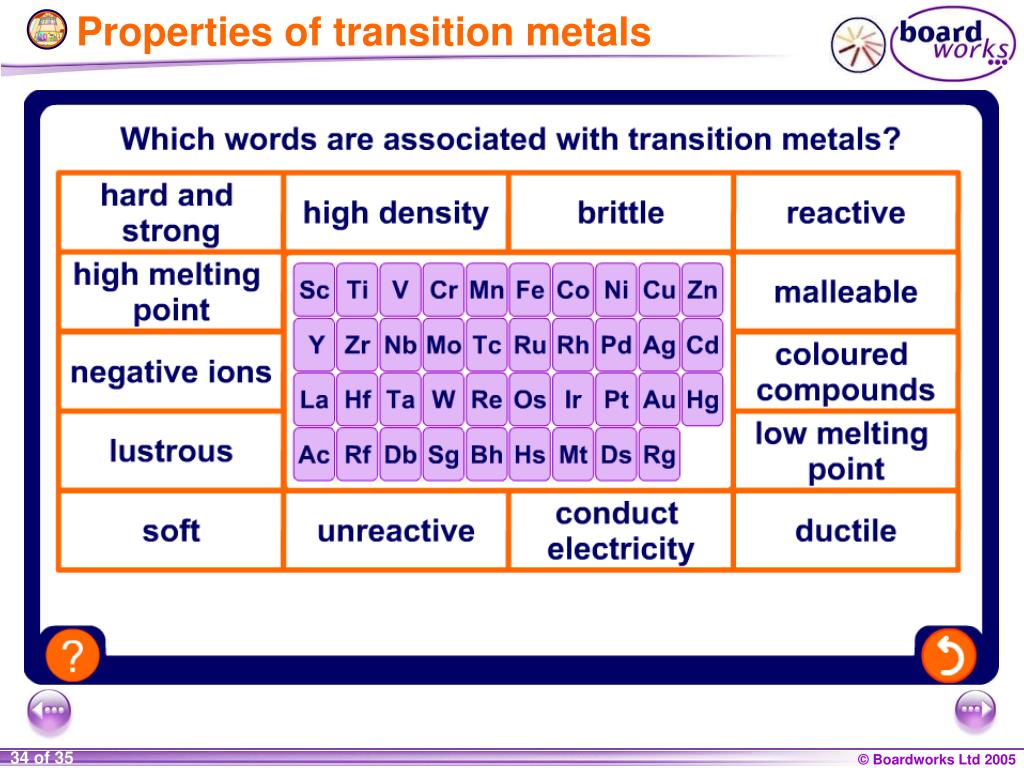
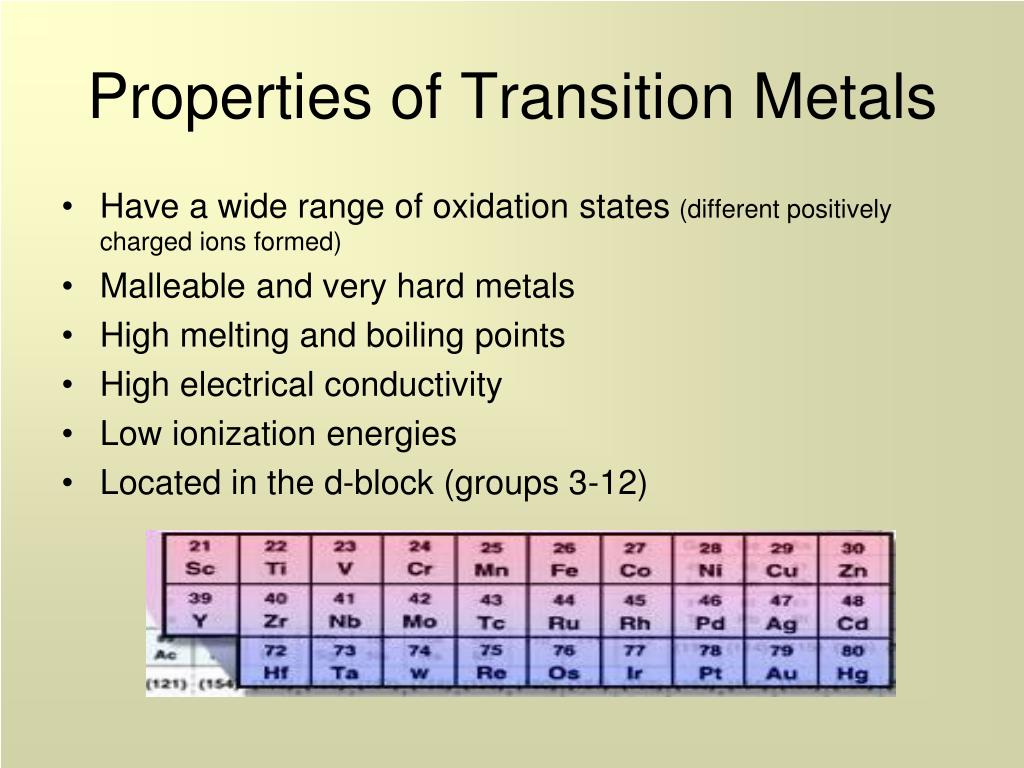
So, what exactly are transition metals? Think of them as the chameleons of the element world. They’re a group of metals (duh!) found in groups 3 to 12 of the periodic table. These aren’t your boring old alkali metals; these guys are far more versatile and complex. We're talking iron, copper, gold, silver, titanium, and a whole bunch more. Recognize some of those? I thought you might!
The Colorful Crew: Variable Oxidation States
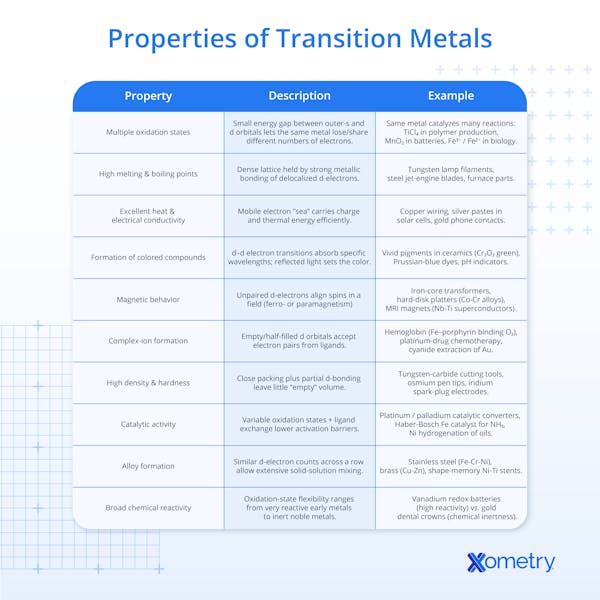
One of the coolest things about transition metals is their ability to rock multiple "oxidation states." What does that even mean? Simply put, it means they can lose different numbers of electrons when forming compounds. Think of it like having multiple personalities, but instead of being quirky, it creates a rainbow of colors. Seriously!
Must Read
For example, iron can exist as Fe2+ (ferrous) or Fe3+ (ferric). Copper can be Cu+ (cuprous) or Cu2+ (cupric). Each oxidation state results in a different compound, and each compound has its own unique color. Ever wondered why some gemstones are different colors? Transition metals, baby! They're the artists of the periodic table.
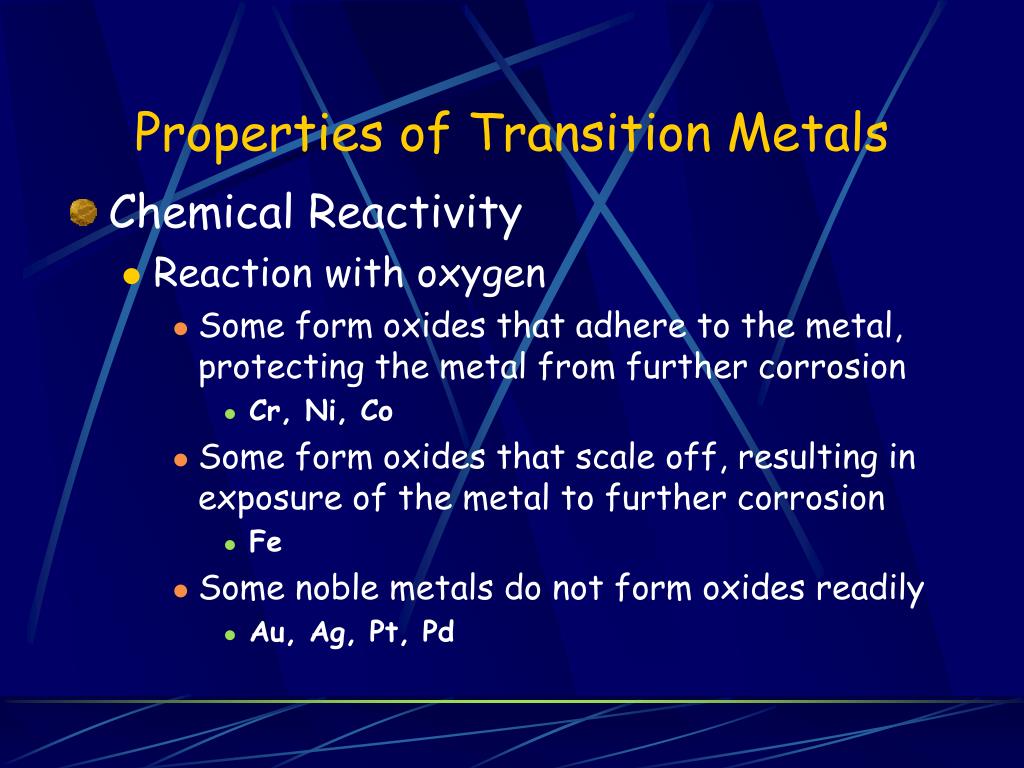
This ability to have multiple oxidation states makes them excellent catalysts, too. Catalysts are substances that speed up chemical reactions without being consumed themselves. Think of them as the matchmakers of the chemical world, getting everyone together to create something new. (And who doesn’t love a good matchmaker?)

Magnetic Marvels: Paramagnetism
Ever played with magnets? Well, some transition metal compounds are paramagnetic, meaning they are attracted to magnetic fields. Why? It all comes down to unpaired electrons. Transition metals have electrons hanging out in their d-orbitals, and when these electrons aren't paired up, they create tiny magnetic moments.
When a magnetic field is applied, these little magnetic moments align with the field, creating an overall attraction. It's like a tiny army of magnets all working together! This property is used in all sorts of cool applications, like MRI machines in hospitals. Pretty awesome, right?
Strength and Stability: High Melting and Boiling Points
Transition metals are generally known for their high melting and boiling points. This is because of the strong metallic bonds that hold the atoms together. These bonds are formed by the electrons in both the s and d orbitals. Think of it like a super strong glue holding everything together. They’re tough cookies, these transition metals!
This strength and stability make them ideal for building materials, tools, and all sorts of other things that need to withstand high temperatures and pressures. From the steel in skyscrapers to the titanium in airplanes, transition metals are the backbone of modern engineering.
Complex Compounds: Coordination Chemistry
Transition metals love to form complex compounds, also known as coordination complexes. These are formed when a central metal ion (the transition metal) is surrounded by ligands. Ligands are molecules or ions that donate electrons to the metal ion, forming a coordinate covalent bond. It's like the metal is the sun, and the ligands are planets orbiting around it.
These complex compounds have all sorts of interesting properties and applications, from pigments and dyes to catalysts and pharmaceuticals. For instance, hemoglobin in your blood is a complex compound containing iron. It’s what carries oxygen around your body! So next time you take a breath, thank a transition metal.
In summary, transition metals are:
- Colorful
- Able to form multiple oxidation states
- Often paramagnetic
- Strong and stable
- Excellent catalysts
- Able to form complex compounds
See? Transition metals are far more than just boring elements on a chart. They are essential components of our world, contributing to everything from the colors we see to the technologies we use.
So, are you feeling inspired yet? I hope so! The world of transition metals is vast and fascinating, just waiting to be explored. Go forth, learn, and discover! Maybe you'll be the one to discover the next amazing property of these remarkable elements!