What Are The Metalloids On The Periodic Table

Have you ever looked at the periodic table and wondered about those elements that seem to be hanging out in the middle, not quite metals and not quite nonmetals? These are the metalloids, also known as semi-metals. They're the chameleons of the element world, and understanding them is surprisingly relevant to our daily lives. Think of them as the unsung heroes, quietly powering our technology and even contributing to some cool art!
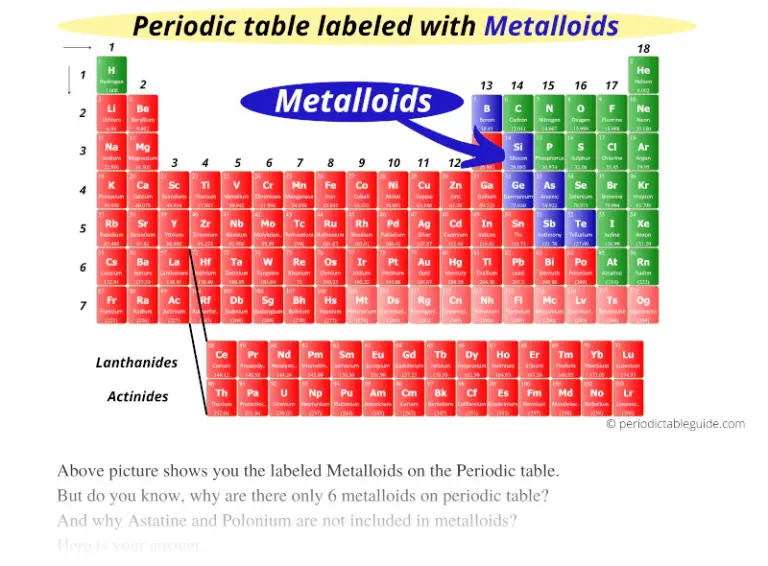
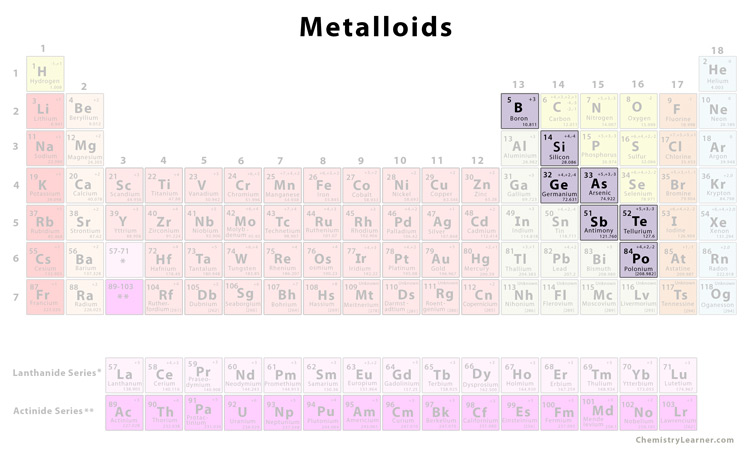
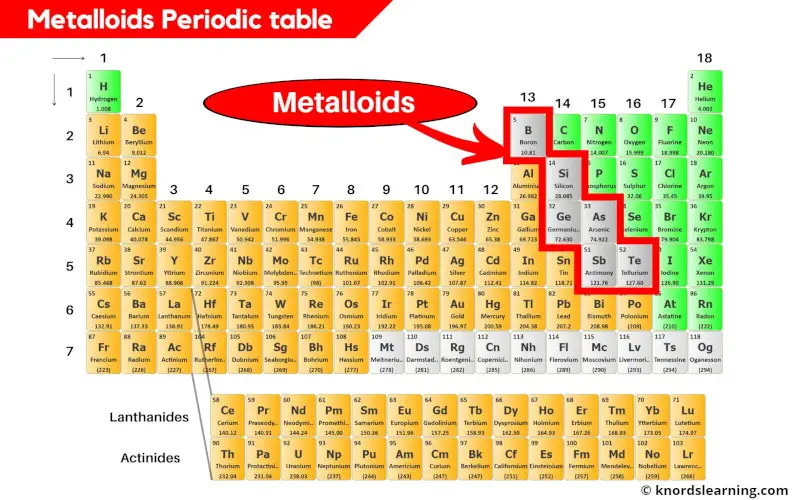
So, what exactly are metalloids? Well, they're a group of elements that have properties of both metals and nonmetals. This 'in-between' nature is what makes them so useful. Imagine a switch that can sometimes conduct electricity and sometimes not – that's kind of what a metalloid does at a fundamental level. The periodic table typically identifies these elements along a diagonal line, often including boron (B), silicon (Si), germanium (Ge), arsenic (As), antimony (Sb), and tellurium (Te). Some sources also include polonium (Po) and astatine (At), though their classification is sometimes debated.
The real magic of metalloids lies in their semiconducting properties. This means they can conduct electricity under certain conditions, but not others. This is crucial for creating transistors, the tiny switches that power all our digital devices – from smartphones and laptops to cars and washing machines. Without metalloids, the modern world would look drastically different. Think no internet, no video games, and significantly less efficient appliances! The ability to precisely control their conductivity is what makes them so valuable in electronics.
Must Read
Beyond electronics, metalloids find their way into various other applications. Boron, for instance, is essential for making borosilicate glass, known for its resistance to thermal shock (think Pyrex cookware). Silicon is used in everything from concrete and bricks to implants and cosmetics. Arsenic, though often associated with poison, has medicinal uses in some specific treatments. Antimony is used in flame retardants and in the production of some alloys. Tellurium is used as an additive in steel and cast iron to improve their machinability.
Even in education, metalloids play a vital role. Many science classrooms use silicon-based compounds in experiments, and learning about metalloids helps students understand the fundamental principles of chemistry and materials science. Plus, understanding the properties of these elements allows us to appreciate the complexity and beauty of the periodic table. Think about making your own silicon crystals! You can find resources online that guide you through the process, allowing you to see firsthand the unique properties of this metalloid. Another fun way to explore them is to simply look around your house. How many devices contain silicon chips? Can you find items made with borosilicate glass?
If you're curious to learn more, start by exploring online resources like the Royal Society of Chemistry or Khan Academy. Many universities also offer free introductory chemistry courses. You can even look for demonstrations of how semiconductors work – there are many videos that explain the concept in a visually engaging way. Don't be afraid to dive in and explore – the world of metalloids is full of fascinating discoveries waiting to be made!