What Are The 4 Types Of Welding

Ever gazed at a gleaming skyscraper or a gnarly metal sculpture and thought, "How on earth do they stick all that together?" If your answer is anything other than, "Magic, obviously!" then pull up a comfy chair, metaphorically speaking, because we're about to demystify the sizzling, sparking, oddly beautiful world of welding. And don't worry, we're doing this café-style, with jokes, a sprinkle of exaggeration, and zero risk of eye injuries.
Forget the intimidating industrial jargon. Think of me as your slightly over-caffeinated tour guide into the molten heart of metal joining. Today, we're diving into the four main types of welding that keep our world from literally falling apart. Each one has its own personality, its quirks, and its perfect moment to shine (sometimes literally).
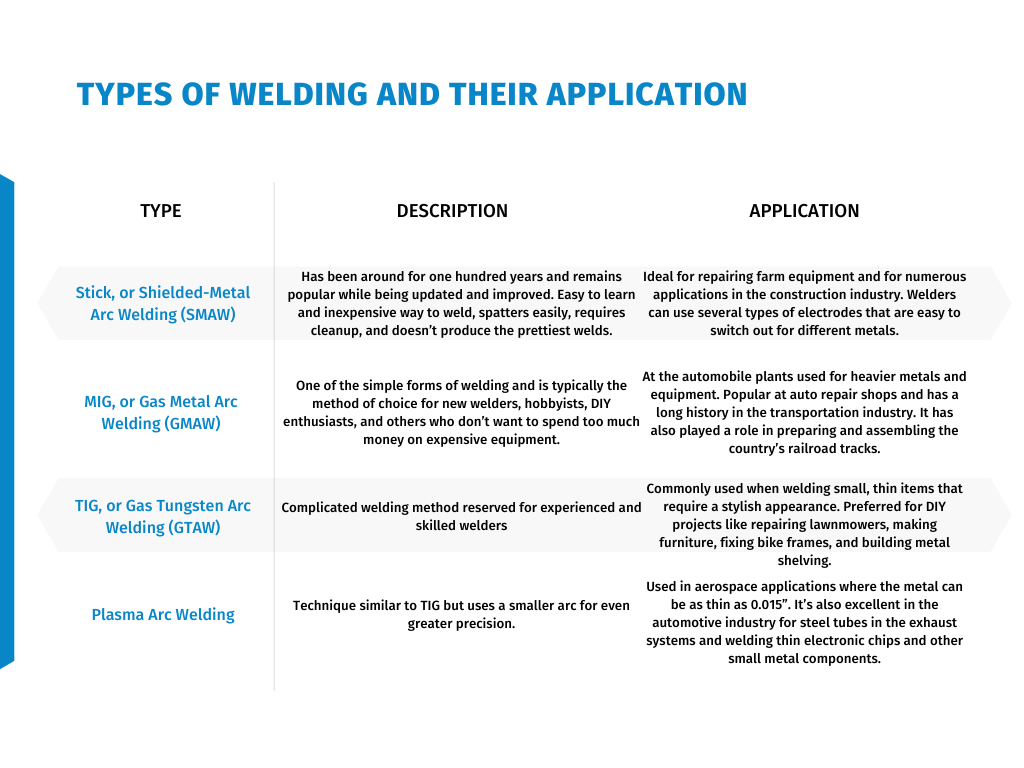
1. Stick Welding (SMAW): The Grumpy Grandpappy of the Group
First up, we have the OG, the patriarch, the one who probably tells kids to get off his lawn: Shielded Metal Arc Welding, or as pretty much everyone calls it, Stick Welding. Imagine a grizzled veteran welder, sparks flying like a heavy metal concert, welding something ancient and rusty in a dimly lit garage. That's Stick.
Must Read
It uses these consumable "sticks" (electrodes, if you want to be formal) that look like fancy, coated sparklers. You strike an arc by tapping or dragging the stick on the metal, and boom! Metal melts, metal joins. It's like building with molten LEGOs, but way more dangerous and way, way more satisfying. The coating on the stick burns off, creating a cloud of gas that shields your weld from pesky atmospheric contaminants (like oxygen, which apparently loves to ruin a good weld). It's incredibly versatile, good for dirty metal, and can even be done outdoors in breezy conditions. So, if you need to weld something robust and aren't afraid of a little spatter and slag cleanup, Stick is your tough-as-nails friend. It's the welding equivalent of a trusty old pickup truck – not pretty, but it gets the job done, every single time.
2. MIG Welding (GMAW): The Easy Button
Next, let's talk about the "Easy Mode" of welding: Gas Metal Arc Welding, mercifully shortened to MIG Welding. If Stick welding is a manual transmission, MIG is a slick automatic. You pull a trigger, and a continuous wire feeds out like magic toothpaste, creating the weld. It's fast, it's clean, and honestly, even your slightly clumsy Uncle Barry could probably learn to lay down a decent MIG bead after a few hours (disclaimer: Uncle Barry should still wear safety gear).
This is the workhorse of auto body shops, manufacturing lines, and anyone who wants to join metal without a PhD in molten metal physics. The catch? You need a tank of shielding gas (usually argon or a mix) to protect that molten puddle from oxygen and nitrogen, which are total party poopers for a clean weld. Think of it as giving your weld a tiny, invisible force field. MIG is fantastic for thin-to-medium thickness metals and is beloved by beginners because of its relatively forgiving nature. It’s the IKEA furniture of welding – quick to assemble, looks good, and doesn’t require too much brainpower.
3. TIG Welding (GTAW): The Picasso of the Puddle
Now, if you want to get really fancy, we move to Gas Tungsten Arc Welding, affectionately known as TIG Welding. This is where welding becomes art. Seriously, TIG welders are the zen masters of metal. Imagine conducting an orchestra, but your baton is a non-consumable tungsten electrode, your foot is on a pedal controlling the heat, and you're manually feeding a separate filler rod into a tiny, shimmering puddle of molten metal. It's a ballet of precision and control.
The results? Absolutely stunning welds that look like a perfect stack of dimes, clean enough to eat off (though I wouldn't recommend it). TIG is slower, requires immense patience, and has a steeper learning curve than MIG or Stick. But for welding super-thin materials, exotic metals like titanium, or anything that needs to look impossibly perfect – like aerospace components or high-end custom fabrication – TIG is your sophisticated friend. It uses shielding gas, like MIG, but the non-consumable electrode means no spatter, just pure, unadulterated beauty. If MIG is the automatic transmission, TIG is the finely tuned manual, requiring skill, finesse, and an eye for detail that borders on obsessive. It’s the difference between doodling and painting a masterpiece.
4. Flux-Cored Arc Welding (FCAW): The Rugged Individualist
Finally, we have the slightly misunderstood, but incredibly useful, Flux-Cored Arc Welding, or simply Flux-Cored. This one is often described as MIG's rugged, independent cousin. Remember how MIG needed a big, bulky gas tank? Flux-Cored says, "Pffft, who needs gas?"

Its special wire has a core filled with flux (a chemical compound, not a time-traveling DeLorean component!) that, when heated, creates its own shielding gas. This means no external gas tank is required, making it awesome for outdoor jobs, windy conditions where shielding gas would just blow away, or welding on slightly less-than-pristine metal. It's a bit messier than MIG, creating more spatter and slag, but it's a true workhorse for heavy fabrication, structural steel, and generally getting the job done when conditions aren't perfect. If MIG is the clean-cut city slicker, Flux-Cored is the cowboy who gets the job done, no matter the weather, usually with a plume of smoke and a "Yee-haw!" (the smoke is actual, the "Yee-haw!" is optional but encouraged).
So there you have it! From the tough old stick to the artistic TIG, the speedy MIG to the rugged Flux-Cored. Each has its own personality, its quirks, and its perfect application. Next time you see a metal sculpture, a sturdy bridge, or even the frame of your car, you'll know there's more than just "sticking metal together" going on. There's a whole world of molten metal artistry, science, and a little bit of magic happening behind those safety masks. Now, if you'll excuse me, I think my latte needs some... structural reinforcement.