
Pir Motion Sensor How It Works

Okay, let's talk about something that's probably helping you out multiple times a day without you even realizing it. You know those lights that flick on automatically when you walk into a room? Or the alarm system that knows someone's there even before they touch a door? Yep, we're talking about those clever little gadgets that detect motion.
But how do they do it? Do they have tiny cameras? Are they sending out invisible laser beams? Nope, most of the time, the secret sauce is something called a PIR motion sensor. And trust me, once you understand how it works, it's pretty darn cool.
What Even IS a PIR Sensor?
First off, PIR stands for Passive Infrared. Sounds a bit sci-fi, right? But let's break it down into much simpler terms. Think of it like a superhero with a special vision – but instead of X-ray vision, it has heat vision.
Must Read
Every living thing – you, me, your dog, even that lukewarm coffee cup – gives off a little bit of heat. This heat isn't something we can usually see with our eyes, but it's there. Scientists call it infrared radiation. It's just light that's at a different wavelength than what our eyes can pick up. So, when we say "infrared," we're essentially talking about heat signals.
The "Passive" Part: It's a Listener, Not a Talker
Now, let's tackle the "passive" bit. This is super important. A PIR sensor doesn't send out anything. It's not like a flashlight beaming out light and waiting for it to bounce back. Instead, it's like a tiny, vigilant ear that's always listening for heat signals.
Imagine you're in a completely dark room. If you shine a flashlight (active sensor), you're sending out light. But if you're just standing there, feeling the warmth of another person nearby (passive sensor), you're simply receiving information. That's what a PIR sensor does. It just sits there, patiently waiting to detect changes in the infrared radiation around it.
The Magic Inside: Two Tiny, Balanced Eyes
Alright, so how does this heat-listening gadget actually work? Inside a PIR sensor, there are typically two halves, two tiny little heat detectors, often called pyroelectric sensors. Think of them as two miniature, super-sensitive thermometers sitting side-by-side. These two halves are designed to be perfectly balanced – they're looking at the same amount of background heat and should be giving off identical electrical signals.
Now, here's where the magic happens. When something warm, like a human or an animal, moves into the sensor's view, it doesn't just pass over both halves at the same time. Instead, it usually moves into the view of one half first, and then the other.
So, one half suddenly "sees" a burst of new heat, while the other is still looking at the background. This creates a difference in the signals coming from the two halves. It's like one thermometer suddenly jumping up, while the other stays put. This difference, this sudden imbalance, is the PIR sensor's signal that says, "Hey! Something just moved!"
It’s like having two siblings who always agree on everything, and then one of them suddenly shouts, "Ice cream!" The other one might not have heard yet, causing a brief moment of disagreement. That disagreement is what the sensor is looking for!
The Funky Fresnel Lens: The Bumpy Dome's Secret
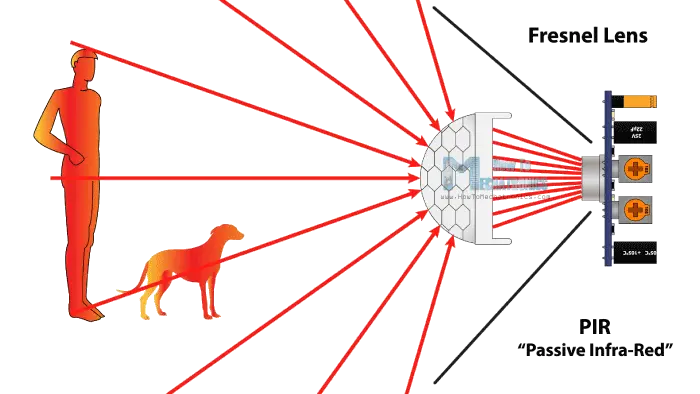
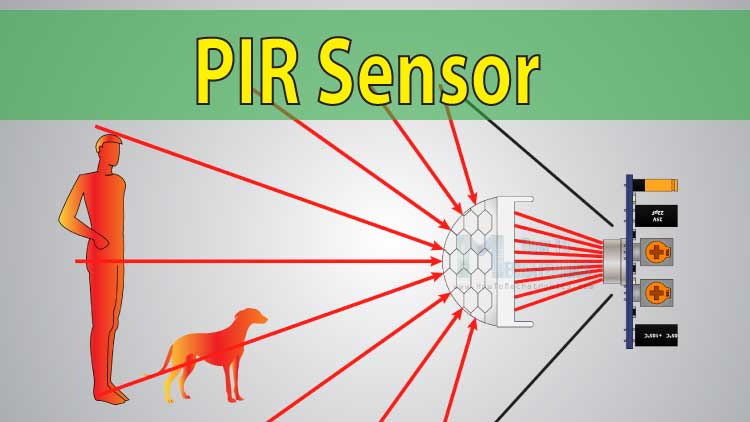
You know that little white, often bumpy or clear, dome-like cap that usually covers the actual sensor? It looks a bit like a bug's eye, right? That's not just for aesthetics or protection; it's a crucial part of the puzzle called a Fresnel lens.
This lens is incredibly clever. It doesn't magnify things like a regular lens. Instead, it's designed to divide the sensor's field of view into multiple, distinct detection zones or "fingers." Imagine a pie sliced into many wedges, or a grid drawn across the room. Each of these zones focuses the infrared energy onto one or both of those tiny internal heat detectors.
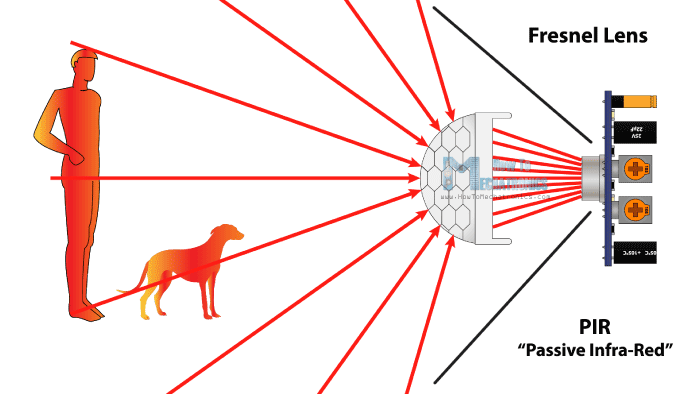
Why is this important? Because without it, the sensor would just see a big blob of heat. The Fresnel lens ensures that as you walk across the room, your body's heat signature passes through one zone, then another, then another. This constant switching between zones causes those rapid, successive changes in the heat levels detected by the two halves of the sensor, triggering the "motion detected" signal.
It essentially turns a single wide view into a series of invisible tripwires for heat signatures! This makes the sensor super sensitive to movement, not just static heat.
Putting It All Together: A Symphony of Heat Detection
So, when you step into a room, your body, a source of infrared radiation, crosses one of the Fresnel lens's detection zones. This focused heat energy hits one side of the internal pyroelectric sensor, creating an imbalance. As you continue to move, your heat signature crosses into another zone, shifting the heat focus to the other side of the sensor, or creating a new imbalance.

This continuous, alternating pattern of "heat here, then heat there" is exactly what the PIR sensor's internal circuitry is looking for. When it detects this rapid fluctuation, it knows something warm has moved across its field of view, and bam! The lights come on, or the alarm system gets a ping.
Why Is This So Cool?
PIR sensors are brilliant because they are:
- Passive: They don't emit anything, so they consume very little power.
- Invisible: They work by detecting infrared, which isn't visible to the human eye. So they don't "see" you in the traditional sense, just your heat signature. Great for privacy!
- Effective: They work day or night, as long as there's a heat change.
- Simple and Reliable: Once you understand the mechanics, it's a wonderfully elegant solution to detecting movement.
Isn't it fascinating how such a simple principle – detecting tiny shifts in heat – can power so many everyday conveniences? The next time an automatic light clicks on, give a little nod to the clever PIR sensor doing its silent, heat-sensing job. Pretty neat for something you barely even notice, right?