Metalloids Are Located Where On The Periodic Table

Okay, so you've probably seen the periodic table, maybe hanging in your high school chemistry lab, or even printed on a shower curtain (hey, no judgment!). It looks like a bunch of colorful squares all neatly organized. But amidst all those metals and non-metals, there's a fascinating little group we're going to chat about: the metalloids. Think of them as the cool kids sitting on the fence between two worlds.
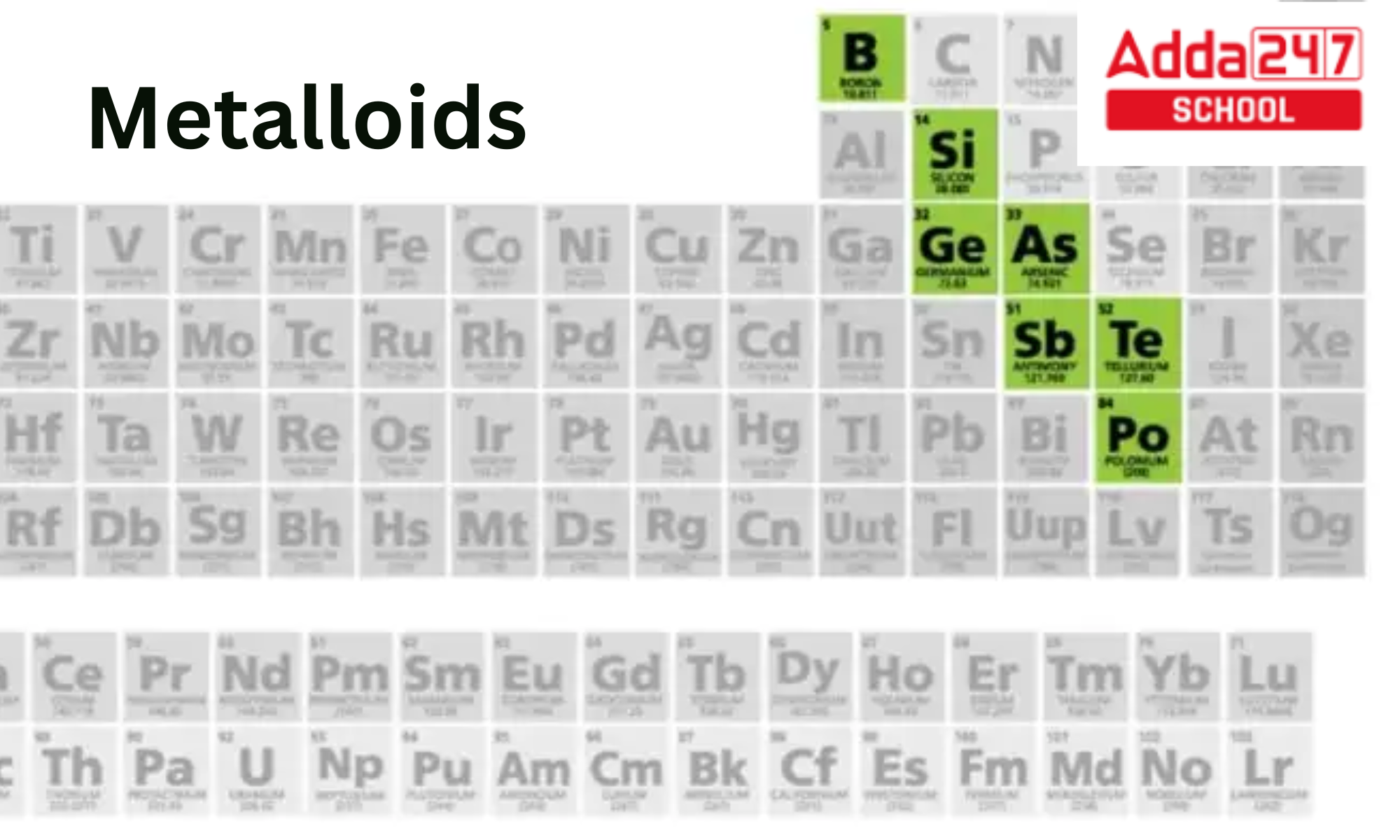
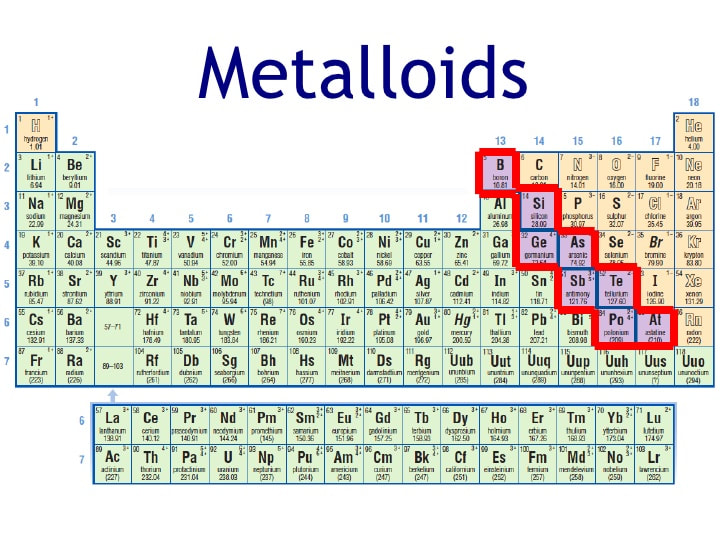
Now, where exactly are these "fence-sitters" located? That's what we're diving into. They occupy a diagonal, stair-step region along the right side of the periodic table. Imagine drawing a zigzag line, starting from boron (B) and heading down towards astatine (At). That's metalloid territory! The elements that typically get counted as metalloids are boron (B), silicon (Si), germanium (Ge), arsenic (As), antimony (Sb), tellurium (Te), and sometimes polonium (Po) and astatine (At), depending on who you ask. It's not an exact science, even here!
Why should you care about where these things hang out on a chart? Glad you asked! These elements have properties of both metals and non-metals. This "in-between-ness" makes them incredibly useful in a ton of everyday applications. Think of them as the ultimate multi-tool in the element world.
Must Read
Why Metalloids Matter: More Than Just Periodic Table Fillers
Let's get specific. Probably the most famous metalloid is silicon (Si). You might recognize that name. It's the backbone of the entire computer industry. Seriously! Silicon is a semiconductor, meaning it conducts electricity under certain conditions but not others. This is essential for creating transistors, the tiny switches that power all our computers, smartphones, and gaming consoles. Without silicon, we'd be stuck in the dark ages of technology, probably still using abacuses (which, incidentally, don't contain any metalloids... just sayin').
Imagine trying to build a skyscraper out of jelly. Not gonna work, right? You need something strong and reliable. That's where metals shine. But what if you needed something that could also insulate electricity sometimes? Jelly still isn't the answer. Enter the metalloids! They offer a blend of properties that are just perfect for many electronic applications.

But silicon isn't the only star of the metalloid show! Consider germanium (Ge). While silicon dominates the semiconductor industry now, germanium was its predecessor. You'll still find it in some electronics, and it's also used in fiber optic cables. These cables transmit data as light, allowing us to stream cat videos and binge-watch our favorite shows at lightning speeds. So, next time you're enjoying a Netflix marathon, thank germanium for helping make it possible.
And let's not forget about arsenic (As). Okay, okay, I know what you’re thinking: "Arsenic? Isn't that poison?" Yes, it is, and historically, it's had a pretty bad rap. But arsenic also has its uses, especially in the creation of certain alloys and, in the past, in some types of medications. (Although, generally, we try to avoid ingesting poisonous metalloids!). It's a reminder that even elements with a dark side can have beneficial applications when used carefully.
Finding the Metalloids: A Quick Guide
So, how can you quickly identify a metalloid on the periodic table? Remember that diagonal line! Visual learners, picture a staircase. Boron is at the top of the staircase, and then each step down includes silicon, germanium, arsenic, antimony, and tellurium. It’s not a perfect rule, but it gets you pretty close.
Also, look for elements whose properties are described as being "intermediate" between metals and non-metals. This is a big clue that you've stumbled upon a metalloid.

Why is it a zig-zag? Because that reflects the gradual shift in properties as you move across the periodic table! On the left side, you've got the super metallic elements, shiny, conductive, and eager to share electrons. On the right, you've got the nonmetals, which are generally insulators and like to grab electrons. The metalloids are the transition zone, where the metallic character slowly fades away.
Ultimately, the metalloids might not be as flashy as gold or as essential as oxygen, but their unique blend of properties makes them indispensable in modern technology. They are the unsung heroes of our digital world, quietly enabling the gadgets and gizmos we rely on every day. So, the next time you glance at the periodic table, give those "fence-sitting" metalloids a little nod of appreciation. They've earned it!