
Led Christmas Tree Lights Power Consumption
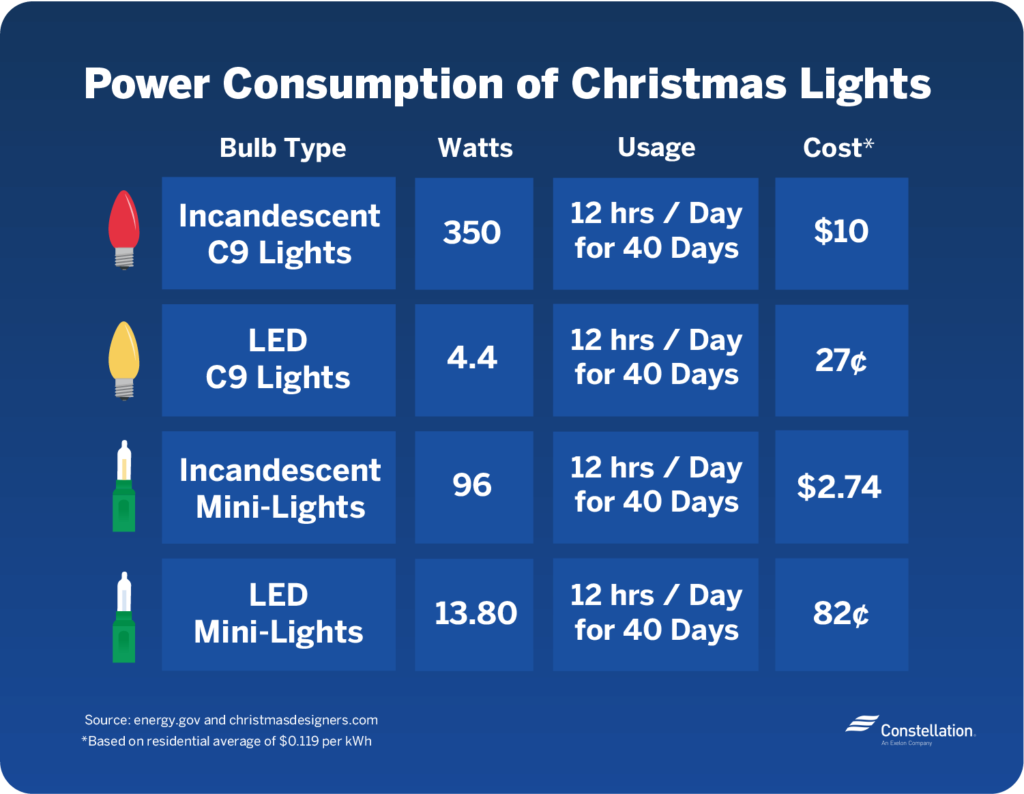
Okay, let's talk Christmas lights! Specifically, those twinkling, magical LED Christmas tree lights that bring so much joy to our homes. But, a little voice in the back of your head might be whispering, "How much is this festive glow really costing me?" Don't worry, we're going to break it down in a way that's easier than untangling a string of those old-school incandescent bulbs.
Why should you even care about the power consumption of your Christmas lights? Well, for a few reasons. First, there's the obvious: your electricity bill. No one wants a January surprise that's less "tidings of comfort and joy" and more "tidings of 'OMG, I used how much electricity?!'" Second, it's about being kind to Mother Earth. Less energy used means less strain on resources. Think of it as a little Christmas gift to the planet. Plus, you get bragging rights at the holiday party!
The LED Advantage: A Christmas Miracle (Almost!)
Remember those old incandescent Christmas lights? The ones that got so hot you could practically cook a marshmallow on them? Yeah, those were energy hogs. LEDs (Light Emitting Diodes) are a completely different story. They’re the superheroes of the Christmas lighting world. They use a fraction of the energy of their incandescent ancestors. I'm talking like, 75% to 90% less. That's a huge difference!
Must Read
Think about it this way: Imagine you're driving across town to pick up a Christmas tree. An incandescent bulb is like driving a gas-guzzling Hummer, while an LED is like zipping around in a fuel-efficient hybrid. Same job, way less fuel (or electricity) used.
To put some numbers on it (don't worry, it won't get too math-y), let's say you have a string of 100 incandescent bulbs. That could use around 40-60 watts. A similar string of 100 LEDs? Maybe 5-10 watts. See the difference? It's like the difference between a gentle whisper and someone shouting from the rooftops.

Calculating Your Christmas Light Consumption (Simplified!)
Alright, so you're curious how much your specific lights are costing you? Here's a super-simple way to estimate:
- Find the wattage: Check the box your lights came in, or look for a tag on the string itself. It should tell you the wattage (e.g., 4.8W, 8.6W, etc.).
- Figure out how many hours you'll use them: Be realistic! Are you planning to keep them on all night, every night, from Thanksgiving to New Year's? Or just a few hours each evening?
- Find out the cost of electricity in your area: Your electricity bill should tell you this. It's usually listed as cents per kilowatt-hour (kWh). Let’s just assume, for this example, it is $0.20/kWh.
Now, the super-easy formula:

(Wattage / 1000) x Hours Used x Cost per kWh = Cost
Let's say you have a string of LED lights that uses 5 watts, you leave them on for 6 hours a day, and your electricity costs $0.20 per kWh.
(5 / 1000) x 6 x $0.20 = $0.006 per day!
That's literally less than a penny a day! Now, multiply that by the number of days you'll have the lights up, and you'll get your total estimated cost.

Little Changes, Big Savings
Even though LEDs are super efficient, there are still ways to save even more energy (and money!).
- Use a timer: Why leave the lights on all night when no one's even awake to see them? A simple timer can automatically turn them on and off. Think of it as a little robot that saves you money.
- Consider solar-powered lights: Especially for outdoor decorations. They charge during the day and light up at night, using absolutely zero electricity. It’s like magic!
- Unplug when you travel: Even when turned off, some electronics still draw a tiny bit of power (this is called "phantom load"). Unplugging them completely eliminates this.
The best part is, saving energy doesn't mean sacrificing the joy of the season. You can still have a dazzling, festive display without breaking the bank or feeling guilty about your environmental impact. So, go ahead, deck the halls with those LED lights and enjoy the warm, cozy glow knowing that you're being both merry and responsible!
Happy Holidays! (And may your January electricity bill be a pleasant surprise.)