
Jet Engine How Does It Work
Ever gazed up at a massive airliner soaring through the sky? You know, the one that looks like it’s barely moving, yet just flew across an entire ocean? That, my friend, is pure, unadulterated jet engine magic at work.
And guess what? It’s not some mystical force. It’s actually a brilliant, brutal, and surprisingly simple dance of physics. Think of it as a super-powered, continuous explosion machine. Because, well, that's kinda what it is!
The Big Idea: Suck, Squeeze, Bang, Blow!
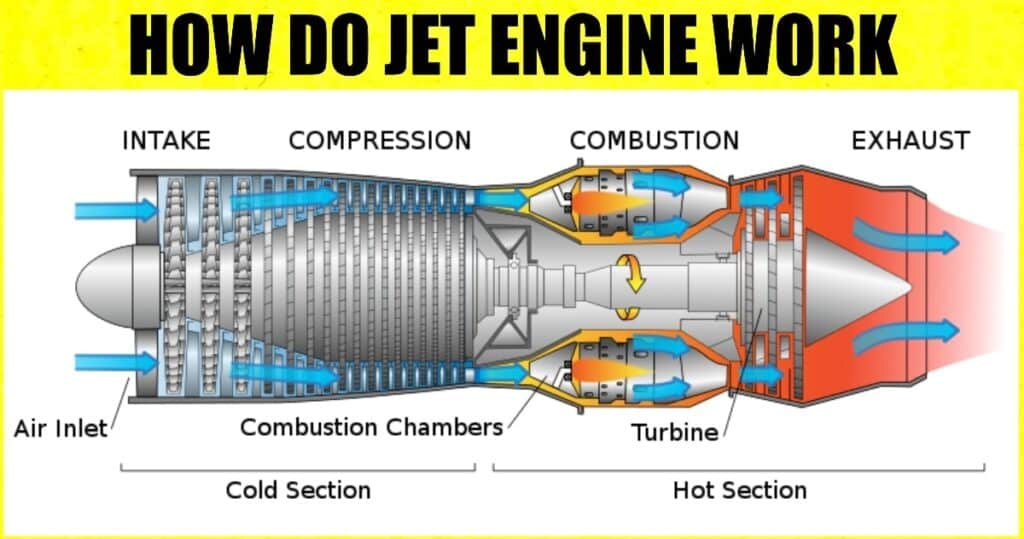
Forget complex diagrams for a sec. At its core, every jet engine does four things, in that exact order:
Must Read
- Suck in air. A LOT of it.
- Squeeze it. Hard.
- Bang! Ignite it. Like an endless firework show.
- Blow it out. Really, really fast.
That’s it! That rapid expulsion of hot air is what pushes the plane forward. It’s Newton’s Third Law having a party: for every action, there is an equal and opposite reaction. The engine shoves air backward, and the air shoves the engine (and plane!) forward. Simple, right?
Part 1: The Greedy Gulper – The Compressor
First up, the intake. This is the giant opening at the front. It’s designed to gobble up air like a hungry monster. A big turbofan engine on a passenger jet can suck in a volume of air equivalent to a swimming pool every second! Imagine that snack time!
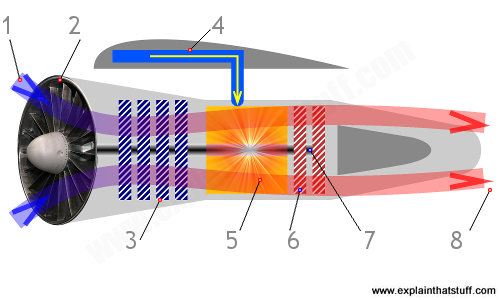
Once the air is inside, it hits the compressor. This isn't just one fan, oh no. It's a whole series of blades, rows and rows of them, spinning at mind-boggling speeds. They look like a stack of tiny, angry ceiling fans. Their job? To cram all that air into a much smaller space. Think of it like a bicycle pump, but on an industrial, supersonic scale.
This "squeeze" does two things: it increases the air pressure massively (up to 40 times atmospheric pressure!) and it heats the air up significantly, just from the friction of all that compression. Wild, huh?
Part 2: The Inferno – The Combustor
Now, we have super-compressed, pre-heated air. Time for the main event! This air gets squirted into the combustor (or combustion chamber). This is where things get fiery.

Fuel is continuously sprayed into this chamber, mixes with that hot, pressurized air, and BAM! Ignition. We’re talking a controlled explosion, folks, but an explosion nonetheless. The temperature inside a jet engine combustor can reach over 3,000°F (1,650°C). That's hotter than lava! Your BBQ grill wishes it was this cool.
The amazing part? The metal walls of the combustor don’t melt. How? Clever engineering using "cooling holes" that create a thin blanket of cooler air against the walls. Science is so smart!
Part 3: The Energy Recycler – The Turbine
Alright, we’ve got super-hot, super-fast expanding gases blasting out of the combustor. This is the raw power! But we need to harness some of that energy.

That’s where the turbine comes in. Right behind the combustor, these are another series of fan-like blades. But instead of compressing air, they’re designed to catch the blast of hot gas, like tiny wind turbines in a hurricane. As the hot gas hits the turbine blades, it makes them spin.
And here's the genius part: the turbine is connected by a shaft directly to the compressor at the front! So, the energy from the hot exhaust gases makes the turbine spin, which in turn spins the compressor, sucking in more air. It’s a self-sustaining, continuous power loop! Pure brilliance.
Part 4: The Push – The Nozzle
After all that squeezing, banging, and turbine-spinning, the super-hot, high-velocity gases are finally ready to escape through the nozzle at the back of the engine. This is the "blow" part. As these gases rocket out at incredible speeds, they create thrust, pushing the plane forward.

Think of letting go of an inflated balloon. The air rushes out one way, and the balloon zips the other. A jet engine is essentially a super-charged, continuous balloon-release system, only with way more fire and a lot less string.
Fun Facts & Quirks!
- Jet engines are incredibly strong. They're often tested by firing frozen chickens into them at high speed to simulate bird strikes. Yes, really!
- Those massive fans on the front of a turbofan engine? They're actually doing most of the work, pushing huge amounts of air around the core engine, not just through it. This makes them super fuel-efficient.
- The average jet engine has tens of thousands of parts, all working in perfect harmony. It's a symphony of precision engineering.
- The sound! That iconic roar isn't just noise; it's the sound of thousands of pounds of thrust being generated. It's the sound of power, literally!
So, the next time you hear that incredible roar as a plane takes off, remember the elegant, brutal dance happening inside. Suck, squeeze, bang, blow! It's a marvel of human ingenuity, powered by pure physics, and proof that sometimes, the coolest things are just a really, really controlled explosion.
Isn't science just the coolest?