
Is Young's Modulus The Same As Elastic Modulus

Okay, let’s talk about something that might sound super sciency. But trust me, it's sneakily lurking in your everyday life. We're diving into the world of moduli! Specifically, Young's Modulus and Elastic Modulus.
Now, are they the same thing? That's the million-dollar question, isn't it?
The Official Line (Boring, But Necessary)
Textbooks and serious scientists will tell you something very specific. They'll explain that Young's Modulus measures a material’s stiffness under tensile stress. Basically, how much it stretches or compresses under a straight pull or push.
Must Read
And the Elastic Modulus? It's the umbrella term. It describes a material's resistance to any type of elastic deformation.
This could be stretching, squeezing, twisting, or even bending! See? More general.
So, Officially... No
Technically, Young's Modulus is a type of Elastic Modulus. Like a square is a rectangle, but not all rectangles are squares. Got it? Good.
But here’s where my… unpopular opinion comes in.
My (Slightly Heretical) Take
Let's be honest. In everyday conversations, do people really care about such precise distinctions?
I'd argue that most of the time, when someone mentions the "elastic modulus," they're probably thinking about Young's Modulus.
Especially if they’re talking about, say, the stiffness of a rubber band or a metal beam. No one's performing complex shear stress calculations at a picnic!
It's All About Context, Baby!
Imagine you're choosing a bungee cord. You ask the shop assistant, "What's the elastic modulus?"
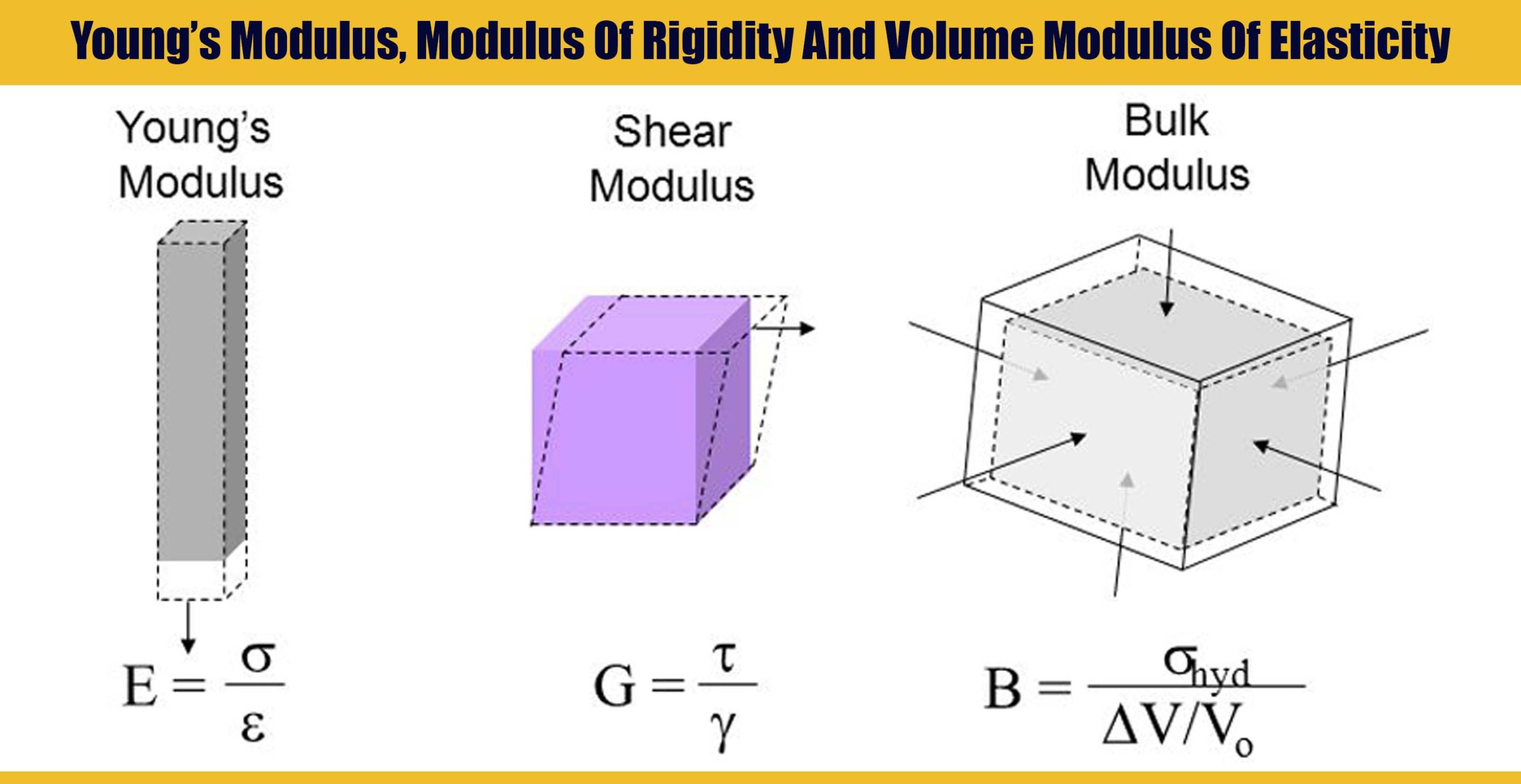
Are they really going to launch into a dissertation on Poisson's ratio and bulk modulus? Probably not!
They’ll likely tell you how much the cord stretches before it snaps, which is closely related to Young's Modulus.
Why the Confusion?
Part of the problem is the jargon. "Elastic Modulus" sounds like it should be a specific thing.
Like "Diamond Modulus," which would be a super-hard measurement. Instead, it is general term for measurement of stiffness!
And Young's Modulus? Well, poor Mr. Young. His name is just attached to one specific type.
The Physics Professor Test
Okay, picture this: You’re at a party, and you accidentally corner a physics professor. You ask, “Is Young's Modulus the same as Elastic Modulus?”
They’ll likely pause, adjust their glasses, and launch into a very long, detailed explanation of tensors and material properties. Prepare for a lecture!
But if you ask your engineer friend the same question? They'll probably say, "Yeah, pretty much. What are we building?"

Practicality vs. Purity
Look, I'm not saying we should all throw physics textbooks out the window. Precision is important!
But in real life? Clear communication is often more valuable than perfect accuracy.
If using "elastic modulus" to mean "stiffness under tension" gets the point across, then who am I to judge?
My (Unscientific) Conclusion
So, is Young's Modulus the same as Elastic Modulus? Officially, no.
But in everyday usage, where clarity trumps technicality? I'm going to say… close enough.
Fight me in the comments! (Just kidding… mostly.)
Let's Get Real (About Rubber Bands)
Think about a rubber band. You stretch it. That stretching relates directly to Young's Modulus.
Are you thinking about its shear modulus while you're launching paper clips across the room? Probably not.

So, when you say "This rubber band has a high elastic modulus," people understand you mean it's hard to stretch.
The "Good Enough" Principle
Engineering and applied science are all about the "good enough" principle. Is it accurate enough for the task at hand?
If you're designing a suspension bridge, you'll need to know all the moduli with extreme precision. But if you're choosing a spring for a toy car?
Close enough is often good enough. Don't overcomplicate things!
The Case for Simplicity
Science can be intimidating. All those big words and complicated equations!
But understanding basic concepts doesn't have to be a chore. Sometimes, simplifying things makes them more accessible.
And if that means blurring the lines between Young's Modulus and Elastic Modulus in casual conversation? So be it.
Embrace the Nuance (Or Ignore It)
Ultimately, it's up to you. Do you want to be a stickler for technical accuracy? Go for it!
Do you prefer to use language that's easy to understand, even if it's slightly imprecise? That's fine too.
Just be aware of the potential for misunderstanding, and adjust your language accordingly. And maybe carry a physics textbook to your next party. Just in case.
The Moral of the Story (Maybe)
Don't be afraid to simplify complex topics for general understanding.
Context matters! Think about your audience and the situation.
And remember, a little bit of scientific understanding is better than none at all. Even if it's slightly… unconventional.
One Last Thought
Maybe we should rename Young's Modulus. Something catchier. Something less… specific.
How about "Stretchiness Factor"? Or "Pull-Apart-Resistance"?
Okay, maybe not. But a girl can dream, right?