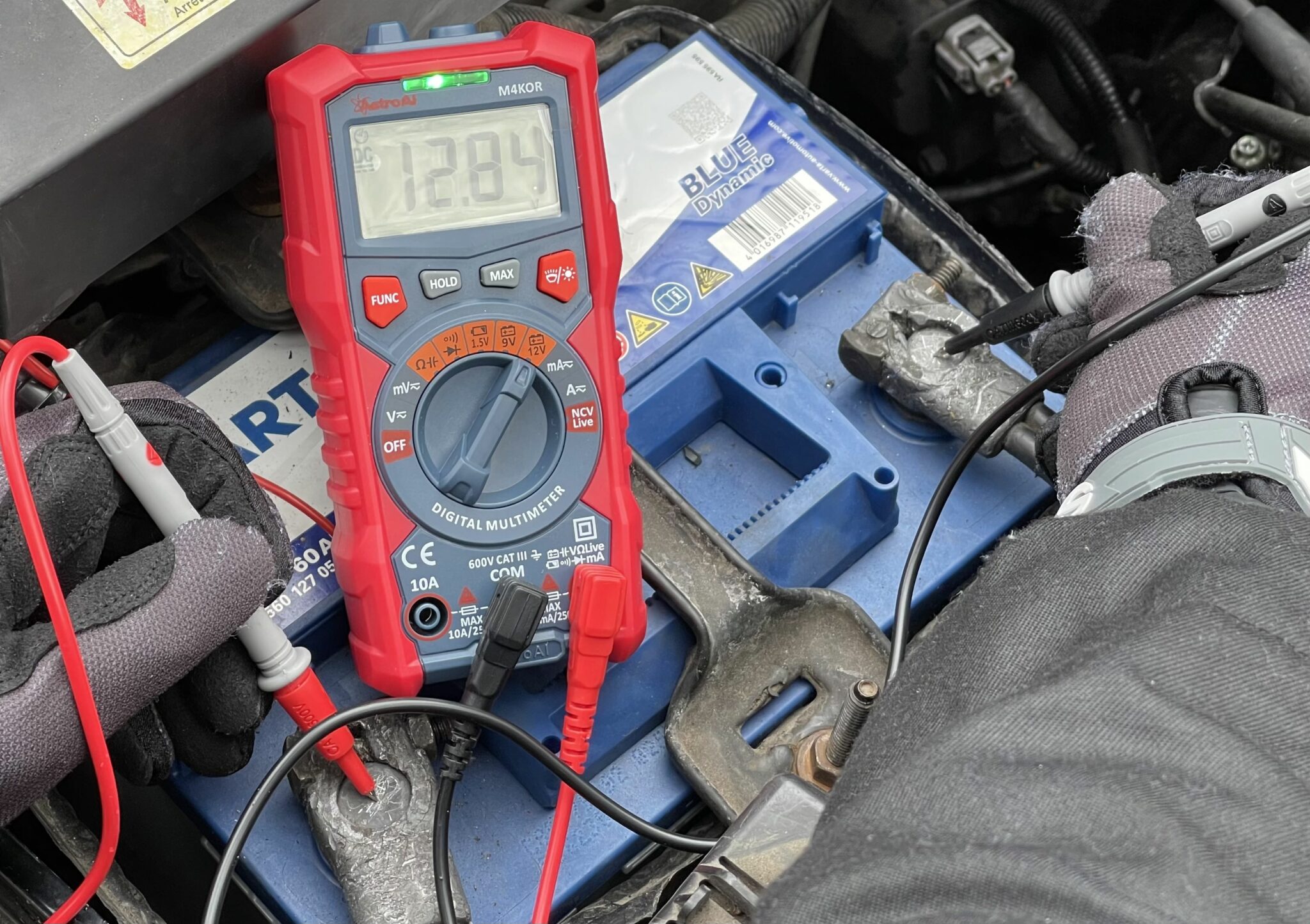
How To Use A Multimeter To Test A Car Battery

Ever felt that sinking feeling when you turn the key in your ignition and… nothing? Just a pathetic click, or worse, silence? Chances are, your car battery might be the culprit. But before you call a tow truck or start blaming gremlins, there's a simple tool that can help you diagnose the problem: a multimeter. Learning how to use one to test your car battery isn't just practical; it's surprisingly empowering. Think of it as becoming a detective for your car!
So, what is a multimeter, and why is it useful? Essentially, it's an electronic Swiss Army knife. It measures voltage, current, and resistance. In the case of your car battery, we're primarily interested in voltage. A healthy car battery should hold a certain voltage, and if it's significantly lower, it could indicate a problem. Knowing this helps you avoid getting stranded and potentially saves you money by identifying the issue before it becomes a bigger (and more expensive) problem.
The benefits extend beyond just car batteries too. Knowing how to use a multimeter opens doors to understanding basic electrical circuits. In education, students use multimeters in physics and electronics classes to learn about Ohm's Law and to troubleshoot simple circuits. In daily life, you could use it to check the voltage of household batteries, troubleshoot faulty wiring in a lamp, or even diagnose issues with your bicycle's electric components. It's a skill that translates to numerous areas.
Must Read
Ready to give it a try? Here’s a simplified guide to testing your car battery:
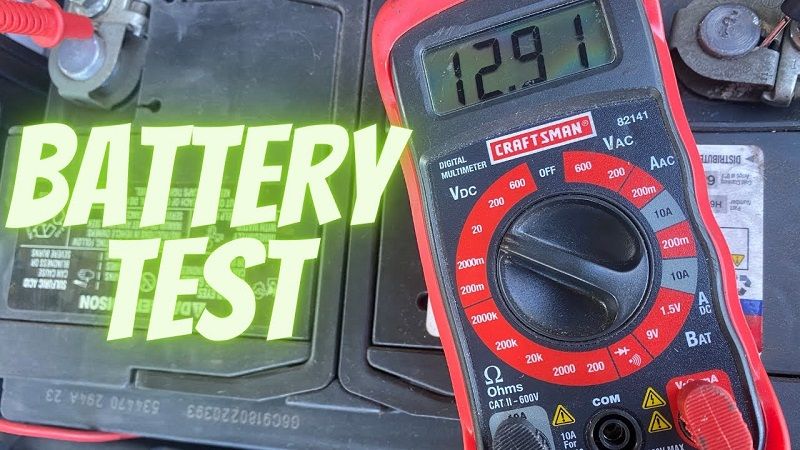
- Safety First! Wear eye protection (safety glasses) and avoid touching any exposed metal parts while the multimeter is connected.
- Set the Multimeter: Turn your multimeter on and set it to measure DC voltage (usually indicated by a "V" with a straight line above it). Select a range slightly above the expected voltage of your car battery (usually 12V or 20V).
- Connect the Probes: Locate the positive (+) and negative (-) terminals on your car battery. Connect the red probe of the multimeter to the positive terminal and the black probe to the negative terminal.
- Read the Voltage: Observe the reading on the multimeter's display. A fully charged battery should read around 12.6 volts or higher. A reading below 12.4 volts could indicate a discharged battery. A reading significantly lower than that (e.g., below 11.8 volts) could indicate a bad battery.
- Test Under Load: For a more accurate assessment, you can test the battery while the car is running. Have someone start the car and observe the voltage reading. It should drop slightly but remain above 10 volts. A significant drop indicates a weak battery.
Important Note: These are simplified steps. Always consult your car's owner's manual and the multimeter's manual for specific instructions and safety precautions. If you're uncomfortable working with electrical components, it's always best to consult a qualified mechanic.
Exploring the world of multimeters is a journey. Start with simple tests, like checking AA batteries around the house. Watch some YouTube videos on basic electrical circuits. You'll be surprised at how quickly you pick up the basics. Soon, you'll be diagnosing car battery problems and impressing your friends with your newfound electrical prowess. Remember, the best way to learn is by doing. So grab a multimeter and start exploring!