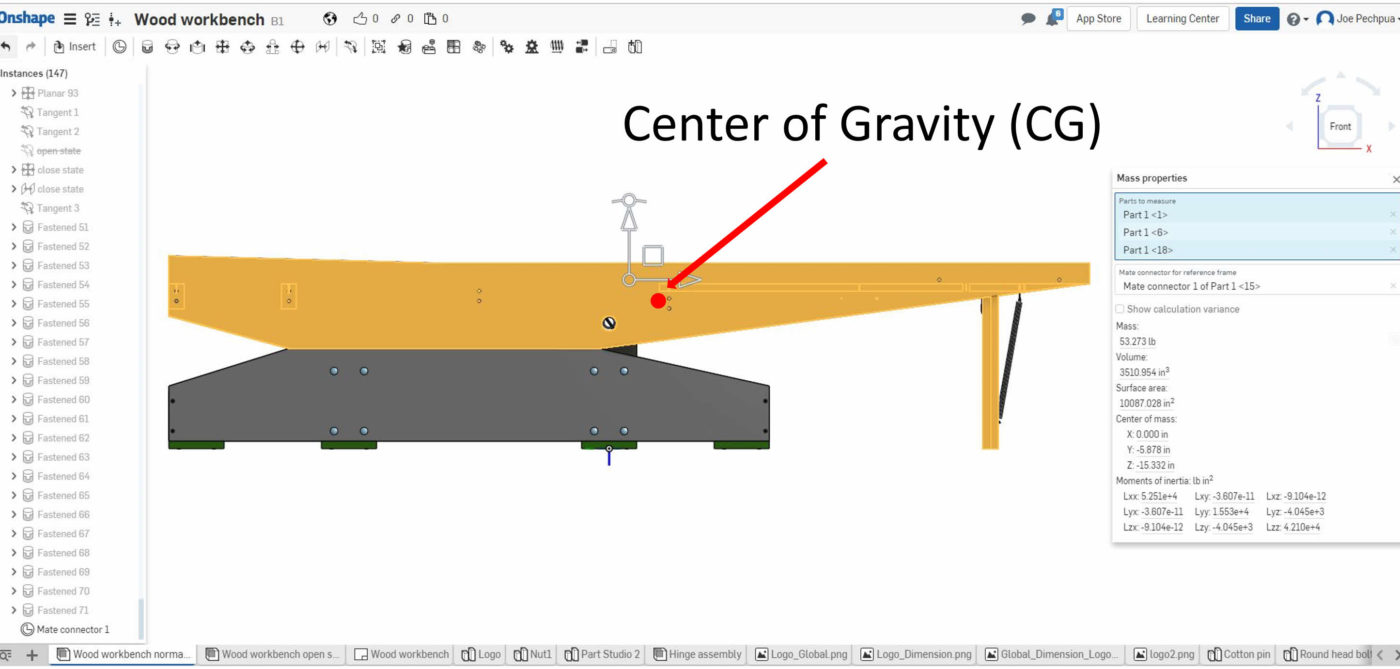
How To Test Objects In Onshape Assembly Gravity

Ever wondered if your virtual contraption would actually work in the real world? In the sleek world of Onshape, you can ditch the guesswork and give your assemblies a gravitational reality check. Think of it as a digital stress test, like putting your dream house through a virtual hurricane before laying the first brick.
Setting the Stage: Onshape Assembly Basics
First things first: you’ll need an Onshape Assembly. This is where all your individual part designs come together to form a glorious whole. Think of it as the digital equivalent of a LEGO masterpiece. Make sure you’ve got all the pieces properly defined and mated – no floating pieces allowed! Think of it like preparing your set before pressing 'record' on a stop motion film. You want to avoid that 'where did that piece come from?' moment.
Introducing Gravity: The Unseen Force
Onshape doesn't automatically factor in gravity. It's like a silent movie where you have to imagine the sound effects. To introduce this fundamental force, we need to use the Motion Studies tool. It’s located in the assembly environment and is your gateway to simulating real-world physics.
Must Read
Inside Motion Studies, you'll find various tools, but we're focusing on Simulations. Click on the 'Add Simulation' button (it looks like a little graph). This is where the magic begins.
Defining the Simulation: What Goes Up...
Now comes the fun part: setting up the simulation. We need to tell Onshape about gravity. Look for the 'Gravity' option, usually under 'External Loads' or 'Environment'. Ensure it's enabled. Here's a pro-tip: the direction of gravity defaults to the Z-axis. Adjust this if your assembly is oriented differently. Imagine trying to pour water upwards, the same principle applies here.
Next, you'll need to consider the degrees of freedom of your parts. Are they free to move? Are they connected with joints that allow rotation? Onshape needs to know this to accurately simulate the effect of gravity. For example, a hinged door has one degree of freedom (rotation around the hinge), while a static, bolted connection has none. Think about how a puppet moves. It's not just gravity, but also the strings holding it together (or not!).
Adding Constraints: The Rules of Engagement
Constraints are vital. They define how your parts interact. Do you have a pin joint? A sliding joint? Make sure these are accurately defined in Onshape. Incorrect constraints can lead to… shall we say… explosive results in your simulation. Nobody wants a digital chain reaction of unintended consequences.

Running the Simulation: Lights, Camera, Action!
With everything set up, it's time to run the simulation. Click the 'Run' or 'Solve' button (it usually looks like a play button). Onshape will now calculate how your assembly behaves under the influence of gravity. Watch closely! Does everything fall as expected? Do parts collide? This is your chance to identify design flaws before they become costly real-world problems. It’s like watching a prototype test video, bracing yourself for the unexpected.
Analyzing the Results: The Post-Mortem
After the simulation, Onshape provides a wealth of data. You can view animations of the motion, plot graphs of forces and displacements, and even export the data for further analysis. This is where you really understand how your design performs. Did that support beam hold? Did the suspension system compress correctly? This is equivalent to reading a play's reviews after the opening night.

Pro Tips and Tricks: Level Up Your Gravity Game
- Simplify Complex Assemblies: Start with simplified versions of your assembly to debug the simulation setup.
- Check Units: Make sure all your units (length, mass, time) are consistent. A mix-up can lead to disastrously wrong results.
- Use Appropriate Constraints: Don't over-constrain or under-constrain your assembly. The constraints should accurately represent the real-world behavior.
- Iterate: Design is an iterative process. Run simulations, analyze the results, make adjustments, and repeat. Think of it as a digital dance of design and refinement.
Beyond the Virtual: Real-World Relevance
Simulating gravity in Onshape isn't just about avoiding digital crashes; it's about building better, more reliable products. By understanding how your designs behave under real-world conditions, you can optimize their performance, reduce material costs, and ultimately create solutions that stand the test of time (and gravity!). It’s a little like preparing for a marathon: you don’t just show up on the day, you train, analyze your performance, and adjust your strategy.
So, next time you're designing something in Onshape, remember to give it a gravity check. It's a small step in the virtual world that can make a huge difference in the real one.