
How To See Planets From Earth Without Telescope
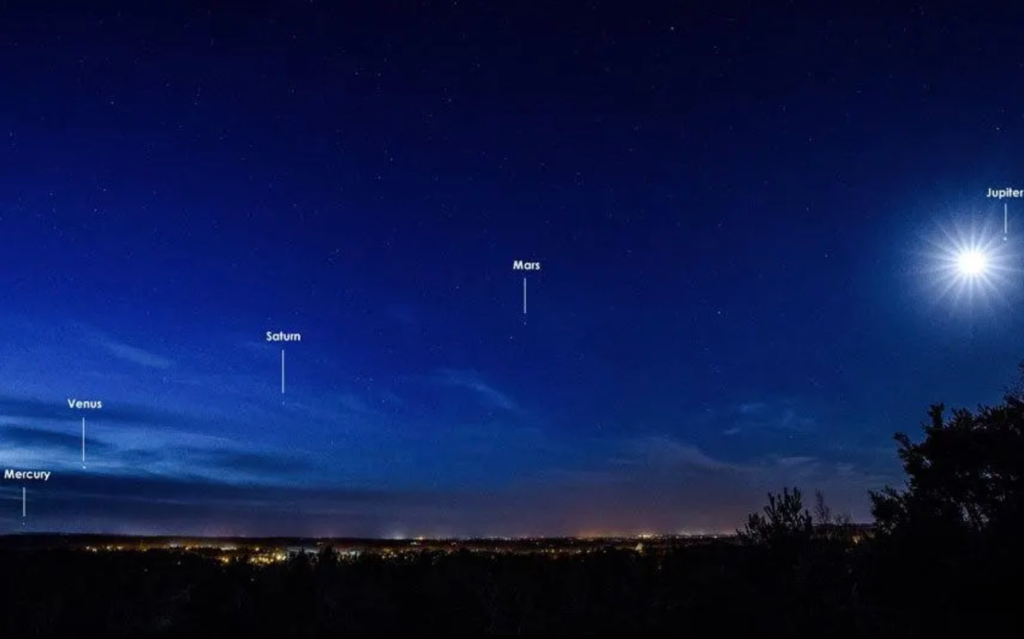
Have you ever looked up at the night sky, truly looked, and wondered what else is out there? We often think we need expensive equipment like telescopes to explore the cosmos, but the truth is, you can see planets from Earth with just your own two eyes! It's a humbling and awe-inspiring experience, connecting us to something far grander than ourselves. Learning to identify these celestial wanderers is like unlocking a secret code to the universe, a code you can decipher from your own backyard.
So, what's the point? Why bother learning to spot planets without a telescope? For starters, it’s incredibly accessible. No special tools are required, just a willingness to look up. It's also a wonderful way to appreciate the sheer scale of our solar system and our place within it. Imagine pointing out Venus, a scorching hot world, or Mars, the rusty red planet, to your friends and family. You become a temporary guide to the cosmos, sharing the wonder and mystery of space. Beyond the cool factor, it fosters a deeper connection with the natural world, reminding us of the forces at play beyond our planet.
The benefits extend beyond pure enjoyment. In education, identifying planets can be a fantastic way to introduce astronomy to children. Instead of abstract concepts, they can see the planets, making the learning experience more tangible and engaging. It can spark curiosity and encourage further exploration into science and related fields. In daily life, knowing the planets' positions can add a new dimension to your evening walks or camping trips. It allows you to participate in the cosmic dance, observing the ever-changing relationships between Earth and its planetary neighbors. Plus, knowing when to look for specific planets can lead to some truly stunning views. Imagine witnessing Venus at its brightest, shimmering like a diamond in the twilight sky.
Must Read
Ready to start planet-spotting? Here are a few practical tips: First, find a location with minimal light pollution. The darker the sky, the easier it will be to see fainter objects. Next, download a stargazing app like Stellarium or SkyView. These apps use your location and time to show you exactly where planets are in the sky. They’re like having a personal planetarium in your pocket! Venus and Mars are often the easiest to spot due to their brightness and distinctive colors. Venus appears as a brilliant "star" in the early morning or evening sky, while Mars has a reddish hue. Look for them near the horizon, especially after sunset or before sunrise.
Jupiter and Saturn are also visible to the naked eye, though they are fainter and require darker skies. Jupiter is typically the brighter of the two. They often appear as steady, bright lights that don't twinkle like stars. Keep an eye out for planetary conjunctions, when two or more planets appear close together in the sky. These are stunning events and relatively easy to see without any equipment. Finally, remember that patience is key. Learning to identify planets takes time and practice. Don't be discouraged if you don't see them right away. Keep looking up, keep learning, and eventually, you'll unlock the secrets of the night sky. So go forth and explore the universe, one planet at a time!


