
How To Hook Up A 3 Phase Motor

Alright, so you’ve got this shiny (or maybe not-so-shiny, let’s be real) 3-phase motor staring back at you, huh? And you're thinking, "Whoa, three phases? That sounds like a whole lot more complicated than my toaster!" Trust me, I get it. It feels like stepping into the big leagues of electrical wizardry. But guess what? It’s really not that scary. In fact, once you get the hang of it, hooking up a 3-phase motor is often simpler than wrestling with a single-phase beast.
So, grab a coffee (or whatever your preferred thinking beverage is) and let’s walk through this like we’re just, you know, hanging out. You'll be a 3-phase pro in no time. Promise!
First Things First: Safety Dance!
Okay, before we even think about touching wires, let's talk safety. This isn't a suggestion, it's a commandment. Seriously, electricity is like that friend who's super fun but also totally unpredictable if you don't treat them with respect. It can bite, and it bites hard.
Must Read
Step one, always: KILL THE POWER. I mean it. Not just "flip the switch" at the machine. Go to the breaker panel, find the main breaker for that circuit, and flip it. Better yet, slap a lock-out/tag-out on it if you're in a shop environment. You want to be absolutely, positively, undeniably sure that no sneaky electrons are going to come zapping your fingers when you least expect it.
Think of it as setting the stage. You wouldn't try to change a flat tire on a car speeding down the highway, right? Same principle. Power off, friend. Power off.
Meet Your Wires (They're Not So Shy)
Alright, power's off, you're safe, you've probably had a sip of that coffee. Now let's open up the motor's terminal box. You'll likely see a bunch of wires in there. For a standard 3-phase motor (we’re talking simple induction motors here, not fancy VFD-controlled ones with a million sensors), you're usually looking for three main power leads and a ground.
These are often labeled T1, T2, T3. Sometimes they'll just be numbered 1, 2, 3. These are your motor's "phases." They're the muscle. Then there's usually a green or bare copper wire – that's your ground, and it’s super important.
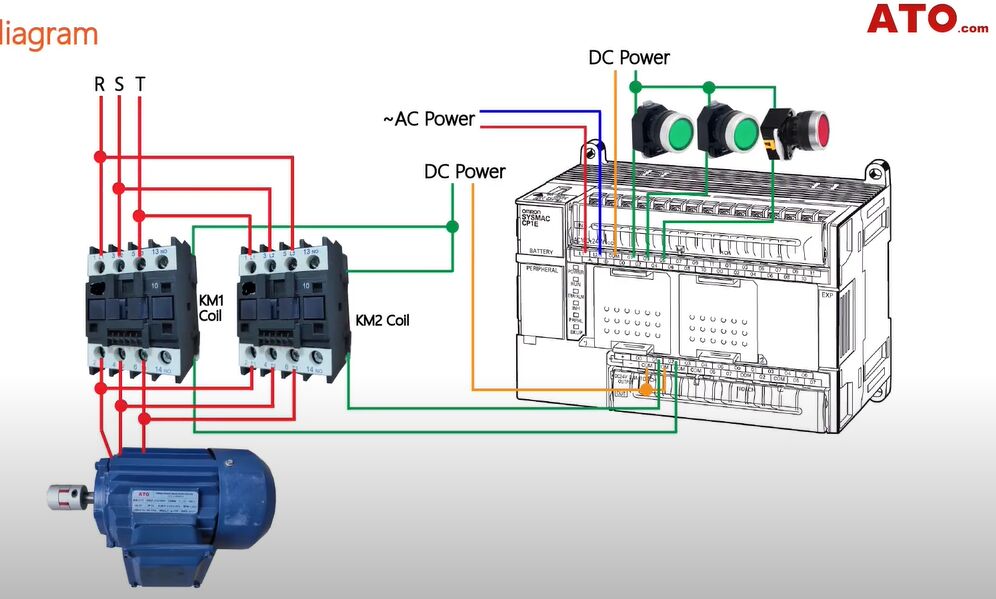
Now, look at your incoming power supply. You should have three hot wires (L1, L2, L3) and a ground wire. The colors might vary depending on where you are in the world (black, red, blue; brown, black, grey; etc.), but the important thing is that you have three distinct "hots" and a ground.
Don't panic if your wire colors don't perfectly match up between the supply and the motor's internal leads. What matters is that you connect a hot to T1, a hot to T2, and a hot to T3. It's like a three-way handshake!
The Big Connection: It's Easier Than You Think
Here’s where the magic happens. Or, you know, the very logical electrical connection process. It’s not rocket science, just good old electrical engineering! Get your crimpers and connectors ready (or just good old wire nuts, if that's your style and it's rated for the current).
1. Match 'em Up: Take your L1 (one of your incoming hot wires) and connect it securely to the motor's T1 terminal. 2. Next in Line: Grab your L2 and connect it to T2. 3. The Last One: You guessed it! L3 goes to T3.

See? Told you it wasn't rocket science! It’s just 1-to-1, 2-to-2, 3-to-3. Easy peasy lemon squeezy.
Don't Forget Your Ground! (Seriously, Don't)
Before you even think about closing that terminal box, make sure your ground wire is connected. Your supply ground wire (green or bare copper) needs to go to the motor's ground terminal. This is usually marked with a ground symbol or simply a green screw. This isn’t just for fun; it’s a lifesaver. If something goes wrong internally with the motor, that ground wire is what protects you from getting shocked. It gives fault current a safe path to ground. Think of it as your motor's safety blanket, and yours!
The Moment of Truth: Spin Cycle!
Okay, all your connections are tight, insulated, and neatly tucked away. Double-check everything. Take a deep breath. Close up the terminal box. Now, go back to that breaker panel.
Remove your lock-out/tag-out. Flip the breaker. Head back to your motor and, from a safe distance, briefly hit the start button or flip the switch. Just for a second or two.
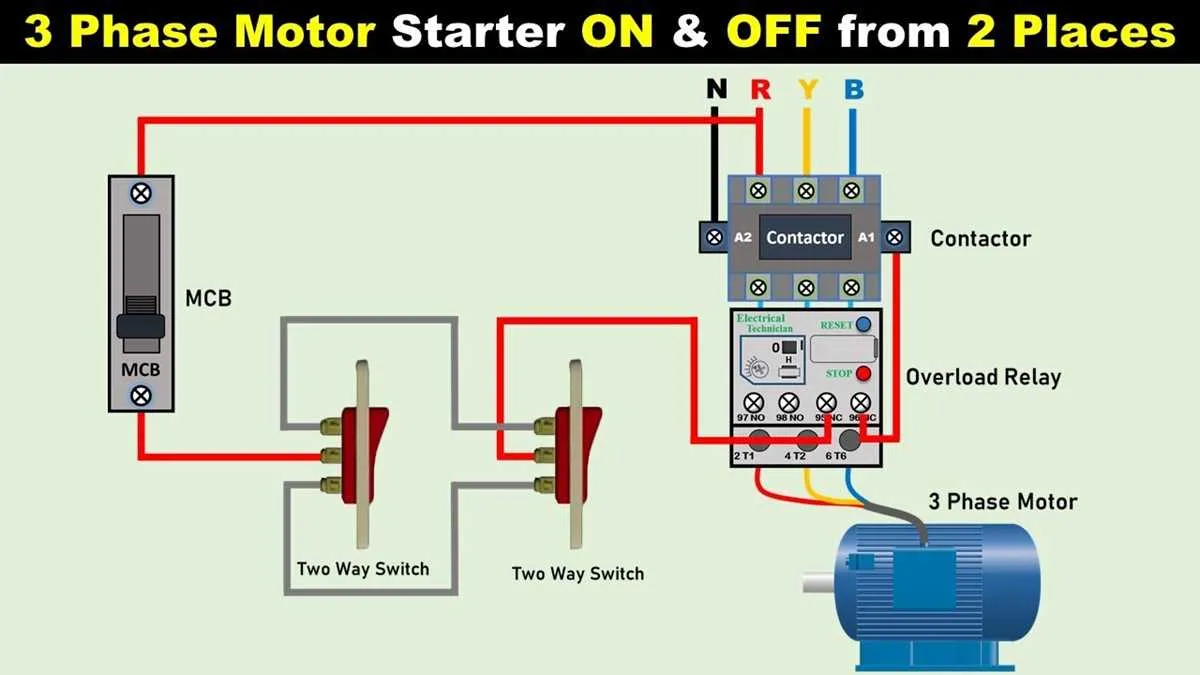
What are you looking for? Direction of rotation!
-
Is it spinning the right way? Awesome! High five! You just hooked up a 3-phase motor like a boss. Let it run, check for weird noises, smells, or vibrations. If all looks good, you're golden.
-
Is it spinning backward? Don't panic! This is super common with 3-phase motors. They're like little electrical compasses, and sometimes you just need to swap two wires to change their direction.
Oops, Wrong Way! How to Fix It
If your motor is spinning the wrong way, go back to Step one: KILL THE POWER! Seriously, don't try to do this with power on. Once the power's off and verified, open up that terminal box again.

Now, pick any two of your incoming hot wires (L1, L2, or L3) and simply swap them. For example, if L1 was going to T1 and L2 to T2, now connect L1 to T2 and L2 to T1. Leave L3 alone. Just swap any two of the three phase wires. It really doesn't matter which pair.
Re-secure everything, close the box, restore power, and test again. Voila! It should now be spinning in the correct direction. If it's still wrong, you might have swapped the wrong two, or there's a more complex issue, but usually, one swap does the trick.
You Did It!
See? I told you it wasn't so bad! You’ve just successfully navigated the world of 3-phase power, made your connections, and got that motor humming along happily. You're basically an electrical wizard now, just, you know, a very casual one who knows how to stay safe.
Next time you see a 3-phase motor, you won't be intimidated. You'll just think, "Hey, I know that guy!" Go forth and power all the things, my friend!