
How To Find The Coefficient Of Kinetic Friction
Friction! It's that force that keeps us from sliding all over the place. And while it might seem like a drag (pun intended!), understanding friction, and specifically the coefficient of kinetic friction, can actually be pretty fascinating. Think about it: why is it easier to slide a hockey puck on ice than on asphalt? It all comes down to that sneaky coefficient! Plus, knowing how to find it can be surprisingly useful in all sorts of everyday situations.
So, why should you care about the coefficient of kinetic friction? Well, for beginners just dipping their toes into the world of physics, it's a fantastic way to solidify your understanding of forces, motion, and how they interact. For families, it can lead to fun experiments! Imagine building a ramp and testing different materials to see which has the lowest coefficient – who can make their toy car go the furthest? And for hobbyists, like woodworkers or even mechanics, understanding friction is essential for everything from choosing the right lubricants to designing efficient mechanisms.
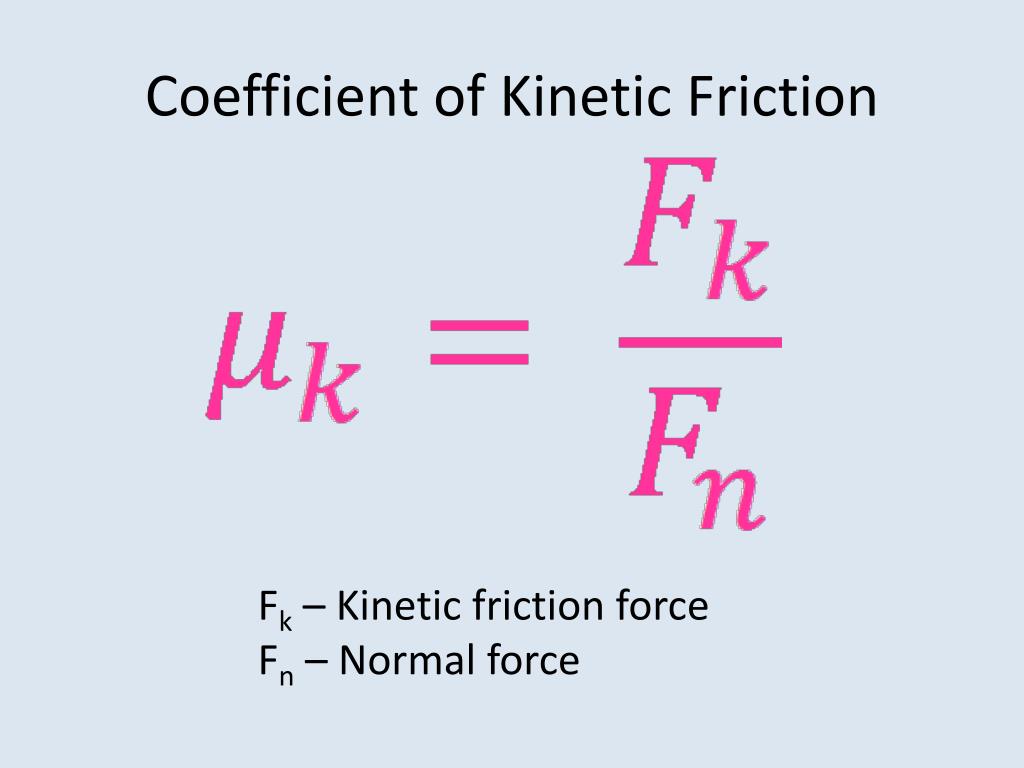
But what exactly is the coefficient of kinetic friction? Simply put, it's a number that represents the amount of friction between two surfaces when one is sliding over the other. A lower coefficient means less friction, making it easier to slide. Now, let's talk about how to find it. The most common way is to use a simple equation: μk = Ff / Fn, where μk is the coefficient of kinetic friction, Ff is the force of friction, and Fn is the normal force (the force pressing the two surfaces together).
Must Read
Here's a practical example. Let's say you're dragging a box across a level floor. You use a spring scale to measure the force needed to keep the box moving at a constant speed – that's your force of friction (Ff). Then, you measure the weight of the box – that's your normal force (Fn). Divide the force of friction by the normal force, and boom! You've got the coefficient of kinetic friction. Remember, it's a dimensionless number, meaning it doesn't have any units.
There are variations on this, of course. If you're dealing with an inclined plane, you'll need to take the angle of the incline into account when calculating the normal force. But the fundamental principle remains the same: you're finding the ratio between the force of friction and the force pressing the surfaces together. Understanding free body diagrams is incredibly helpful in visualizing these forces!

Simple tips for getting started:
- Start simple: Use a flat surface and a block to minimize complications.
- Measure accurately: A good spring scale and accurate weight measurements are crucial.
- Maintain constant speed: This ensures that the force you're measuring is kinetic friction.
- Repeat experiments: Multiple trials will help improve accuracy.
So, there you have it! Finding the coefficient of kinetic friction doesn't have to be intimidating. With a little understanding of the underlying principles and some careful measurements, you can unlock a deeper appreciation for the forces that govern the world around us. And who knows, maybe you'll even discover a new way to make things slide a little easier!


