
How To Find Ductility From Stress Strain Curve
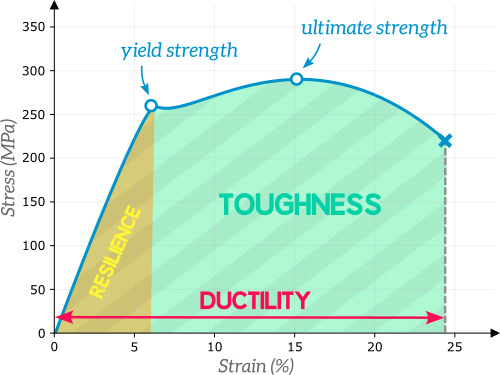
Alright, so you're looking at a stress-strain curve, huh? Don't let it intimidate you. Think of it like this: it's basically a graph of how much something stretches (strain) when you pull on it (stress). Finding the ductility is like figuring out how much your favorite stretchy pants can handle before they, well, rip.
See, everything has a limit. Even those "one-size-fits-all" socks that somehow always end up fitting your big toe perfectly and leaving your heel exposed. That's kind of like the stress-strain curve telling you when your material has had enough.
Understanding the Stress-Strain Relationship
Imagine you're gently pulling a rubber band. That's the stress you're applying. The rubber band stretching is the strain. The more you pull (more stress), the more it stretches (more strain). Up to a point, right? Eventually, snap!
Must Read
The stress-strain curve is just a fancy way of plotting this relationship. It's got stress on one axis (usually the vertical, or y-axis) and strain on the other (horizontal, or x-axis). The shape of the curve tells you a LOT about the material. Is it brittle like a dry cracker? Or ductile like...well, those stretchy pants?
Think about it like this: would you rather have a friendship that's like a dry cracker, breaks easily at the slightest tension? Or one that's more like a stretchy pant, forgiving and able to handle a bit of 'stressful' situations. Ductility is that friend who can handle a bit of drama!

Ductility: The Measure of "Stretchiness"
Ductility is basically a material's ability to deform plastically before it fractures. "Plastically"? Don't sweat it. It just means it can change shape permanently without breaking. Think of bending a paperclip. You can bend it quite a bit before it snaps, right? That's ductility in action!
A material with high ductility can be drawn into wires (think copper wiring) or hammered into thin sheets (think aluminum foil). A material with low ductility is brittle. Like that old, stale gingerbread man that snaps when you try to pose him dramatically for Instagram.

How to Find Ductility on the Curve: Two Main Methods
Okay, here's where we get slightly technical, but I promise it's not rocket science. There are two main ways to find ductility using the stress-strain curve:
- Percent Elongation: This is the more common and intuitive method. Basically, you look at the total strain at fracture (where the curve ends – BAM! The material broke!). Then you express this strain as a percentage. A higher percentage means more ductility. It’s like saying, "This material stretched 20% of its original length before breaking!" Think about measuring your kid's height every year. Percent Elongation tells you how much your material 'grew' before hitting it's limit.
- Percent Reduction in Area: This method is used especially for materials tested under tensile loading (pulling). It's a bit more involved. You measure the original cross-sectional area of the material before you pulled on it, and then the area of the fracture surface after it broke. Then, you calculate the percentage change. A larger reduction in area indicates higher ductility. The more it narrows, the more it could take the stretching.
So, you find the point on the curve where the material fractured, then you figure out the strain at that point and, voila, you've got your percent elongation! For reduction in area, it involves some more precise measuring after the material's, well, gone to pieces.

Why Ductility Matters
Ductility is super important in engineering because it tells engineers how a material will behave under stress. Will it bend? Will it crack? Will it explode dramatically?
Knowing the ductility helps engineers choose the right materials for the right applications. Think about bridges. You want materials that can bend and flex a little bit without snapping during earthquakes. That's why steel, which is fairly ductile, is often used. A brittle material would be a disaster!
So, next time you're wrestling with a stubborn piece of metal or marveling at the strength of a bridge, remember the humble stress-strain curve and the powerful concept of ductility. It's all about figuring out how much stuff can stretch before it goes splat.
