
How To Convert From Kw To Kwh
Alright, settle in, because we're about to crack open one of life's great mysteries. No, not Bigfoot, or where all those missing socks go. We're talking about something even more electrifying: the dazzling, confusing, and ultimately super-fun world of converting from kW to kWh!
Sounds like a mouthful, right? Like some secret code only engineers understand. But guess what? It’s not! It’s actually pretty simple, incredibly useful, and frankly, a little bit like learning a magic trick. You'll be impressing your friends, confusing your pets, and maybe even understanding your electricity bill better. How cool is that?
What's the Big Deal, Anyway?
Ever looked at a gadget and seen "kW" then glanced at your energy bill and seen "kWh" and thought, "Huh?" You're not alone! It's like seeing "miles per hour" on your speedometer but then getting charged for "miles." One tells you how fast you're going, the other tells you how far you've gone. See? Already making sense!
Must Read
This isn't about getting super serious with physics. It's about unlocking a tiny bit of the energy language that surrounds us. It's about seeing the "h" at the end and realizing it's not a typo, but the secret ingredient!
Meet Our First Star: kW (Kilowatt)
Let's give a round of applause for the kW! Think of kW as power. It's the instant oomph, the burst of energy something needs right now to do its job. Imagine a super-fast race car. Its engine might have a certain horsepower – that's its kW equivalent. It's about how much power it can deliver at any single moment.
Got a powerful microwave? That's its kW rating flexing its muscles. A big electric oven? More kW! It's like the speed at which something uses or produces energy. A 1 kW toaster, for instance, uses 1 kilowatt of power the instant you press the lever. It's always ready to rumble, but it's not actually "doing" anything until you hit that button, right?
Now, Let's Introduce kWh (Kilowatt-hour)
And here's the star of the show, the mysterious kWh! This little guy is all about energy. Not just the instant burst, but the total amount of energy that's been used or produced over a period of time. Going back to our race car, kWh is like the total distance the car traveled. It factors in how fast it went AND for how long.
Your electricity bill? That's all about kWh. They're not charging you for the speed at which your fridge could potentially cool things, but for the actual amount of energy it used over the month. It's the difference between saying "my car can go 100 mph" (kW) and "I drove 200 miles today" (kWh). One is capability, the other is consumption!
The Secret Sauce: Time (The "h" Factor)!
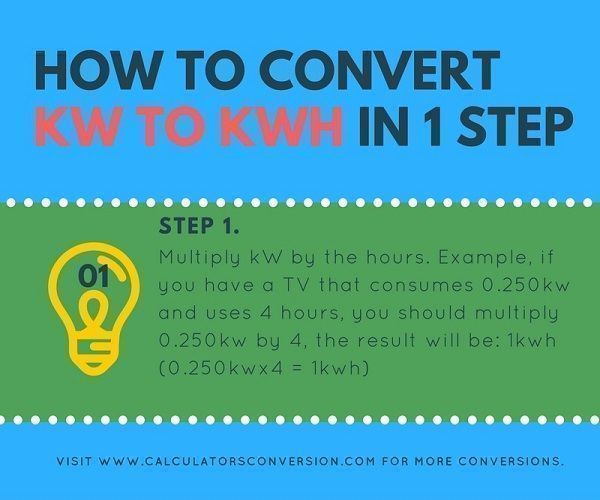
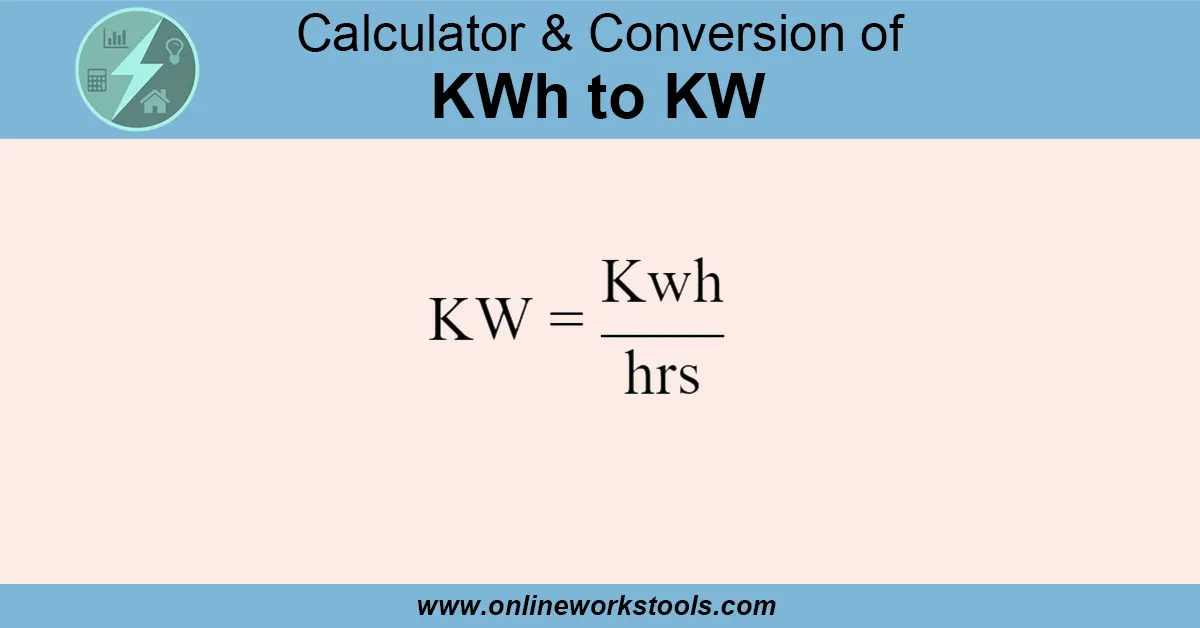
See that little "h" at the end of kWh? That's not just for show. That's the magic ingredient, the key that unlocks the whole mystery! The "h" stands for hours. And that, my friend, is how you convert from kW to kWh. You simply multiply the power (kW) by the time (hours) that power was used!
It’s not rocket science, it’s just… time! Think about it: a very powerful device used for a short time might use less total energy than a less powerful device used for a very, very long time. That’s why the "h" is so important. It brings context to the power. Without it, you’re just talking about potential, not actual usage.
The (Not So) Secret Formula!
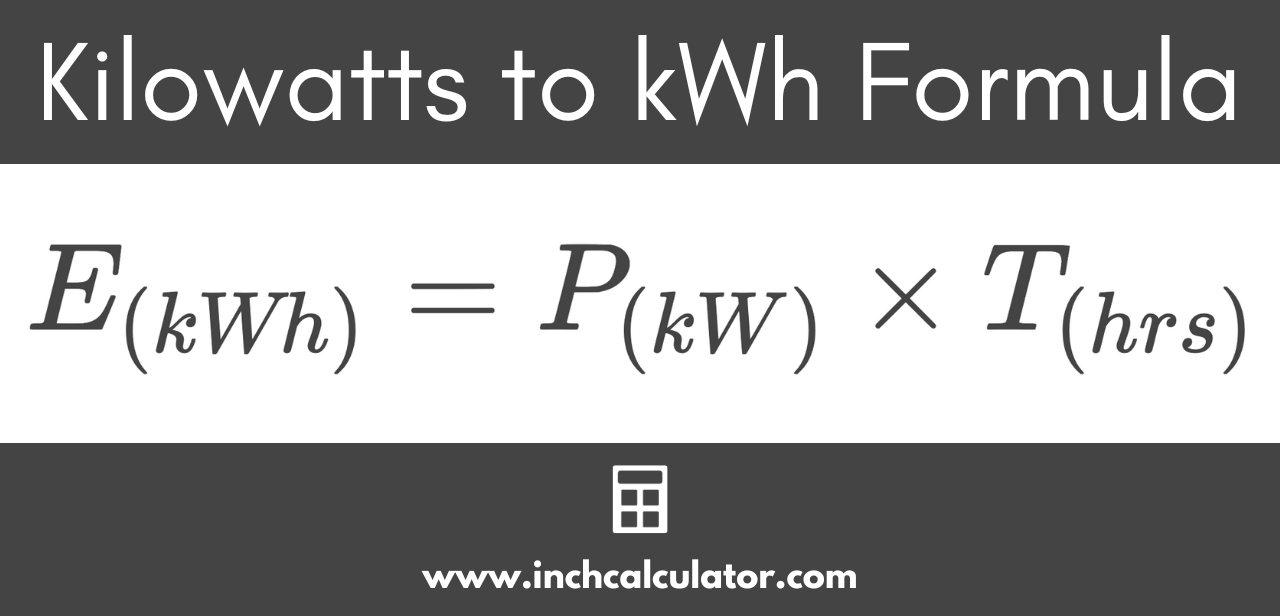
Ready for the big reveal? Here it is, written in plain English, no complex equations needed:
kW × hours = kWh
Boom! Mind blown yet? It’s seriously that straightforward. Take the device's power rating in kilowatts, figure out how many hours you used it, multiply those two numbers together, and voilà! You have its energy consumption in kilowatt-hours. It’s like baking a cake; you need the ingredients (kW) and the time in the oven (hours) to get the finished delicious cake (kWh)!
Let's Play! Some Fun Examples!
Imagine you have a trusty 1 kW toaster (that's 1000 watts, for the curious!). If you use it for just one hour straight (maybe you're making a LOT of toast for a party), you've used:
1 kW × 1 hour = 1 kWh. Simple!
But what if you only toast for, say, 15 minutes a day? That's 0.25 hours (15/60).
1 kW × 0.25 hours = 0.25 kWh. See? It gets smaller!
Now, let's get a bit wild. Your fancy new electric vehicle charger pulls 7 kW of power. You plug in your car for 4 hours to get a good charge. How much energy did you use?
7 kW × 4 hours = 28 kWh. That's a decent chunk of energy, probably giving your EV a good boost!
It's like figuring out how many chocolate chip cookies you ate. You can have a big cookie (high kW) or a small cookie (low kW). But the total number of cookies (kWh) depends on how many you eat over time!
Why Bother With All This Fun?
Beyond just satisfying your inner energy detective, understanding kW and kWh is genuinely useful!
- Save Money: You can estimate how much those energy-hungry devices are really costing you on your bill.
- Be Eco-Savvy: Understand your personal energy footprint.
- Impress Friends: Casually drop "Oh, that's like, 0.5 kWh for my coffee maker this morning" at brunch. Instant genius status!
- Smart Shopping: Compare appliances not just by their raw power, but by their estimated annual energy consumption (often listed in kWh!).
Quirky Energy Tidbits!
Did you know a standard incandescent light bulb (remember those?) uses about 0.06 kWh if left on for an hour? Whereas an LED equivalent uses barely 0.006 kWh for the same time! That's why the switch matters!
Or that if you ran a 100-watt light bulb (that's 0.1 kW) for a whole year, 24/7, it would consume about 876 kWh? That’s enough to power a small fridge for quite a while! See how the time factor totally changes the game? It’s not just about how bright it is; it’s about how long it stays bright.
You're an Energy Wizard Now!
So there you have it! The great kW to kWh conundrum, demystified with a dash of fun and a sprinkle of magic. You now speak a little more of the secret language of energy. It’s not scary math; it’s just understanding that power + time = energy used.
Go forth and amaze! Start looking at your appliances differently, with a newfound appreciation for their energy story. And remember, the "h" isn't silent; it's the loudest part of the whole conversion! You're basically an energy superhero. Congrats!