
How To Convert From Kva To Kw
Alright, settle in, grab your imaginary latte, because we're about to demystify something that makes even the most seasoned DIY enthusiasts scratch their heads: the mystical art of converting KVA to KW. You know that feeling, right? You're looking at a generator, or some industrial-grade electrical equipment, and suddenly you see "KVA" and "KW" staring back at you like two secretive twins whispering in a language you definitely didn't learn in school. It feels like deciphering ancient hieroglyphs, doesn't it? Well, fear not, my friend, because by the end of this, you'll be practically fluent.
KVA: The Overenthusiastic Salesperson
Let's start with KVA. What on earth is it? KVA stands for kilo-Volt-Amperes. Think of KVA as the big talker, the salesperson who promises the moon. It's the apparent power, the total electrical potential available in a system. Imagine you’ve ordered a massive, frothy beer at a pub. The KVA is the entire volume of that glass, foam and all. It’s the total capacity, the "potential" you're getting. But let's be honest, you're not drinking the foam, are you? That’s where KW comes in.
So, KVA is the sum of both the useful power and the "reactive" power (the stuff that just bounces around doing no real work, like that friend who talks a lot but never helps you move). It's always a bigger number than KW, because it includes all the electrical show-offs and the silent loafers.
Must Read
KW: The Hardworking Reality
Now for KW. This stands for kilowatts. This, my dear friends, is the hero of our story. KW is the real power. It's the actual, usable power that does the work. Going back to our beer analogy: the KW is the actual liquid beer you drink. That's the stuff that makes things happen, that powers your lights, runs your motors, and keeps your artisanal toaster toasting. This is the power your utility company actually charges you for (mostly!).
KW is what you're truly interested in when you're trying to figure out how much oomph a piece of equipment genuinely has. It's the horsepower of the electrical world, if you will, without the confusing V8 analogies.
The Secret Sauce: Power Factor
"But wait," I hear you ask, "if KVA is the whole glass and KW is the beer, what's the mysterious ingredient that connects them?" Ah, my astute observer! That, my friend, is the Power Factor. And this is where the magic (or the mild headache) happens.

The Power Factor (often just written as PF) is essentially a measure of how efficiently electrical power is being converted into useful work. It's a number between 0 and 1 (or 0% and 100%). Think of it as the beer-to-foam ratio. A perfect Power Factor of 1 (or 100%) means every single bit of KVA is being converted into useful KW – no foam, just pure, glorious beer. In reality, that’s about as common as finding a unicorn sipping an espresso at the next table.
Most systems have a Power Factor somewhere between 0.8 and 0.95. Why isn't it always 1? Blame things like electric motors, transformers, and fluorescent lights. These "inductive loads" create reactive power, which contributes to KVA but not KW. It's like they're demanding a bigger glass of beer than they actually drink, just to make a point. The Power Factor tells you how much of the KVA is actually doing the heavy lifting.
So, if KVA is the potential, and KW is the real deal, the Power Factor is the efficiency rating. It's the cosmic bouncer deciding how much of that apparent power actually gets to party as real power.

The "Ta-Da!" Moment: The Conversion Formula
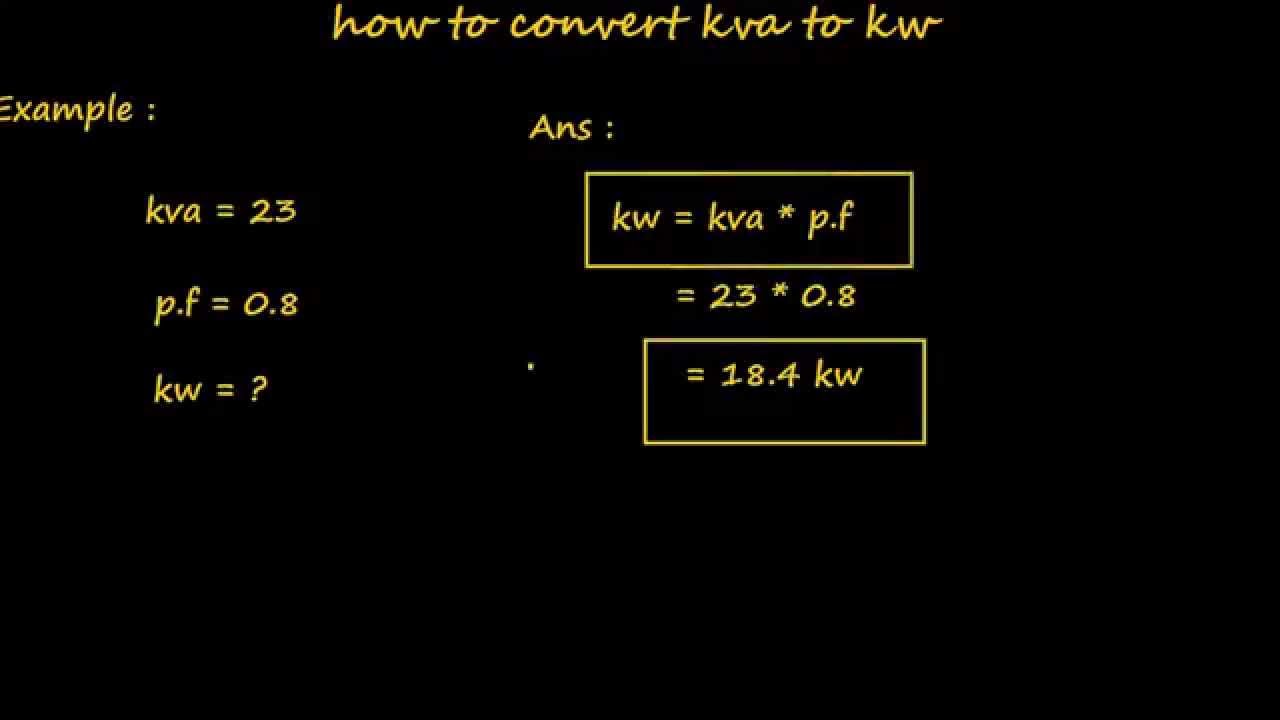
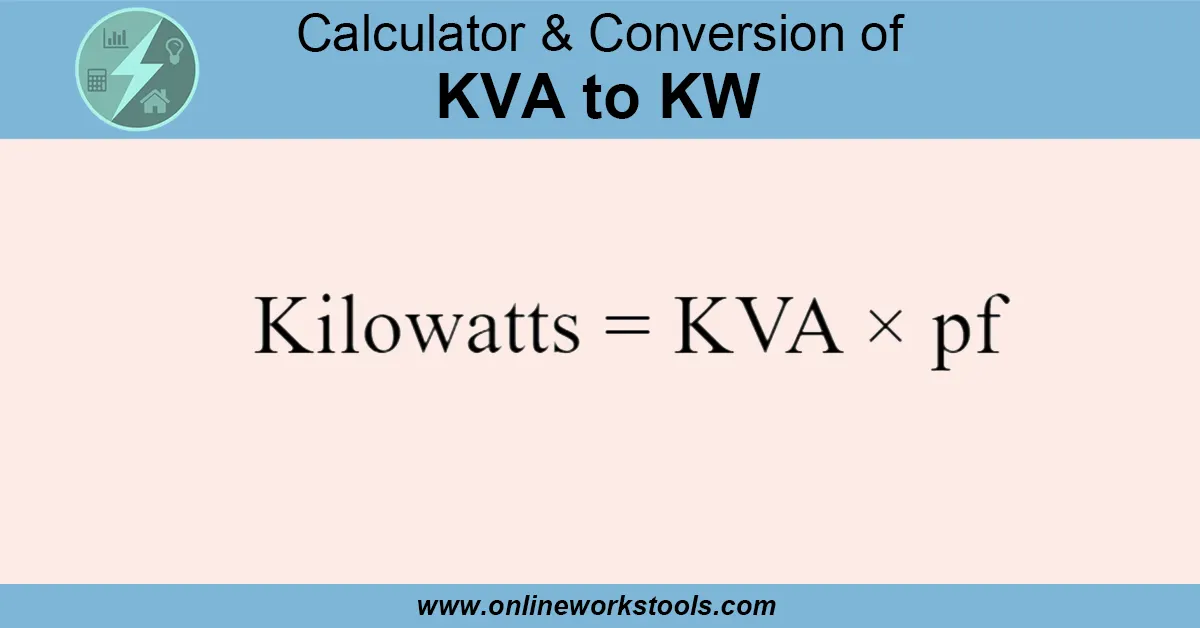
Ready for the big reveal? It’s surprisingly simple! To convert KVA to KW, you just multiply KVA by the Power Factor:
KW = KVA × Power Factor (PF)
See? Not so terrifying after all!
Let's do a quick mental example. Say you have a generator rated at 100 KVA. And let's assume a typical Power Factor of 0.8 (which is often given, or you can use 0.8 as a common estimate if you're not sure).
KW = 100 KVA × 0.8 = 80 KW
So, your 100 KVA generator is actually delivering 80 KW of usable power. The other 20 KVA? That's the "foam," the reactive power just bouncing around, making the system look bigger than its actual working muscle. It's like promising a 100-page novel but 20 pages are just blank.

Why Does Any of This Even Matter? (Beyond Impressing Your Friends)
You might be thinking, "This is fascinating, but will it help me make a better cup of coffee?" Well, indirectly, yes! Understanding this conversion is incredibly practical:
- Buying Equipment: You don't want to buy a 100 KVA generator when your actual power needs are 90 KW, because you'd be overspending! You'd really need a generator that delivers at least 90 KW, which might be a 112.5 KVA generator (assuming PF 0.8). It helps you right-size your machinery.
- Saving Money: Businesses, especially those with large inductive loads, often get penalized by utility companies for a low power factor. It’s like being charged for the foam in your beer. Improving your Power Factor (often with specialized equipment) can significantly reduce your energy bills.
- Preventing Headaches: Incorrectly sizing equipment can lead to tripped breakers, overheated wires, or just generally inefficient operations. Knowing your KW ensures your system runs smoothly.
The Grand Finale
So, there you have it! KVA is the total package, KW is the real muscle, and the Power Factor is the efficiency rating that ties them together. It's not some arcane secret guarded by grumpy engineers; it's just basic electrical common sense, dressed up in a few confusing acronyms.
Next time you see KVA and KW, you won't just see mysterious letters; you’ll see the potential versus the actual work, and you’ll know the secret handshake of the Power Factor. Go forth, impress your friends, maybe even explain it to that barista who's always talking about "amps." You've earned it! Now, about that actual latte...