How To Convert Ac To Dc Voltage

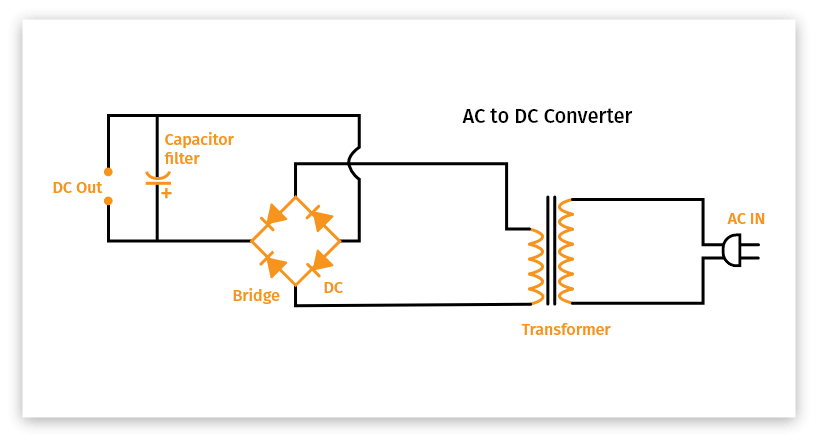
Ever wondered how your phone charger, laptop power brick, or even those fancy LED strip lights manage to sip power from your wall outlet? It’s all thanks to a little bit of electrical magic called AC to DC voltage conversion. Our homes run on Alternating Current (AC), which is great for transmitting power over long distances, but most of our beloved small electronics need Direct Current (DC) to operate. Understanding this conversion isn't just a technical detail; it's a super useful skill that demystifies how our gadgets work and opens up a whole world of DIY possibilities!
This topic is surprisingly fun and incredibly useful for a variety of folks. For beginners, it's the first step into truly understanding how electronics are powered. You'll learn why that "brick" on your phone charger is so important and how it transforms the aggressive AC from the wall into a gentle DC current that won't fry your delicate device. It's like learning the secret language of power!
For families, grasping AC to DC conversion can be a real problem-solver. Ever had a gadget stop working, only to find the power adapter was the culprit? Knowing the basics helps you identify compatible replacements, troubleshoot common issues, and even power fun kids' projects safely from a standard wall outlet. Imagine running a small robot or an LED art piece without relying solely on batteries!
Must Read
And for hobbyists and aspiring makers, this knowledge is absolutely fundamental. If you're building an Arduino project, a Raspberry Pi setup, or any custom circuit, you'll almost certainly need a stable DC power source. Converting AC to DC means you can create custom power supplies, run 12V LED lighting from your mains, or integrate external components that require a specific voltage. It’s the cornerstone for bringing your electronic inventions to life.
You encounter examples of AC to DC conversion everywhere! Your smartphone charger is perhaps the most common; it takes 120V or 240V AC from the wall and steps it down to typically 5V DC for charging. Laptop power supplies do a similar job, often converting AC to 19V DC. Even the power adapter for your Wi-Fi router or smart home devices performs this crucial task. In the DIY world, you might use a ready-made "wall wart" (a small AC-DC adapter) to power a low-voltage project, or for more advanced builds, create your own rectifier and voltage regulator circuit to achieve precise DC outputs.

Ready to dip your toes in? Here are some simple, practical tips for getting started:
- Start with the "Wall Wart": For your first experiments, don't try to build a circuit from scratch directly connected to the wall. Instead, use existing, safe AC-DC adapters (like old phone chargers). They've already done the hard work of conversion for you.
- Read the Labels: Look at the output specifications on these adapters. They’ll tell you the DC Voltage (e.g., 5V, 9V, 12V) and the Current (e.g., 1A, 2A) they provide. This is crucial for matching to your projects.
- Get a Multimeter: This affordable tool is your best friend. Use it to check the DC voltage output of an adapter to ensure it's providing the expected power before connecting it to a circuit.
- Safety First: Always work with unplugged devices. Never open or modify commercial power bricks. When dealing with any electrical current, respect it, and if in doubt, seek guidance from experienced individuals or reliable resources.
Understanding how to convert AC to DC voltage isn't just about technical know-how; it's about gaining a powerful insight into the world around us. It's incredibly satisfying to know exactly why your gadgets power up, and even more so to harness that power for your own creative projects. So go ahead, plug in, and start exploring the fascinating realm of electrical transformation!