
How To Check Amps On A Battery With A Multimeter

Hey there, battery buffs and DIY dynamos! Ever wondered how to peek inside your battery and see just how much juice it's really got? I'm talking about checking the amps, and guess what? It's way easier than you might think! And no, you don't need to be an electrician with a PhD to do it.
We're gonna ditch the mystery and unravel the secrets of amp checking with your trusty multimeter. Think of it as your battery's personal translator, turning electrical mumbo jumbo into easy-to-understand numbers. Ready to dive in? Let's go!
What You'll Need
First things first, gather your gear. This isn't a grand expedition, thankfully. You’ll need:
Must Read
- A multimeter: This is your star player. Make sure it can measure DC amps (that's direct current, the kind batteries use). Most decent multimeters can handle this just fine.
- The battery you want to test: Obvious, right? But hey, better safe than sorry!
- Safety glasses (optional, but highly recommended): Because safety first, always!
- A little bit of know-how (that's what this article is for!): And a can-do attitude!
Safety First! (And Second, and Third...)
Okay, before we get our hands dirty, let's talk safety. Batteries can be a little grumpy if you treat them wrong. So, a few golden rules:
- Never short-circuit a battery! This means directly connecting the positive and negative terminals without a load. It's like giving the battery a heart attack. Sparks, heat, and potentially bad things can happen. Don't do it!
- Wear safety glasses. Seriously. It's better to look slightly dorky than to risk your eyesight.
- Work in a well-ventilated area. Batteries can sometimes release gases, and fresh air is always a good idea.
Got it? Good! Let's move on.

Setting Up Your Multimeter
Now for the fun part! Grab your multimeter and let's get it prepped. This might look intimidating, but trust me, it's not rocket science.
- Turn it on: Locate the power switch (usually a knob) and flick it on.
- Select the Amps setting: Rotate the knob to the DC Amps (usually labeled as "A" with a straight line above it) setting. You might have different ranges to choose from (like 200mA, 10A, etc.). Start with the highest range, just in case. We can always dial it down later.
- Plug in the leads: Make sure your test leads are plugged into the correct ports. The black lead (negative) usually goes into the "COM" (common) port. The red lead (positive) needs to go into the port labeled for measuring amps. This might be a separate port specifically for higher amperage measurements, so double-check your multimeter's manual. Important: This is different than measuring voltage! Be sure to plug the red lead into the correct port.
The Amp-Checking Tango
Alright, the stage is set! Now for the main event: actually checking the amps. Here's the trick: to measure amps, you need to connect the multimeter in series with the circuit. What does that mean? It means you need to break the circuit and let the current flow through the multimeter.

Here's a simplified example: Let's say you want to test the amps flowing to a small light bulb connected to your battery.
- Disconnect one of the wires connecting the light bulb to the battery. Let's say you disconnect the wire from the positive (+) terminal.
- Connect the red lead of your multimeter to the positive (+) terminal of the battery.
- Connect the black lead of your multimeter to the wire you disconnected from the positive (+) terminal.
Now, the current is flowing from the battery, through your multimeter, and then to the light bulb. Your multimeter is now displaying the amount of current (in amps) flowing through the circuit.
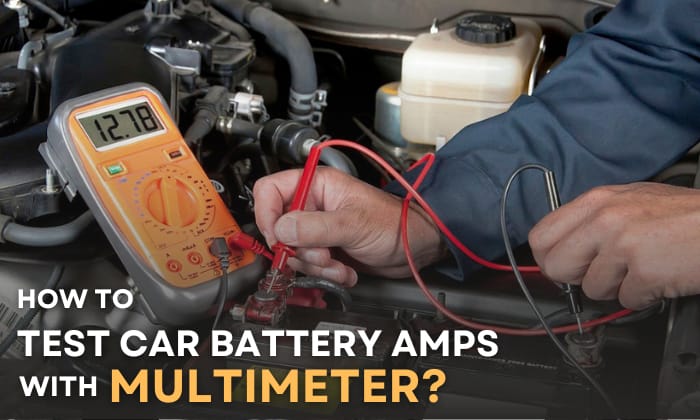
Read the Display: The number displayed on your multimeter is the amperage. Write it down! What does it mean? That depends on what you're testing! For example, a fully charged car battery during starting might draw hundreds of amps. A small LED light, just a few milliamps.
Interpreting the Results
Okay, so you've got a number. What does it all mean? Well, that depends on what you're measuring! Understanding what a "good" amperage is requires a little research into the specific device or battery you're testing. Check the manufacturer's specifications or do a little online digging.
![How to Check Battery Amps with a Multimeter: Proven Technique [2025]](https://multimeterworld.com/wp-content/uploads/2023/08/testing-battery-amps-with-multimeter.webp)
Practice Makes Perfect (and Safer!)
The best way to get comfortable with checking amps is to practice. Start with something simple and low-voltage, like a small battery and a resistor. Get familiar with the process before tackling anything more complex. And remember: safety first!
So, there you have it! You're now equipped with the knowledge to check amps on a battery like a pro (or at least a very enthusiastic amateur). Go forth, explore, and don't be afraid to experiment (safely, of course!). The world of electronics is waiting to be discovered, one amp at a time!
Now that you've taken the plunge, imagine all the possibilities! Diagnosing car battery issues, optimizing your home's energy usage, or even building your own electronic gadgets. The knowledge of how to check amps is a gateway to a world of exciting projects and deeper understanding. Don't stop here! Keep learning, keep experimenting, and who knows? Maybe you'll be the next great innovator. The power is literally in your hands!