
How To Calculate Young's Modulus Of Elasticity

Ever wondered what makes a rubber band stretchy or a steel beam so, well, un-stretchy? I mean, we use these materials every day, but what's the secret sauce behind their "bendability," or lack thereof? That secret has a name: it's called Young's Modulus of Elasticity. Sounds intimidating, right? Don't sweat it! We're going to break it down in a way that's easier than assembling IKEA furniture (okay, maybe a slight exaggeration).
Think of Young's Modulus as a material's inner resistance to being deformed. It basically tells you how much force you need to apply to change its shape. It's like the material is saying, "Nah, I'm good in this shape," and the higher the modulus, the louder it's saying it.
Why Should I Care About This Modulus Thingy?
Great question! Why should you care? Well, imagine you're an architect designing a bridge. You wouldn't want it to sag like a wet noodle, would you? Or maybe you're designing a new super-bouncy trampoline. In both cases, understanding Young's Modulus is absolutely crucial.
Must Read
Knowing this property allows engineers and designers to predict how materials will behave under stress. This helps them choose the right materials for the right job, ensuring structures are safe, efficient, and don't, you know, collapse unexpectedly. Think of it as the ultimate material personality test!
The Formula: Demystified!
Okay, let's peek at the formula. Don't run away screaming! It's not as scary as it looks. Here it is:
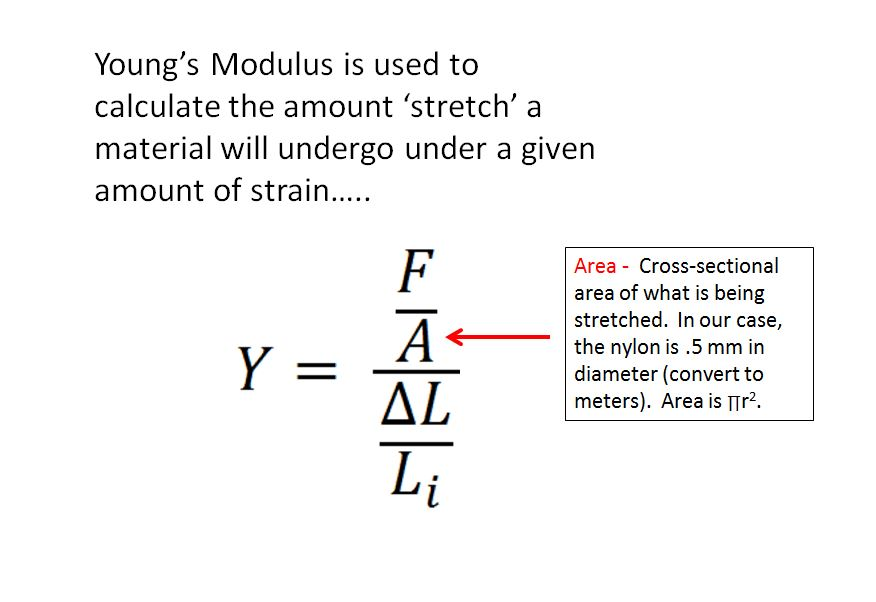
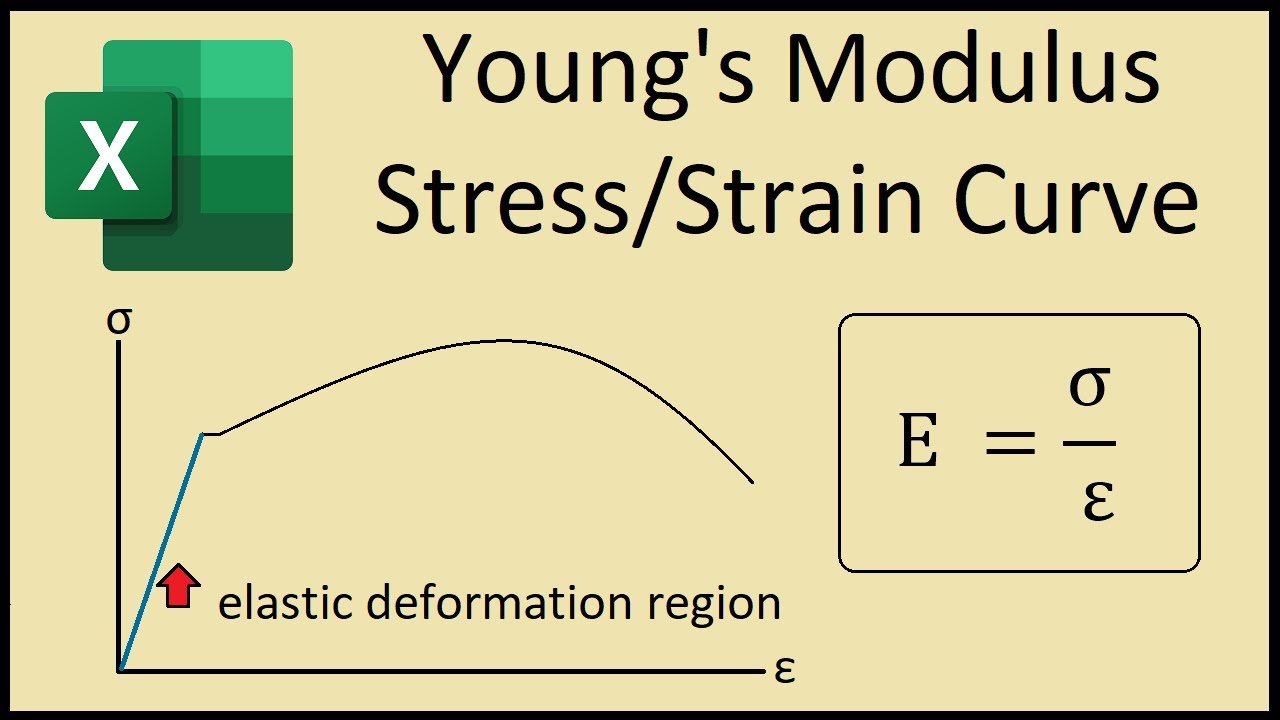
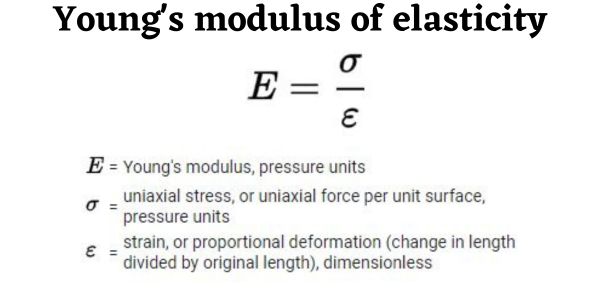
Young's Modulus (E) = Stress (σ) / Strain (ε)
See? It's just a simple ratio. But what exactly is stress and strain?

- Stress (σ): This is the amount of force applied per unit area. Imagine pushing on something. The harder you push (force), and the smaller the area you're pushing on, the greater the stress. We measure it in Pascals (Pa) or pounds per square inch (psi).
- Strain (ε): This is the deformation of the material relative to its original size. It's a measure of how much the material stretches or compresses. Strain is a dimensionless quantity, meaning it doesn't have any units. It's just a ratio of change in length to original length.
So, in plain English, Young's Modulus is essentially asking, "How much force do I need to apply to get a certain amount of stretch (or compression)?"
Let's Get Practical: A Super-Simple Example
Imagine you have a metal rod with a length of 1 meter. You apply a force to stretch it by 0.01 meters (1 centimeter). Let's say the stress you applied was 100 Pascals. To find the Young's Modulus:
- Calculate Strain: Strain = (Change in Length) / (Original Length) = 0.01 m / 1 m = 0.01
- Calculate Young's Modulus: E = Stress / Strain = 100 Pa / 0.01 = 10,000 Pa
That's it! You've just calculated Young's Modulus. In this case, the metal rod has a Young's Modulus of 10,000 Pascals. This means it takes 10,000 Pascals of stress to produce a strain of 0.01. You might think that's very small, but think about the scale. The rod is one meter long, and only stretched one centimeter under the applied force.
Comparing Materials: The Fun Part!
Here's where things get interesting. Different materials have vastly different Young's Moduli. This is why some things are stiff and others are squishy.
- Steel: Steel has a very high Young's Modulus (around 200 GPa). That's why it's used in bridges and buildings – it can withstand a lot of stress without deforming much. It's like the weightlifting champion of materials.
- Rubber: Rubber has a very low Young's Modulus (around 0.01-0.1 GPa). That's why it stretches so easily. It's the yoga instructor of materials.
- Wood: Wood's Young's Modulus depends on the type of wood (around 10-20 GPa). It's somewhere in between steel and rubber, making it a good choice for many applications.
Think of it this way: If you tried to stretch a steel beam and a rubber band with the same force, the rubber band would stretch like crazy, while the steel beam would barely budge. That's because steel has a much higher Young's Modulus than rubber.
Important Caveats
Now, before you go around calculating the Young's Modulus of everything you see, a few things to keep in mind:
- Temperature matters: A material's Young's Modulus can change with temperature.
- Direction matters: Some materials are stronger in one direction than another (think of wood grain). This is called anisotropy.
- The real world is complex: The formula we used is a simplified model. Real-world situations can be much more complicated.
So there you have it! You've taken your first steps into the fascinating world of Young's Modulus. It's a powerful tool for understanding how materials behave, and it plays a vital role in engineering and design. Next time you see a skyscraper or bounce on a trampoline, you'll have a better appreciation for the invisible forces at play!