
How To Calculate The Ultimate Tensile Strength
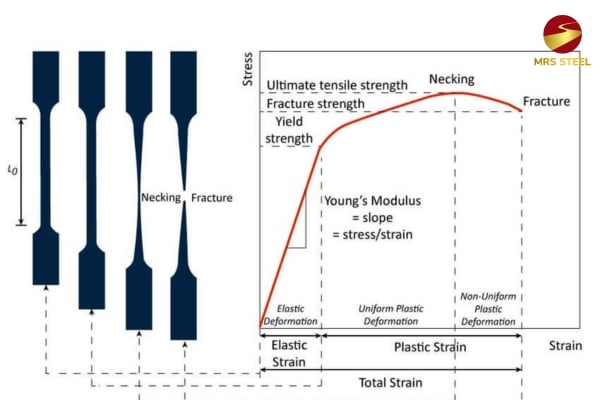
Hey friend! So, you wanna know about Ultimate Tensile Strength (UTS)? It sounds super intimidating, right? Like something out of a sci-fi movie? But trust me, it's not brain surgery. (Unless you are a brain surgeon, in which case, maybe some parts overlap? Kidding! Mostly.) Let's break it down, shall we?
Basically, UTS tells you how much oomph a material can take before it completely gives up the ghost and snaps. We're talking about stretching it until it breaks. Think of it like that last shred of your willpower before you finally cave and eat that entire pizza. (We've all been there.)
So, How Do We Find This Magical Number?
Alright, here's the (not-so) secret sauce. The core formula is surprisingly simple:
Must Read
UTS = Maximum Load / Original Cross-Sectional Area
See? Not scary at all! Let's dissect this a bit further.
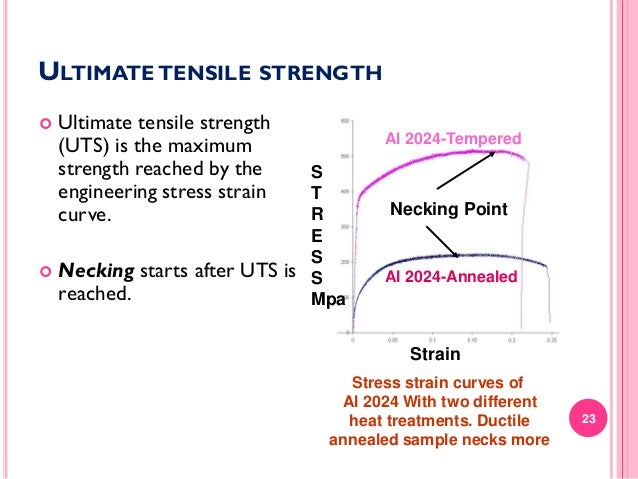
Maximum Load: The Breaking Point
This is the maximum force the material can handle before it throws in the towel and breaks. We measure this in units like Newtons (N) or pounds-force (lbf). Imagine you're playing tug-of-war with a rope. The maximum load is how hard you can pull before the rope snaps. Ouch!
Original Cross-Sectional Area: Size Matters!
This is the original area of the material before you start stretching it. Think of cutting a sausage perpendicularly - the area you see is the cross-sectional area. We measure this in square meters (m²) or square inches (in²). A thicker sausage (or material) generally means a larger area, and more resistance to being pulled apart. Makes sense, right?
Putting It All Together: A (Very) Simplified Example
Let's say you've got a metal rod. You put it in a fancy machine (called a tensile testing machine, naturally) that pulls on it until it breaks. The machine tells you the maximum load was 10,000 N. You also measured the rod's original cross-sectional area, and it was 0.0001 m² (a tiny rod!).

Time for some math! (Don't worry, it's the easy kind.)
UTS = 10,000 N / 0.0001 m² = 100,000,000 N/m²
That's a big number! We usually express this in Megapascals (MPa), where 1 MPa = 1,000,000 N/m². So, our UTS is 100 MPa.

Ta-da! You've calculated the Ultimate Tensile Strength. Go you!
Important Caveats (Because Life Isn't Always Simple)
Okay, quick reality check. This is a simplified explanation. There are always complexities lurking in the shadows.
- Material Variations: Not all materials are created equal. Even seemingly identical pieces can have slight differences in their composition or manufacturing process.
- Testing Conditions: Temperature, humidity, and the speed at which you apply the load can all affect the results. It’s like baking – the same recipe can come out differently depending on your oven!
- Stress Concentrations: Sharp corners or holes can create stress concentrations, making the material break at a lower load than expected. Think of tearing a piece of paper – it's much easier to tear if you start with a small cut.
So, while the formula is straightforward, getting accurate and reliable UTS data requires careful testing and attention to detail. It's a whole field of engineering, after all! But don't let that intimidate you. You now have a basic understanding of what UTS is and how it's calculated.

Why Should You Care?
Good question! UTS is important for engineers and designers because it helps them choose the right materials for their projects. Need a material that can withstand a lot of stress? Look for a high UTS! Building a bridge? You definitely care about UTS. Designing a paperclip? Maybe not as much. (But still, good to know!)
So, there you have it. Ultimate Tensile Strength, demystified. Now go forth and impress your friends with your newfound knowledge! (Or at least, understand what someone's talking about if they randomly bring it up at a party. You never know!)
And remember, even if you never actually calculate UTS in your life, knowing what it represents is always a good thing. It's all about understanding the world around us, one stretched-to-the-breaking-point material at a time. You got this!