How To Calculate Static Coefficient Of Friction
Ever wondered why that box stubbornly refuses to budge until you give it a really good shove? Or why your car doesn't slide down a hill the moment you let off the brake? The answer, in part, lies in something called the static coefficient of friction. It might sound like a term confined to physics textbooks, but understanding it can actually be quite insightful and even a little fun!
So, what exactly is the static coefficient of friction? Simply put, it's a number that represents the relative roughness between two surfaces that are in contact and not moving relative to each other. It tells you how much force is needed to overcome the stickiness and get one surface to start sliding across the other. Think of it as a measure of how much those surfaces "want" to stay put.
Why bother learning about it? Well, the static coefficient of friction has a surprising number of practical applications. In education, it’s a fundamental concept in physics, helping students understand forces, motion, and engineering principles. It allows them to predict how objects will behave under different conditions. But it’s not just for academics! In daily life, understanding friction, even in a basic way, can help you make informed decisions. For example, consider the design of shoe soles. A higher static coefficient of friction means better grip and less chance of slipping, especially on wet or icy surfaces. Similarly, knowing the coefficient of friction between your tires and the road is crucial for safe driving. It influences braking distance and handling, particularly in adverse weather. Even something as simple as opening a stubborn jar lid can be easier if you understand how friction works! By increasing the force (perhaps by using a rubber grip, which has a higher coefficient of friction than the smooth metal lid) you can overcome the static friction more easily.
Must Read
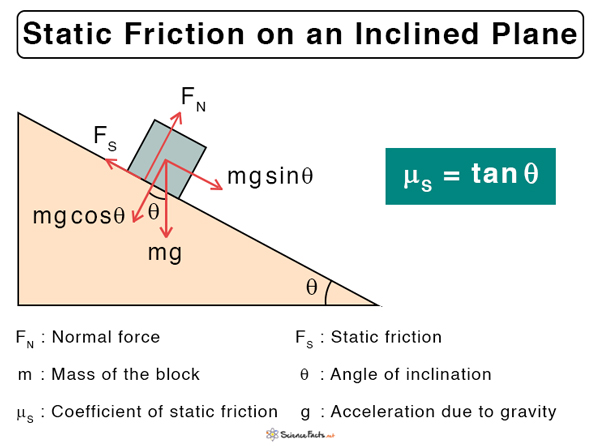
Calculating the static coefficient of friction is actually quite straightforward. The basic formula is: μs = Fs(max) / N, where μs is the static coefficient of friction, Fs(max) is the maximum static friction force (the force needed to just barely start the object moving), and N is the normal force (the force pressing the two surfaces together, usually equal to the object’s weight if on a horizontal surface).

Here's a simple way to explore it at home. Grab a small, flat object like a book (surface 1) and a piece of wood or a table (surface 2). Slowly tilt the table. At some point, the book will start to slide. The angle at which it begins to slide is directly related to the static coefficient of friction! You can use trigonometry (specifically, the tangent of the angle) to estimate the coefficient of friction. While this method won't give you a precise value, it's a fun and intuitive way to see the concept in action. Try different materials – a piece of sandpaper on wood, or a rubber mat on tile – and observe how the angle changes. Remember to keep the experiment safe and avoid using objects that could easily break or cause injury.
Ultimately, understanding the static coefficient of friction is about understanding the forces that shape our world. It's a small piece of the puzzle, but it’s a surprisingly versatile and insightful one.