
How To Calculate Air Conditioner Size For A House

So, you're thinking about getting a new air conditioner, huh? Or maybe your current one is huffing and puffing like a marathon runner in stilettos and you suspect it's undersized. Either way, you've stumbled upon a question that plagues homeowners every summer: "What size AC do I really need?"
Fear not, intrepid homeowner! Figuring out the right BTU (British Thermal Unit - don't worry, we'll explain later!) for your space isn't brain surgery. It's more like... a slightly complicated recipe that involves counting things and maybe a calculator.
The Great BTU Mystery: Solved (Kind Of)
Let's demystify this BTU thing. Basically, BTU is a measurement of how much heat an air conditioner can remove from a room per hour. The higher the BTU, the more powerful the AC. It's like comparing a tiny chihuahua to a Great Dane – both dogs, but vastly different cooling capabilities.
Must Read
The Old-Fashioned (But Still Useful) Square Footage Method
This is the simplest approach. Grab a measuring tape and channel your inner Indiana Jones (minus the snakes, hopefully). Measure the length and width of each room you want to cool.
Multiply the length by the width. That's your square footage! Now, for every square foot, you generally need 20 BTUs. Multiply your square footage by 20, and voila! You have a rough estimate of the BTUs required.
For example, a 15ft x 20ft room is 300 square feet. Multiply that by 20, and you get 6,000 BTUs. Seems simple, right? But wait, there's more!
The "Wait, There's More!" Factors
That simple calculation? It’s a starting point, a suggestion, a gentle nudge in the right direction. Reality is a bit more nuanced. Think of your home as a temperamental garden – some spots need more TLC (or, in this case, cooling) than others.
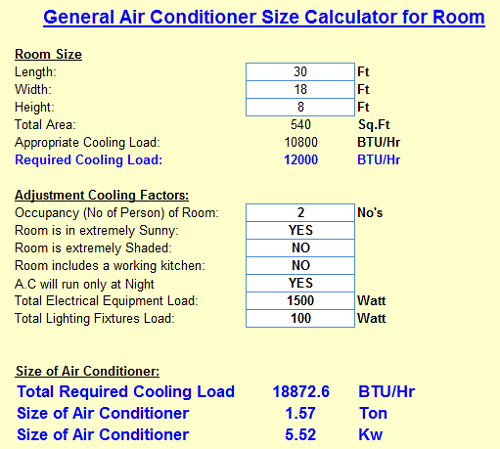
Sunlight: Sunny rooms get hotter. If your room is a sun-drenched paradise, add 10% to your BTU estimate. Think of it as compensating for the sun's relentless enthusiasm.
Shade: Conversely, if your room is perpetually shrouded in shadows (a vampire's delight!), subtract 10%. Your AC won't have to work as hard.
Ceiling Height: Got soaring cathedral ceilings? (Lucky you!) You'll need more cooling power. If your ceilings are significantly higher than the standard 8 feet, you’ll need to consider the extra volume of air to be cooled. Consult a professional for the most accurate assessment in this case.
Number of People: Are you cooling a bustling family room or a quiet office? Each person generates heat (we're all tiny furnaces, really). Add 600 BTUs per person who regularly occupies the space. Imagine a family of four – that's an extra 2,400 BTUs!

Kitchens: Kitchens are heat-generating powerhouses. Ovens, stoves, dishwashers – they all contribute to the thermal chaos. If you're cooling a kitchen, add at least 4,000 BTUs.
The Importance of Being Properly Sized (Or, Why Goldilocks Was Right)
You might think, "Hey, bigger is better, right?" Wrong! An oversized AC is like wearing shoes that are three sizes too big – uncomfortable and inefficient. It will cool the room too quickly and then shut off, leading to temperature swings and higher energy bills.
Plus, it won't properly dehumidify the air. A properly sized AC runs for longer cycles, removing moisture and creating a more comfortable environment. Think of it as a Goldilocks situation – you want the AC that's "just right."
On the other hand, an undersized AC will run constantly, struggling to keep up. It will be noisy, inefficient, and ultimately, short-lived. You'll be left sweating and cursing your poor judgment.
/air-conditioning-chart-1152654_final-01-5c522db7c9e77c0001d7671e.jpg)
Window Units vs. Central Air: A Tale of Two Cooling Systems
This calculation method is mostly applicable for window units or single-room cooling. Central air systems require a more complex calculation, often involving a professional assessment of your entire home.
Window units are great for spot cooling, like a bedroom or office. Central air systems cool the entire house, offering more consistent temperature control.
The choice depends on your needs and budget. Window units are generally cheaper and easier to install, but central air is more efficient and convenient for larger spaces.
The "When in Doubt, Call a Pro" Clause
Let's be honest, all this BTU math can be a bit overwhelming. If you're feeling lost or unsure, don't hesitate to call a professional HVAC (Heating, Ventilation, and Air Conditioning) technician.
They can perform a load calculation, taking into account all the factors that affect your home's cooling needs. They'll assess your insulation, windows, and ductwork to determine the optimal AC size.
Think of it as getting a second opinion from a doctor. It's always good to have expert advice, especially when dealing with a significant investment like an air conditioner.
A Few Final Words of Wisdom (and Maybe a Joke)
Remember, the goal is to find an AC that keeps you comfortable without breaking the bank. Do your research, consider your specific needs, and don't be afraid to ask for help.
And now, for a little levity: What do you call an air conditioner that can sing? A cool crooner!
Choosing the right AC size might seem like a chore, but it’s an important investment in your comfort and well-being. With a little knowledge and perhaps a calculator, you can find the perfect cooling solution for your home. Stay cool!