
How Much Water Does A Dishwasher Use On Average
Ah, the dreaded mountain of dishes. It starts innocently enough with a breakfast bowl, then a lunch plate, and before you know it, your kitchen sink is staging a silent protest, threatening to overflow with the remnants of culinary adventures. That's when your trusty dishwasher rolls in like a knight in shining, stainless steel armor, ready to whisk away the grime and save your sanity.
But then a little voice in your head, perhaps an echo from a well-meaning relative, pipes up: "All that water! Think of the environment!" You might pause, mid-load, wondering if you're single-handedly draining a small lake every time you hit that start button. Well, let me tell you, friend, it’s probably not as much as you think. In fact, you might even gasp be saving water!
The Great Water Reveal: Less Than a Long Shower, More Than a Teacup
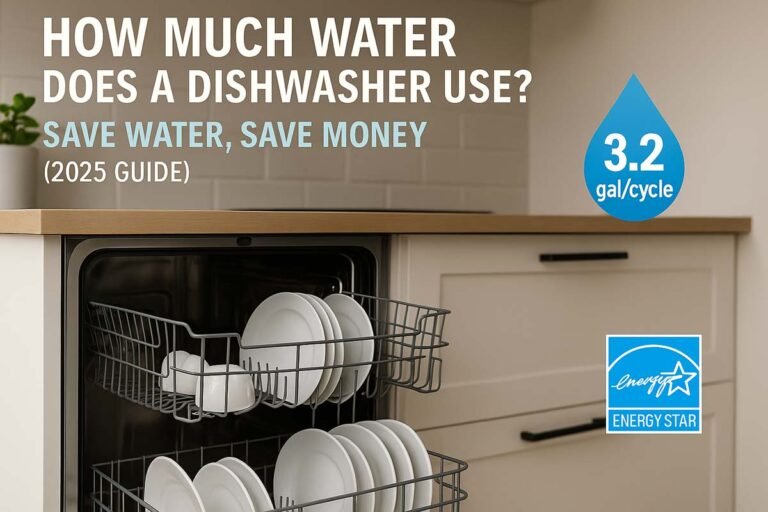
Let's get down to brass tacks. On average, a modern dishwasher uses somewhere in the neighborhood of 3 to 5 gallons of water per cycle. Yes, you read that right. Three to five. Not three to five hundred, just three to five. If you have an older model, perhaps one that's seen a few more holiday dinners than a millennial, it might be closer to 6-10 gallons. Still, let that sink in for a moment (pun absolutely intended).
Must Read
To put that into perspective, think about some other everyday water expenditures. A good, long, contemplative shower? We're talking 10-20 gallons, easily. Watering your prize-winning petunias for a few minutes with a hose? You could be pouring out 10 gallons in no time. Even flushing your toilet (depending on its age) can use between 1.6 to 7 gallons per flush!
The Handwashing Hustle: The Prune-Fingered Truth
Now, let's talk about the alternative: handwashing. We've all been there, standing over the sink, water running freely, scrubbing away at that stubborn lasagna pan. It feels efficient because you're actively involved, but are you really? When you're handwashing a sink full of dishes, especially if you let the tap run while you scrub, you can easily use upwards of 20 gallons of water. Your hands might be pruny, your back might ache, and you might even have dishwater sloshing over the side, but water-saving? Probably not.

It's like trying to fill a bathtub with an eyedropper versus having a carefully calibrated hose do the job. Your dishwasher is the smart hose, optimizing every drop. It's not just spraying water willy-nilly; it's a sophisticated ballet of jets, sensors, and recirculation.
Why Are They So Frugal? The Dishwasher's Secret Life
Modern dishwashers are incredibly clever. They don't just fill up and drain. Oh no. They use sensors to detect how dirty your dishes are and adjust the water usage accordingly. They recirculate the same hot, soapy water, filtering out food particles, giving those dishes multiple baths with the same initial water. Only at the very end does it typically use fresh water for a final rinse.

Think of it as a super-efficient car wash, but for plates and forks. It targets the grime with precision, rather than a broad, wasteful soak. This ingenious design is why they can get your dishes sparkling clean with surprisingly little H2O.
Your Habits Matter: The Pre-Rinse Predicament
Now, a quick confession time: are you one of those people who pre-rinses every dish until it's practically clean before it even goes into the dishwasher? Don't worry, you're not alone! It's a habit many of us picked up from older generations or just plain old habit. But here's the kicker: modern dishwashers are designed to handle food particles.

That extra rinse you give your plates under the running tap? That's just adding to your household water usage before the dishwasher even starts. If you want to be a true water-saving champion, scrape off the big bits of food, and let your appliance do the rest. Unless you're dealing with cement-like dried oatmeal, your dishwasher can handle it.
The Verdict: A Water-Saving, Time-Saving Warrior!
So, next time you're loading up your dishwasher, you can give yourself a little pat on the back. You're not just saving your hands from turning into raisins or dodging a marital spat over who's on dish duty; you're likely making a smarter, more water-efficient choice than handwashing. That little hum you hear? It's the sound of efficiency, cleanliness, and probably a few gallons of water being saved.
Go forth and load your dishwasher with confidence, knowing that your dinner plates are getting a spa treatment that's both thorough and surprisingly frugal with our precious H2O. Your hands, and the planet, will thank you.
![How Much Water Does A Dishwasher Use [601 Models Studied]](https://ecocostsavings.com/wp-content/uploads/2021/10/how-much-water-does-a-dishwasher-use-768x432.jpg)