How Much Power Does A Garage Door Opener Use
Alright, let's talk garage doors! I know, I know, it doesn’t exactly scream "thrilling Friday night," but trust me on this. Ever wondered just how much juice your garage door opener is slurping up? Probably not, right? But understanding its power usage can be surprisingly…empowering! (Pun absolutely intended.) Think of it like this: knowing is half the battle… against unnecessarily high electricity bills, that is!
So, What's the Deal? (The Electricity Deal, That Is)
Okay, let's get down to brass tacks. The power consumption of a garage door opener isn't a flat number. It varies depending on a few key factors. We're talking about things like:
- The type of opener: Belt drive, chain drive, screw drive… it’s a whole garage door opener ecosystem out there! Each has its own energy profile.
- The age of the opener: Older models tend to be less efficient than newer, sleeker versions. Kind of like us, right? (Just kidding… mostly!)
- How often you use it: Obvious, but worth stating. More up-and-down action equals more energy used.
- The horsepower of the motor: More power, more "oomph," but also potentially more electricity consumption.
Generally, a garage door opener uses power in two main states: standby and operation. Think of it like your phone: it’s always on, but it uses way more battery when you’re actually using it.
Must Read
Standby Mode: The Silent Sipper
This is where your garage door opener sits quietly, patiently waiting for your command. Even when it's not actively opening or closing, it's still drawing a trickle of electricity to power things like the remote receiver, the safety sensors, and the internal circuit board. This is often called "phantom load" or "vampire power." Spooky, huh?
So, how much are we talking? Well, standby power consumption for a garage door opener is usually somewhere between 5 to 10 watts. Doesn't sound like much, does it? But over the course of a year, that can add up! Think of it as death by a thousand paper cuts…but with kilowatt-hours.

Operation Mode: The Power Surge
This is when the magic happens! When you hit that button on your remote (or use the wall-mounted control panel – fancy!), the motor kicks into gear and pulls a significant amount of power to lift that heavy door.
During operation, a typical garage door opener can draw anywhere from 150 to 600 watts. That's a pretty wide range, I know! It really depends on the horsepower of the motor and how heavy your garage door is. (A solid wood door will take more effort to lift than a lightweight aluminum one.)

The good news is that this power surge is relatively short-lived. The opener only uses that much power for a few seconds while the door is moving. So, even though the wattage is high, the overall energy consumption per cycle is relatively low.
Doing the Math: From Watts to Dollars
Alright, let's get practical. How can you figure out how much your garage door opener is actually costing you? Here's a simplified way to estimate:
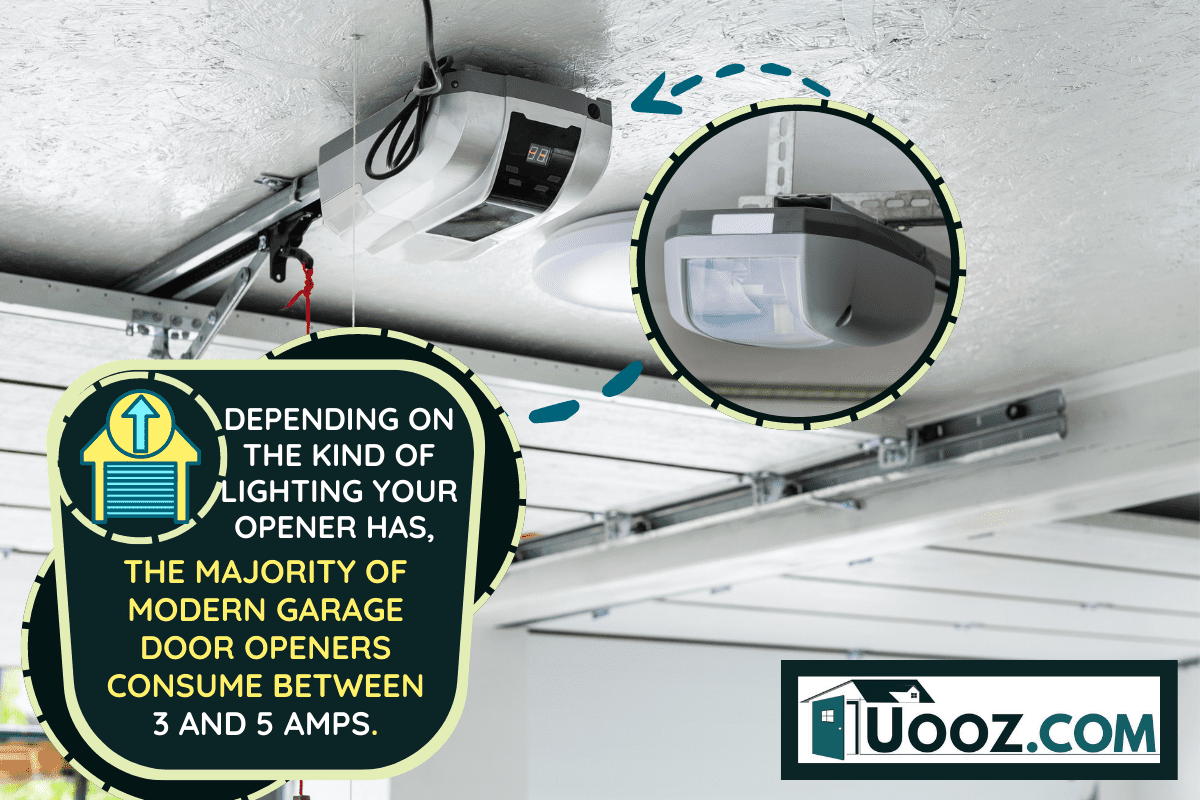
- Find the wattage: Check the label on your garage door opener. It should list the wattage (or amps – you can convert amps to watts by multiplying by your voltage, typically 120V in the US). Let’s say it’s 300 watts during operation.
- Estimate usage: How many times a day do you open and close your garage door? Let's say 4 times.
- Calculate daily energy consumption: Assume each cycle takes 30 seconds (0.5 minutes). So, 4 cycles x 0.5 minutes = 2 minutes of operation per day. 2 minutes / 60 minutes per hour = 0.033 hours. 300 watts x 0.033 hours = 9.9 watt-hours per day.
- Convert to kilowatt-hours (kWh): 9.9 watt-hours / 1000 = 0.0099 kWh per day.
- Factor in standby power: Let's assume 7 watts of standby power running 24 hours a day. 7 watts x 24 hours = 168 watt-hours. 168 watt-hours / 1000 = 0.168 kWh per day.
- Total daily kWh: 0.0099 kWh (operation) + 0.168 kWh (standby) = 0.1779 kWh per day.
- Calculate monthly consumption: 0.1779 kWh/day x 30 days/month = 5.34 kWh per month.
- Multiply by your electricity rate: Check your electricity bill for the price per kWh. Let's say it's $0.15 per kWh. 5.34 kWh x $0.15 = $0.80 per month.
So, in this example, your garage door opener is costing you roughly 80 cents a month. Not a huge sum, but every little bit counts, right?
Tips for Saving Energy (and Money!)
Want to be a garage door opener energy ninja? Here are a few quick tips:
- Consider a newer, more efficient opener: If your opener is ancient, upgrading to a modern model with a DC motor and LED lighting can significantly reduce energy consumption.
- Unplug it during extended absences: Going on vacation? Unplug your garage door opener to eliminate standby power draw completely.
- Use LED bulbs: If your opener has a light, switch to an LED bulb. They use a fraction of the energy compared to traditional incandescent bulbs.
- Maintain your garage door: A properly lubricated and balanced door requires less effort to open, reducing the strain on the motor.
Understanding your garage door opener's power consumption might seem like a trivial detail, but it's just one small piece of a larger puzzle: understanding and managing your home's energy usage. And who knows, maybe this little deep dive into garage door electricity has sparked a newfound interest in home energy efficiency! The world of energy conservation is vast and fascinating, and there's always something new to learn. So, go forth and explore! You might be surprised at what you discover, and you might just save some money along the way. Happy energizing!